Creative Studios and AI: Solving the Speed vs Soul Dilemma
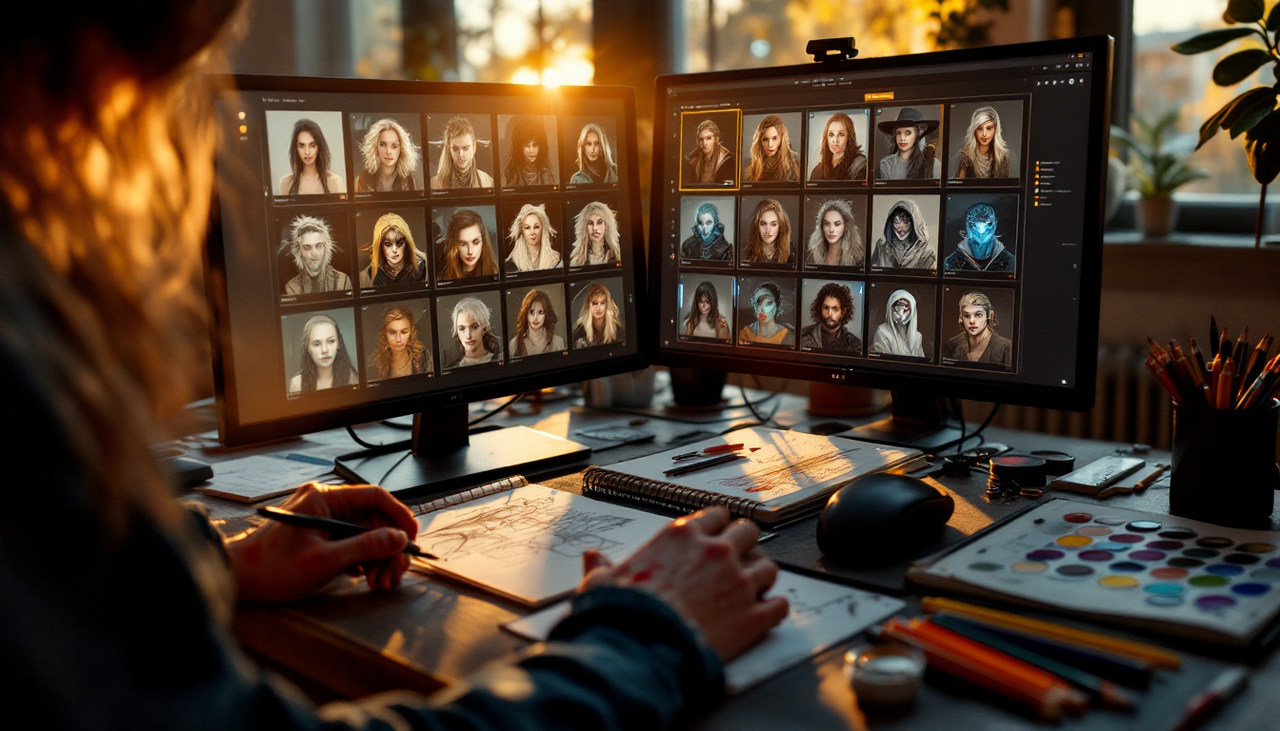
The morning routine at King's Stockholm studio starts like countless other game development houses: coffee, stand-ups, creative briefs. But buried in the daily workflow is something extraordinary. Whilst designers and artists sketch out new puzzle mechanics for Candy Crush Saga, AI systems are simultaneously reworking thousands of older levels, tweaking difficulty curves and refreshing visual elements across more than 18,700 existing puzzles. The human team focuses on invention. The machines handle evolution.
This isn't the dystopian AI takeover narrative we've been sold. It's something stranger and more nuanced: a hybrid creative organism where human imagination and machine capability intertwine in ways that challenge our fundamental assumptions about authorship, craft, and what it means to make things.
Welcome to the new creative pipeline, where 90% of game developers already use AI in their workflows, according to 2025 research from Google Cloud surveying 615 developers across the United States, South Korea, Norway, Finland, and Sweden. The real question isn't whether AI will reshape creative industries. It's already happened. The real question is how studios navigate this transformation without losing the human spark that makes compelling work, well, compelling.
The Hybrid Paradox
Here's the paradox keeping creative directors up at night: AI can accelerate production by 40%, slash asset creation timelines from weeks to hours, and automate the mind-numbing repetitive tasks that drain creative energy. Visionary Games reported exactly this when they integrated AI-assisted tools into their development process. Time to produce game assets and complete animations dropped 40%, enabling quicker market entry.
But speed without soul is just noise. The challenge isn't making things faster. It's making things faster whilst preserving the intentionality, the creative fingerprints, the ineffable human choices that transform pixels into experiences worth caring about.
“The most substantial moat is not technical but narrative: who can do the work of crafting a good story,” according to research from FBRC.ai. This insight crystallises the tension at the heart of hybrid workflows. Technology can generate, iterate, and optimise. Only humans can imbue work with meaning.
According to Google Cloud's 2025 research, 97% of developers believe generative AI is reshaping the industry. More specifically, 95% report AI reduces repetitive tasks, with acceleration particularly strong in playtesting and balancing (47%), localisation and translation (45%), and code generation and scripting support (44%).
Yet efficiency divorced from purpose is just busy work at machine speeds. When concept art generation time drops from two weeks to 48 hours, the question becomes: what do artists do with the 12 days they just gained? If the answer is “make more concept art,” you've missed the point. If the answer is “explore more creative directions, iterate on narrative coherence, refine emotional beats,” you're starting to grasp the hybrid potential.
Inside the Machine-Augmented Studio
Walk into a contemporary game studio and you'll witness something that resembles collaboration more than replacement. At Ubisoft, scriptwriters aren't being automated out of existence. Instead, they're wielding Ghostwriter, an in-house AI tool designed by R&D scientist Ben Swanson to tackle one of gaming's most tedious challenges: writing barks.
Barks are the throwaway NPC dialogue that populates game worlds. Enemy chatter during combat. Crowd conversations in bustling marketplaces. The ambient verbal texture that makes virtual spaces feel inhabited. Writing thousands of variations manually is creative drudgery at its finest.
Ghostwriter flips the script. Writers create a character profile and specify the interaction type. The AI generates paired variations. Writers select, edit, refine. The system learns from thousands of these choices, becoming more aligned with each studio's creative voice. It's not autonomous creation. It's machine-assisted iteration with humans firmly in the director's chair.
The tool emerged from Ubisoft's La Forge division, the company's R&D arm tasked with prototyping and testing technological innovations in collaboration with games industry experts and academic researchers. Swanson's team went further, creating a tool called Ernestine that enables narrative designers to create their own machine learning models used in Ghostwriter. This democratisation of AI tooling within studios represents a crucial shift: from centralised AI development to distributed creative control.
The tool sparked controversy when Ubisoft announced it publicly. Some developers took to social media demanding investment in human writers instead. Even God of War director Cory Barlog tweeted a sceptical reaction. But the criticism often missed the implementation details. Ghostwriter emerged from collaboration with writers, designed to eliminate the grunt work that prevents them from focusing on meaningful narrative beats.
This pattern repeats across the industry. At King, AI doesn't replace level designers. It enables them to maintain over 18,700 Candy Crush levels simultaneously, something Todd Green, general manager of the franchise, describes as “extremely difficult” without AI taking a first pass. Since acquiring AI startup Peltarion in 2022, King's team potentially improves thousands of levels weekly rather than several hundred, because automated drafting frees humans to focus on creative decisions.
“Doing that for 1,000 levels all at once is very difficult by hand,” Green explained. The AI handles the mechanical updates. Humans determine whether levels are actually fun, an intangible metric no algorithm can fully capture.
The Training Gap Nobody Saw Coming
Here's where the transformation gets messy. According to Google Cloud's 2025 research, 39% of developers emphasise the need to align AI use with creative vision and goals, whilst another 39% stress the importance of providing training or upskilling for staff on AI tools. Yet a 2024 Randstad survey revealed companies adopting AI have been lagging in actually training employees how to use these tools.
The skills gap is real and growing. In 2024, AI spending grew to over $550 billion, with an expected AI talent gap of 50%. The creative sector faces a peculiar version of this challenge: professionals suddenly expected to become prompt engineers, data wranglers, and AI ethicists on top of doing their actual creative work.
The disconnect between AI adoption speed and training infrastructure creates friction. Studios implement powerful tools but teams lack the literacy to use them effectively. This isn't a knowledge problem. It's a structural one. Traditional creative education doesn't include AI pipeline management, prompt engineering, or algorithmic bias detection. These competencies emerged too recently for institutional curricula to catch up.
The most forward-thinking studios are addressing this head-on. CompleteAI Training offers over 100 video courses and certifications specifically for game developers, with regular updates on new tools and industry developments. MIT xPRO's Professional Certificate in Game Design teaches students to communicate effectively with game design teams whilst creating culturally responsive and accessible games. Upon completion, participants earn 36 CEUs and a certificate demonstrating their hybrid skillset.
UCLA Extension launched “Intro to AI: Reshaping the Future of Creative Design & Development,” specifically designed to familiarise creative professionals with AI's transformative potential. These aren't coding bootcamps. They're creative augmentation programmes, teaching artists and designers how to wield AI as a precision tool rather than fumbling with it as a mysterious black box.
The Job Metamorphosis
The employment panic around AI follows a familiar pattern: technology threatens jobs, anxiety spreads, reality proves more nuanced. Research indicates a net job growth of 2 million globally, as AI has created approximately 11 million positions despite eliminating around 9 million.
But those numbers obscure the real transformation. Jobs aren't simply disappearing or appearing. They're mutating.
Freelance platforms like Fiverr and Upwork show rising demand for “AI video editors,” “AI content strategists,” and the now-infamous “prompt engineers.” Traditional roles are accreting new responsibilities. Concept artists need to understand generative models. Technical artists become AI pipeline architects. QA testers evolve into AI trainers, feeding models new data and improving accuracy.
New job categories are crystallising. AI-enhanced creative directors who bridge artistic vision and machine capability. Human-AI interaction designers who craft intuitive interfaces for hybrid workflows. AI ethics officers who navigate the thorny questions of bias, authorship, and algorithmic accountability. AI Product Managers who oversee strategy, design, and deployment of AI-driven products.
The challenge is acute for entry-level positions. Junior roles that once served as apprenticeships are disappearing faster than replacements emerge, creating an “apprenticeship gap” that threatens to lock aspiring creatives out of career pathways that previously provided crucial mentorship.
Roblox offers a glimpse of how platforms are responding. Creators on Roblox earned $923 million in 2024, up 25% from $741 million in 2023. At RDC 2025, Roblox announced they're increasing the Developer Exchange rate, meaning creators now earn 8.5% more when converting earned Robux into cash. The platform is simultaneously democratising creation through AI tools like Cube 3D, a foundational model that generates 3D objects and environments directly from text inputs.
This dual movement, lowering barriers whilst raising compensation, suggests one possible future: expanded creative participation with machines handling technical complexity, freeing humans to focus on imagination and curation.
The Unsexy Necessity
If you want to glimpse where hybrid workflows stumble, look at governance. Or rather, the lack thereof.
Studios are overwhelmed with AI integration requests. Many developers have resorted to “shadow AI”, using unofficial applications without formal approval because official channels are too slow or restrictive. This creates chaos: inconsistent implementations, legal exposure, training data sourced from questionable origins, and AI outputs that nobody can verify or validate.
The EU AI Act arrived in 2025 like a regulatory thunderclap, establishing a risk-based framework that applies extraterritorially. Any studio whose AI systems are used by players within the EU must comply, regardless of the company's physical location. The Act explicitly bans AI systems deploying manipulative or exploitative techniques to cause harm, a definition that could challenge common industry practices in free-to-play and live-service games.
Studios should conduct urgent and thorough audits of all engagement and monetisation mechanics through the lens of the EU AI Act. Proactive audits for AI Act compliance matter. Studios shouldn't wait for regulatory enforcement to act.
Effective governance requires coordination across disciplines. Technical teams understand AI capabilities and limitations. Legal counsel identifies regulatory requirements and risk exposure. Creative leaders ensure artistic integrity. Business stakeholders manage commercial and reputational concerns.
For midsized and larger studios, dedicated AI governance committees are becoming standard. These groups implement vendor assessment frameworks evaluating third-party AI providers based on data security practices, compliance capabilities, insurance coverage, and service level guarantees.
Jim Keller, CEO of Tenstorrent, identifies another governance challenge: economic sustainability. “Current AI infrastructure is economically unsustainable for games at scale. We're seeing studios adopt impressive AI features in development, only to strip them back before launch once they calculate the true cloud costs at scale.”
The Copyright Minefield
Here's where hybrid workflows get legally treacherous. US copyright law requires a “human author” for protection. Works created entirely by AI, with no meaningful human contribution, receive no copyright protection. The U.S. Court of Appeals for the D.C. Circuit affirmed in Thaler v. Perlmutter on 18 March 2025 that human authorship is a bedrock requirement, and artificial intelligence systems cannot be deemed authors.
Hybrid works exist in murkier territory. The Copyright Office released guidance on 29 January 2025 clarifying that even extremely detailed or complex prompts don't confer copyright ownership over AI-generated outputs. Prompts are instructions rather than expressions of creativity.
In the Copyright Office's view, generative AI output is copyrightable “where AI is used as a tool, and where a human has been able to determine the expressive elements they contain.” What does qualify? Human additions to, or arrangement of, AI outputs. A comic book “illustrated” with AI but featuring added original text by a human author received protection for the arrangement and expression of images plus any copyrightable text, because the work resulted from creative human choices.
The practical implication: hybrid workflows with AI plus human refinement offer the safest approach for legal protection.
Globally, approaches diverge. A Chinese court found over 150 prompts plus retouches and modifications resulted in sufficient human expression for copyright protection. Japan's framework assesses “creative intention” and “creative contribution” as dual factors determining whether someone used AI as a tool.
The legal landscape remains in flux. Over 50 copyright lawsuits currently proceed against AI companies in the United States. In May 2025, the U.S. Copyright Office released guidance suggesting AI training practices likely don't qualify as fair use when they compete with or diminish markets for original human creators.
Australia rejected a proposed text and data mining exception in October 2025, meaning AI companies cannot use copyrighted Australian content without permission. The UK launched a consultation proposing an “opt-out” system where copyrighted works can be used for AI training unless creators explicitly reserve rights. The consultation received over 11,500 responses and closed in February 2025, with creative industries largely opposing and tech companies supporting the proposal.
Studios Getting It Right
Theory and policy matter less than implementation. Some studios are navigating hybrid workflows with remarkable sophistication.
Microsoft's Muse AI model, revealed in early 2025, can watch footage from games like Bleeding Edge and generate gameplay variations in the engine editor. What previously required weeks of development now happens in hours. Developers prototype new mechanics based on real-world playstyles, collapsing iteration cycles.
Roblox's approach extends beyond tools to cultural transformation. At RDC 2025, they announced 4D object creation, where the fourth dimension is “interaction.” Creators provide a prompt like “a sleek, futuristic red sports car,” and the API delivers a functional, interactive vehicle that can be driven, with doors that open. This transcends static asset generation, moving into fully interactive scripted assets.
In March 2025, Roblox launched a new Mesh Generator API, powered by its 1.8-billion-parameter model “CUBE 3D”, enabling creators to auto-generate 3D objects on the platform. The platform's MCP Assistant integration revolutionises asset creation and team collaboration. Developers can ask Assistant to improve code, explain sections, debug issues, or suggest fixes. New creators can generate entire scenes by typing prompts like “Add some streetlights along this road.”
Ubisoft uses proprietary AI to generate environmental assets, decreasing production times by up to 80% whilst allowing designers to focus on creative direction. Pixar integrates AI within rendering pipelines to optimise workflows without compromising artistic vision.
These implementations share common characteristics. AI handles scale, repetition, and optimisation. Humans drive creative vision, narrative coherence, and emotional resonance.
The Indie Advantage
Conventional wisdom suggests large studios with deep pockets would dominate AI adoption. Reality tells a different story.
According to a 2024 survey by a16z Games, 73% of U.S. game studios already use AI, with 88% planning future adoption. Critically, smaller studios are embracing AI faster, with 84% of respondents working in teams of fewer than 20 people. The survey reveals 40% report productivity gains over 20%, whilst 25% experience cost savings above 20%.
Indie developers face tighter budgets and smaller teams. AI offers disproportionate leverage. Tripledot Studios, with 12 global studios and 2,500+ team members serving 25 million+ daily users, uses Scenario to power their art team worldwide, expanding creative range with AI-driven asset generation.
Little Umbrella, the studio behind Death by AI, reached 20 million players in just two months. Wishroll's game Status launched in limited access beta in October 2024, driven by TikTok buzz to over 100,000 downloads. Two weeks after public beta launch in February 2025, Status surpassed one million users.
Bitmagic recently won the award for 'Best Generative AI & Agents' in Game Changers 2025, hosted by Lightspeed and partnered with VentureBeat, Nasdaq, and industry experts. As a multiplayer platform, Bitmagic enables players to share generated worlds and experiences, turning AI from a development tool into a play mechanic.
This democratisation effect shouldn't surprise anyone. Historically, technology disruptions empower nimble players willing to experiment. Indie studios often have flatter hierarchies, faster decision-making, and higher tolerance for creative risk.
The Cultural Reckoning
Beyond technology and policy lies something harder to quantify: culture. The 2023 SAG-AFTRA and Writers Guild of America strikes set a clear precedent. AI should serve as a tool supporting human talent, not replacing it. This isn't just union positioning. It reflects broader anxiety about what happens when algorithmic systems encroach on domains previously reserved for human expression.
Disney pioneered AI and machine learning across animation and VFX pipelines. Yet the company faces ongoing scrutiny about how these tools affect below-the-line workers. The global AI market in entertainment is projected to grow from $17.1 billion in 2023 to $195.7 billion by 2033. That explosive growth fuels concern about whether the benefits accrue to corporations or distribute across creative workforces.
The deeper cultural question centres on craft. Does AI-assisted creation diminish the value of human skill? Or does it liberate creatives from drudgery, allowing them to focus on higher-order decisions?
The answer likely depends on implementation. AI that replaces junior artists wholesale erodes the apprenticeship pathways that build expertise. AI that handles tedious production tasks whilst preserving mentorship and skill development can enhance rather than undermine craft.
Some disciplines inherently resist AI displacement. Choreographers and stand-up comedians work in art forms that cannot be physically separated from the human form. These fields contain an implicit “humanity requirement,” leading practitioners to view AI as a tool rather than replacement threat.
Other creative domains lack this inherent protection. Voice actors, illustrators, and writers face AI systems capable of mimicking their output with increasing fidelity. The May 2025 Copyright Office guidance acknowledging AI training practices likely don't qualify as fair use when they compete with human creators offers some protection, but legal frameworks lag technological capability.
Industry surveys reveal AI's impact is uneven. According to Google Cloud's 2025 research, 95% of developers say AI reduces repetitive tasks. Acceleration is particularly strong in playtesting and balancing (47%), localisation and translation (45%), and code generation and scripting support (44%). These gains improve quality of life for developers drowning in mechanical tasks.
However, challenges remain. Developers cite cost of AI integration (24%), need for upskilling staff (23%), and difficulty measuring AI implementation success (22%) as ongoing obstacles. Additionally, 54% of developers say they want to train or fine-tune their own models, suggesting an industry shift toward in-house AI expertise.
The Skills We Actually Need
If hybrid workflows are the future, what competencies matter? The answer splits between technical literacy and distinctly human capacities.
On the technical side, creatives need foundational AI literacy: understanding how models work, their limitations, biases, and appropriate use cases. Prompt engineering, despite scepticism, remains crucial as companies rely on large language models for user-facing features and core functionality. The Generative AI market is projected to reach over $355 billion by 2030, growing at 41.53% annually.
Data curation and pipeline management grow in importance. AI outputs depend entirely on input quality. Someone must identify, clean, curate, and prepare data. Someone must edit and refine AI outputs for market readiness.
But technical competencies alone aren't sufficient. The skills that resist automation, human-AI collaboration, creative problem-solving, emotional intelligence, and ethical reasoning, will become increasingly valuable. The future workplace will be characterised by adaptability, continuous learning, and a symbiotic relationship between humans and AI.
This suggests the hybrid future requires T-shaped professionals: deep expertise in a creative discipline plus broad literacy across AI capabilities, ethics, and collaborative workflows. Generalists who understand both creative vision and technological constraint become invaluable translators between human intent and machine execution.
Educational institutions are slowly adapting. Coursera offers courses teaching Prompt Engineering, ChatGPT, Prompt Patterns, LLM Application, Productivity, Creative Problem-Solving, Generative AI, AI Personalisation, and Innovation. These hybrid curricula acknowledge creativity and technical fluency must coexist.
The sector's future depends on adapting education to emphasise AI literacy, ethical reasoning, and collaborative human-AI innovation. Without this adaptation, the skills gap widens, leaving creatives ill-equipped to navigate hybrid workflows effectively. Fast-changing industry demands outpace traditional educational organisations, and economic development, creativity, and international competitiveness all depend on closing the skills gap.
What Speed Actually Costs
The seductive promise of AI is velocity. Concept art that once took two weeks to produce can now be created in under 48 hours. 3D models that required days of manual work can be generated and textured in hours.
But speed without intentionality produces generic output. The danger isn't that AI makes bad work. It's that AI makes acceptable work effortlessly, flooding markets with content that meets minimum viability thresholds without achieving excellence.
Over 20% of games released in 2025 on Steam report using generative-AI assets, up nearly 700% year-on-year. This explosion of AI-assisted production raises questions about homogenisation. When everyone uses similar tools trained on similar datasets, does output converge toward similarity?
The studios succeeding with hybrid workflows resist this convergence by treating AI as a starting point, not an endpoint. At King, AI generates level drafts. Humans determine whether those levels are fun, an assessment requiring taste, player psychology understanding, and creative intuition that no algorithm possesses.
At Ubisoft, Ghostwriter produces dialogue variations. Writers select, edit, and refine, imparting voice and personality. The AI handles volume. Humans handle soul.
The key question facing any studio adopting AI tools: does this accelerate our creative process, or does it outsource our creative judgment?
The Chasm Ahead
Standing at the edge of 2025, the gaming industry faces a critical transition point. Following the 2025 Game Developers Conference, industry leaders acknowledge that generative AI has reached a crucial adoption milestone, standing at the edge of the infamous “chasm” between early adopters and the early majority.
This metaphorical chasm represents the gap between innovative early adopters willing to experiment with emerging technology and the pragmatic early majority who need proven implementations and clear ROI before committing resources. Crossing this chasm requires more than impressive demos. It demands reliable infrastructure, sustainable economics, and proven governance frameworks.
According to a 2025 survey by Aream & Co., 84% of gaming executives are either using or testing AI tools, with 68% actively implementing AI in studios, particularly for content generation, game testing, and player engagement. Yet implementation doesn't equal success. Studios face organisational challenges alongside technical ones.
For developers looking to enhance workflows with AI tools, the key is starting with clear objectives and understanding which aspects of development would benefit most from AI assistance. By thoughtfully incorporating these technologies into existing processes and allowing time for teams to adapt and learn, studios can realise significant gains. Organisations can address challenges by creating structured rollout plans and prioritising staff training. Mitigating challenges often involves clear communication, adequate training, and thorough due diligence before investing in tools.
Staying competitive requires commitment to scalable infrastructure and responsible AI governance. Studios that adopt modular AI architectures, build robust data pipelines, and enforce transparent use policies will be better positioned to adapt as technology evolves.
The Path Nobody Planned
Standing in 2025, looking at hybrid workflows reshaping creative pipelines, the transformation feels simultaneously inevitable and surprising. Inevitable because computational tools always infiltrate creative disciplines eventually. Surprising because the implementation is messier, more collaborative, and more human-dependent than either utopian or dystopian predictions suggested.
We're not living in a future where AI autonomously generates games and films whilst humans become obsolete. We're also not in a world where AI remains a marginal curiosity with no real impact.
We're somewhere in between: hybrid creative organisms where human imagination sets direction, machine capability handles scale, and the boundary between them remains negotiable, contested, and evolving.
The studios thriving in this environment share common practices. They invest heavily in training, ensuring teams understand AI capabilities and limitations. They establish robust governance frameworks that balance innovation with risk management. They maintain clear ethical guidelines about authorship, compensation, and creative attribution.
Most critically, they preserve space for human judgment. AI can optimise. Only humans can determine what's worth optimising for.
The question isn't whether AI belongs in creative pipelines. That debate ended. The question is how we structure hybrid workflows to amplify human creativity rather than diminish it. How we build governance that protects both innovation and artists. How we train the next generation to wield these tools with skill and judgment.
There are no perfect answers yet. But the studios experimenting thoughtfully, failing productively, and iterating rapidly are writing the playbook in real-time.
The new creative engine runs on human imagination and machine capability in concert. The craft isn't disappearing. It's evolving. And that evolution, messy and uncertain as it is, might be the most interesting creative challenge we've faced in decades.
References & Sources
Google Cloud Press Center. (2025, August 18). “90% of Games Developers Already Using AI in Workflows, According to New Google Cloud Research.” https://www.googlecloudpresscorner.com/2025-08-18-90-of-Games-Developers-Already-Using-AI-in-Workflows,-According-to-New-Google-Cloud-Research
DigitalDefynd. (2025). “AI in Game Development: 5 Case Studies [2025].” https://digitaldefynd.com/IQ/ai-in-game-development-case-studies/
Futuramo. (2025). “AI Revolution in Creative Industries: Tools & Trends 2025.” https://futuramo.com/blog/how-ai-is-transforming-creative-work/
AlixPartners. “AI in Creative Industries: Enhancing, rather than replacing, human creativity in TV and film.” https://www.alixpartners.com/insights/102jsme/ai-in-creative-industries-enhancing-rather-than-replacing-human-creativity-in/
Odin Law and Media. “The Game Developer's Guide to AI Governance.” https://odinlaw.com/blog-ai-governance-in-game-development/
Bird & Bird. (2025). “Reshaping the Game: An EU-Focused Legal Guide to Generative and Agentic AI in Gaming.” https://www.twobirds.com/en/insights/2025/global/reshaping-the-game-an-eu-focused-legal-guide-to-generative-and-agentic-ai-in-gaming
Perkins Coie. “Human Authorship Requirement Continues To Pose Difficulties for AI-Generated Works.” https://perkinscoie.com/insights/article/human-authorship-requirement-continues-pose-difficulties-ai-generated-works
Harvard Law Review. (Vol. 138). “Artificial Intelligence and the Creative Double Bind.” https://harvardlawreview.org/print/vol-138/artificial-intelligence-and-the-creative-double-bind/
DLA Piper. (2025, February). “AI and authorship: Navigating copyright in the age of generative AI.” https://www.dlapiper.com/en-us/insights/publications/2025/02/ai-and-authorship-navigating-copyright-in-the-age-of-generative-ai
Ubisoft News. “The Convergence of AI and Creativity: Introducing Ghostwriter.” https://news.ubisoft.com/en-us/article/7Cm07zbBGy4Xml6WgYi25d/the-convergence-of-ai-and-creativity-introducing-ghostwriter
TechCrunch. (2023, March 22). “Ubisoft's new AI tool automatically generates dialogue for non-playable game characters.” https://techcrunch.com/2023/03/22/ubisofts-new-ai-tool-automatically-generates-dialogue-for-non-playable-game-characters/
Tech Xplore. (2025, May). “How AI helps push Candy Crush players through its most difficult puzzles.” https://techxplore.com/news/2025-05-ai-candy-players-difficult-puzzles.html
Neurohive. “AI Innovations in Candy Crush: King's Approach to Level Design.” https://neurohive.io/en/ai-apps/how-ai-helped-king-studio-develop-13-755-levels-for-candy-crush-saga/
Roblox Corporation. (2025, March). “Unveiling the Future of Creation With Native 3D Generation, Collaborative Studio Tools, and Economy Expansion.” https://corp.roblox.com/newsroom/2025/03/unveiling-future-creation-native-3d-generation-collaborative-studio-tools-economy-expansion
CompleteAI Training. (2025). “6 Recommended AI Courses for Game Developers in 2025.” https://completeaitraining.com/blog/6-recommended-ai-courses-for-game-developers-in-2025/
MIT xPRO. “Professional Certificate in Game Design.” https://executive-ed.xpro.mit.edu/professional-certificate-in-game-design
UCLA Extension. “Intro to AI: Reshaping the Future of Creative Design & Development Course.” https://www.uclaextension.edu/design-arts/uxgraphic-design/course/intro-ai-reshaping-future-creative-design-development-desma-x
Tandfonline. (2024). “AI and work in the creative industries: digital continuity or discontinuity?” https://www.tandfonline.com/doi/full/10.1080/17510694.2024.2421135
Brookings Institution. “Copyright alone cannot protect the future of creative work.” https://www.brookings.edu/articles/copyright-alone-cannot-protect-the-future-of-creative-work/
The Conversation. “Protecting artists' rights: what responsible AI means for the creative industries.” https://theconversation.com/protecting-artists-rights-what-responsible-ai-means-for-the-creative-industries-250842
VKTR. (2025). “AI Copyright Law 2025: Latest US & Global Policy Moves.” https://www.vktr.com/ai-ethics-law-risk/ai-copyright-law/
Inworld AI. (2025). “GDC 2025: Beyond prototypes to production AI-overcoming critical barriers to scale.” https://inworld.ai/blog/gdc-2025
Thrumos. (2025). “AI Prompt Engineer Career Guide 2025: Skills, Salary & Path.” https://www.thrumos.com/insights/ai-prompt-engineer-career-guide-2025
Coursera. “Best Game Development Courses & Certificates [2026].” https://www.coursera.org/courses?query=game+development
a16z Games. (2024). Survey on AI adoption in game studios.
Game Developers Conference. (2024). Roblox presentation on AI tools for avatar setup and object texturing.
Lenny's Newsletter. “AI prompt engineering in 2025: What works and what doesn't.” https://www.lennysnewsletter.com/p/ai-prompt-engineering-in-2025-sander-schulhoff
Foley & Lardner LLP. (2025, February). “Clarifying the Copyrightability of AI-Assisted Works.” https://www.foley.com/insights/publications/2025/02/clarifying-copyrightability-ai-assisted-works/
Skadden, Arps, Slate, Meagher & Flom LLP. (2025, March). “Appellate Court Affirms Human Authorship Requirement for Copyrighting AI-Generated Works.” https://www.skadden.com/insights/publications/2025/03/appellate-court-affirms-human-authorship
Game World Observer. (2023, March 22). “Ubisoft introduces Ghostwriter, AI narrative tool to help game writers create lines for NPCs.” https://gameworldobserver.com/2023/03/22/ubisoft-ghostwriter-ai-tool-npc-dialogues

Tim Green UK-based Systems Theorist & Independent Technology Writer
Tim explores the intersections of artificial intelligence, decentralised cognition, and posthuman ethics. His work, published at smarterarticles.co.uk, challenges dominant narratives of technological progress while proposing interdisciplinary frameworks for collective intelligence and digital stewardship.
His writing has been featured on Ground News and shared by independent researchers across both academic and technological communities.
ORCID: 0009-0002-0156-9795 Email: tim@smarterarticles.co.uk