Decoding Musk Timelines: Why Grok Ships Monthly and Cybertruck Took Years
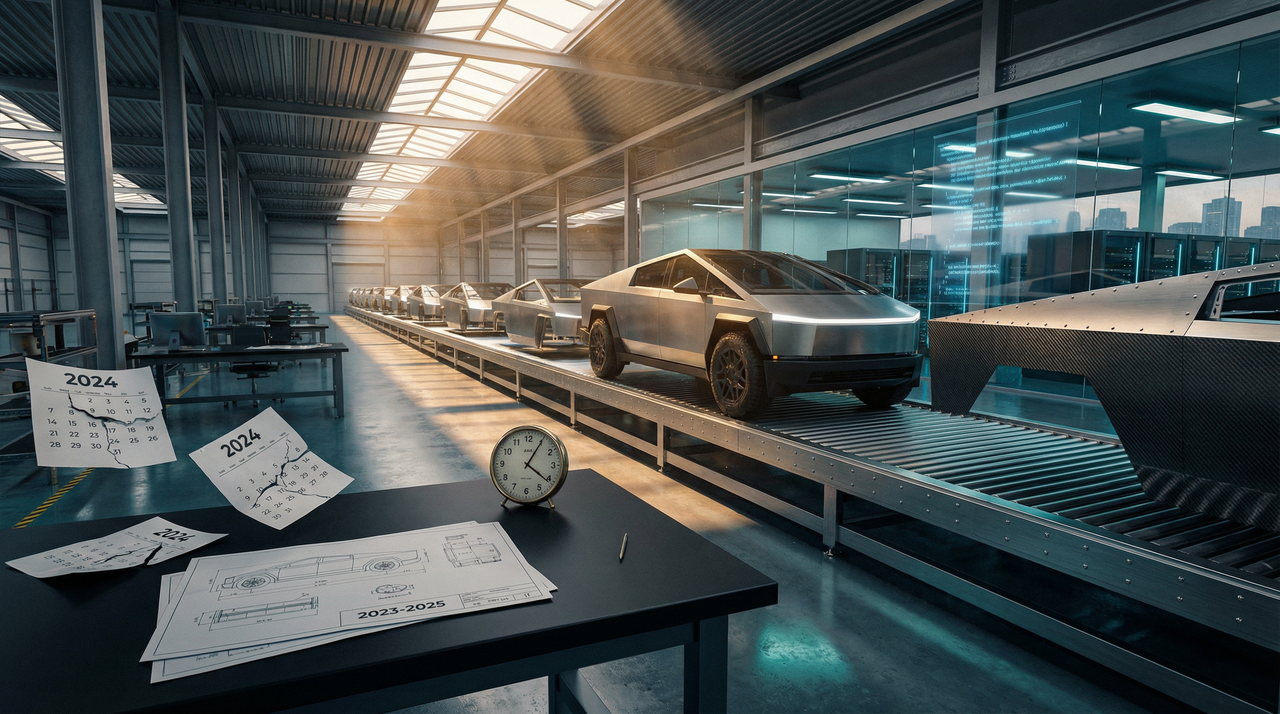
In the twelve months between February 2024 and February 2025, Elon Musk's xAI released three major iterations of its Grok chatbot. During roughly the same period, Tesla unveiled the Cybercab autonomous taxi, the Robovan passenger vehicle, and showcased increasingly capable versions of its Optimus humanoid robot. Meanwhile, SpaceX continued deploying Starlink satellites at a pace that has put over 7,600 active units into low Earth orbit, representing 65 per cent of all active satellites currently circling the planet. For any other technology company, this portfolio would represent an impossibly ambitious decade-long roadmap. For Musk's constellation of enterprises, it was simply 2024.
This acceleration raises a question that cuts deeper than mere productivity metrics: what structural and strategic patterns distinguish Musk's approach across autonomous systems, energy infrastructure, and artificial intelligence, and does the velocity of AI product releases signal a fundamental shift in his development philosophy? More provocatively, are we witnessing genuine parallel engineering capacity across multiple technical frontiers, or has the announcement itself become a strategic positioning tool that operates independently of underlying technical readiness?
The answer reveals uncomfortable truths about how innovation narratives function in an era where regulatory approval, investor confidence, and market positioning matter as much as the technology itself. It also exposes the widening gap between hardware development timelines, which remain stubbornly tethered to physical constraints, and software iteration cycles, which can accelerate at speeds that make even recent history feel antiquated.
When Physics Dictates Timelines
To understand the Grok acceleration, we must first establish what “normal” looks like in Musk's hardware-focused ventures. The Cybertruck offers an instructive case study in the friction between announcement and delivery. Unveiled in November 2019 with a promised late 2021 delivery date and a starting price of $39,900, the stainless steel pickup truck became a monument to optimistic forecasting. The timeline slipped to early 2022, then late 2022, then 2023. When deliveries finally began in November 2023, the base price had swelled to $60,990, and Musk himself acknowledged that Tesla had “dug our own grave” with the vehicle's complexity.
The Cybertruck delays were not anomalies. They represented the predictable collision between ambitious design and manufacturing reality. Creating a new vehicle platform requires tooling entire factory lines, solving materials science challenges (stainless steel panels resist traditional stamping techniques), validating safety systems through crash testing, and navigating regulatory approval processes that operate on government timescales, not startup timescales. Each of these steps imposes a physical tempo that no amount of capital or willpower can compress beyond certain limits.
The manufacturing complexity extends beyond just the vehicle itself. Tesla had to develop entirely new production techniques for working with 30X cold-rolled stainless steel, a material chosen for its futuristic aesthetic but notoriously difficult to form into automotive body panels. Traditional stamping dies would crack the material, requiring investment in specialised equipment and processes. The angular design, while visually distinctive, eliminated the tolerances that typically hide manufacturing imperfections in conventional vehicles. Every panel gap, every alignment issue, becomes immediately visible. This design choice effectively raised the bar for acceptable manufacturing quality whilst simultaneously making that quality harder to achieve.
Tesla's Full Self-Driving (FSD) development history tells a parallel story. In 2015, Musk predicted complete autonomy within two years. In 2016, he called autonomous driving “a solved problem” and promised a cross-country autonomous drive from Los Angeles to Times Square by the end of 2017. That demonstration never happened. In 2020, he expressed “extreme confidence” that Tesla would achieve Level 5 autonomy in 2021. As of late 2025, Tesla's FSD remains classified as SAE Level 2 autonomy, requiring constant driver supervision. The company has quietly shifted from selling “Full Self-Driving Capability” to marketing “Full Self-Driving (Supervised)”, a linguistic pivot that acknowledges the gap between promise and delivery.
These delays matter because they establish a baseline expectation. When Musk announces hardware products, observers have learned to mentally append a delay coefficient. The Optimus humanoid robot, announced at Tesla's August 2021 AI Day with bold claims about near-term capabilities, has followed a similar pattern. Initial demonstrations in 2022 showed a prototype that could barely walk. By 2024, the robot had progressed to performing simple factory tasks under controlled conditions, but production targets have repeatedly shifted. Musk spoke of producing 5,000 Optimus units in 2025, but independent reporting suggests production counts in the hundreds rather than thousands, with external customer deliveries now anticipated in late 2026 or 2027.
The pattern is clear: hardware development operates on geological timescales by Silicon Valley standards. Years elapse between announcement and meaningful deployment. Timelines slip as engineering reality intrudes on promotional narratives. This is not unique to Musk; it reflects the fundamental physics of building physical objects at scale. What distinguishes Musk's approach is the willingness to announce before these constraints are fully understood, treating the announcement itself as a catalyst rather than a conclusion.
AI's Fundamentally Different Tempo
Against this hardware backdrop, xAI's Grok development timeline appears to operate in a different temporal dimension. The company was founded in March 2023, officially announced in July 2023, and released Grok 1 in November 2023 after what xAI described as “just two months of rapid development”. Grok 1.5 arrived in March 2024 with improved reasoning capabilities and a 128,000-token context window. Grok 2 launched in August 2024 with multimodal capabilities and processing speeds three times faster than its predecessor. By February 2025, Grok 3 was released, trained with significantly more computing power and outperforming earlier versions on industry benchmarks.
By July 2025, xAI had released Grok 4, described internally as “the smartest AI” yet, featuring native tool use and real-time search integration. This represented the fourth major iteration in less than two years, a release cadence that would be unthinkable in hardware development. Even more remarkably, by late 2025, Grok 4.1 had arrived, holding the number one position on LMArena's Text Arena with a 1483 Elo rating. This level of iteration velocity demonstrates something fundamental about AI model development that hardware products simply cannot replicate.
This is not gradual refinement. It is exponential iteration. Where hardware products measure progress in years, Grok measured it in months. Where Tesla's FSD required a decade to move from initial promises to supervised capability, Grok moved from concept to fourth-generation product in less than two years, with each generation representing genuine performance improvements measurable through standardised benchmarks.
The critical question is whether this acceleration reflects a fundamentally different category of innovation or simply the application of massive capital to a well-established playbook. The answer is both, and the distinction matters.
AI model development, particularly large language models, benefits from several structural advantages that hardware development lacks. First, the core infrastructure is software, which can be versioned, tested, and deployed with near-zero marginal distribution costs once the model is trained. A new version of Grok does not require retooling factory lines or crash-testing prototypes. It requires training compute, validation against benchmarks, and integration into existing software infrastructure.
Second, the AI industry in 2024-2025 operates in a landscape of intensive competitive pressure that hardware markets rarely experience. When xAI released Grok 1, it was entering a field already populated by OpenAI's GPT-4, Anthropic's Claude 3, and Google's Gemini. This is not the autonomous vehicle market, where Tesla enjoyed years of effective monopoly on serious electric vehicle autonomy efforts. AI model development is a horse race where standing still means falling behind. Anthropic released Claude 3 in March 2024, Claude 3.5 Sonnet in June 2024, an upgraded version in October 2024, and multiple Claude 4 variants throughout 2025, culminating in Claude Opus 4.5 by November 2025. OpenAI maintained a similar cadence with its GPT and reasoning model releases.
Grok's rapid iteration is less an aberration than a sector norm. The question is not why xAI releases new models quickly, but why Musk's hardware ventures cannot match this pace. The answer returns to physics. You can train a new neural network architecture in weeks if you have sufficient compute. You cannot redesign a vehicle platform or validate a new robotics system in weeks, regardless of resources.
But this explanation, while accurate, obscures a more strategic dimension. The frequency of Grok releases serves purposes beyond pure technical advancement. Each release generates media attention, reinforces xAI's positioning as a serious competitor to OpenAI and Anthropic, and provides tangible evidence of progress to investors who have poured over $12 billion into the company since its 2023 founding. In an AI landscape where model capabilities increasingly converge at the frontier, velocity itself becomes a competitive signal. Being perceived as “keeping pace” with OpenAI and Anthropic matters as much for investor confidence as actual market share.
The Simultaneous Announcement Strategy
The October 2024 “We, Robot” event crystallises the tension between parallel engineering capacity and strategic positioning. At a single event held at Warner Bros. Studios in Burbank, Tesla unveiled the Cybercab autonomous taxi (promised for production “before 2027”), the Robovan passenger vehicle (no timeline provided), and demonstrated updated Optimus robots interacting with attendees. This was not a research symposium where concepts are floated. It was a product announcement where 20 Cybercab prototypes autonomously drove attendees around the studio lot, creating the impression of imminent commercial readiness.
For a company simultaneously managing Cybertruck production ramp, iterating on FSD software, developing the Optimus platform, and maintaining its core Model 3/Y/S/X production lines, this represents either extraordinary organisational capacity or an announcement strategy that has decoupled from engineering reality.
The evidence suggests a hybrid model. Tesla clearly has engineering teams working on these projects in parallel. The Cybercab prototypes were functional enough to provide rides in a controlled environment. The Optimus robots could perform scripted tasks. But “functional in a controlled demonstration” differs categorically from “ready for commercial deployment”. The gap between these states is where timelines go to die.
Consider the historical precedent. The Cybertruck was also functional in controlled demonstrations years before customer deliveries began. FSD was sufficiently capable for carefully curated demo videos long before it could be trusted in unscripted urban environments. The pattern is to showcase capability at its aspirational best, then wrestle with the engineering required to make that capability reliable, scalable, and safe enough for public deployment.
The Robovan announcement is particularly telling. Unlike the Cybercab, which received at least a vague timeline (“before 2027”), the Robovan was unveiled with no production commitments whatsoever. Tesla simply stated it “could change the appearance of roads in the future”. This is announcement without accountability, a vision board masquerading as a product roadmap.
Why announce a product with no timeline? The answer lies in narrative positioning. Tesla is not merely a car company or even an electric vehicle company. It is, in Musk's framing, a robotics and AI company that happens to make vehicles. The Robovan reinforces this identity. It signals to investors, regulators, and competitors that Tesla is thinking beyond personal transportation to autonomous mass transit solutions. Whether that product ever reaches production is almost secondary to the positioning work the announcement accomplishes.
This is not necessarily cynical. In industries where regulatory frameworks lag behind technological capability, establishing narrative primacy can shape how those frameworks develop. If policymakers believe autonomous passenger vans are inevitable, they may craft regulations that accommodate them. If investors believe Tesla has a viable path to robotaxis, they may tolerate delayed profitability in core automotive operations. Announcements are not just product launches; they are regulatory and financial positioning tools.
The Credibility Calculus
But this strategy carries compounding costs. Each missed timeline, each price increase from initial projections, each shift from “Full Self-Driving” to “Full Self-Driving (Supervised)” erodes the credibility reserve that future announcements draw upon. Tesla's stock price dropped 8 per cent in the immediate aftermath of the “We, Robot” event, not because the technology demonstrated was unimpressive, but because investors had learned to discount Musk's timelines.
The credibility erosion is not uniform across product categories. It is most severe where hardware and regulatory constraints dominate. When Musk promises new Optimus capabilities or Cybercab production timelines, experienced observers apply mental multipliers. Double the timeline, halve the initial production targets, add a price premium. This is not cynicism but pattern recognition.
Grok, paradoxically, may benefit from the absence of Musk's direct operational involvement. While he founded xAI and provides strategic direction, the company operates with its own leadership team, many drawn from OpenAI and DeepMind. Their engineering culture reflects AI industry norms: rapid iteration, benchmark-driven development, and release cadences measured in months, not years. When xAI announces Grok 3, there is no decade of missed self-driving deadlines colouring the reception. The model either performs competitively on benchmarks or it does not. The evaluation is empirical rather than historical.
This creates a bifurcated credibility landscape. Musk's AI announcements carry more weight because the underlying technology permits faster validation cycles. His hardware announcements carry less weight because physics imposes slower validation cycles, and his track record in those domains is one of chronic optimism.
The Tesla FSD timeline is particularly instructive. In 2016, Musk claimed every Tesla being built had the hardware necessary for full autonomy. By 2023, Tesla confirmed that vehicles produced between 2016 and 2023 lacked the hardware to deliver unsupervised self-driving as promised. Customers who purchased FSD capability based on those assurances essentially paid for a future feature that their hardware could never support. This is not a missed timeline; it is a structural mispromise.
Contrast this with Grok development. When xAI releases a new model, users can immediately test whether it performs as claimed. Benchmarks provide independent validation. There is no multi-year gap between promise and empirical verification. The technology's nature permits accountability at timescales that hardware simply cannot match.
Technical Bottlenecks Vs Regulatory Barriers
Understanding which products face genuine technical bottlenecks versus regulatory or market adoption barriers reshapes how we should interpret Musk's announcements. These categories demand different responses and imply different credibility standards.
Starlink represents the clearest case of execution matching ambition. The satellite internet constellation faced genuine technical challenges: designing mass-producible satellites, achieving reliable orbital deployment, building ground station networks, and delivering performance that justified subscription costs. SpaceX has largely solved these problems. As of May 2025, over 7,600 satellites are operational, serving more than 8 million subscribers across 100+ countries. The service expanded to 42 new countries in 2024 alone. This is not vaporware or premature announcement. It is scaled deployment.
What enabled Starlink's success? Vertical integration and iterative hardware development. SpaceX controls the entire stack: satellite design, rocket manufacturing, launch operations, and ground infrastructure. This eliminates dependencies on external partners who might introduce delays. The company also embraced incremental improvement rather than revolutionary leaps. Early Starlink satellites were less capable than current versions, but they were good enough to begin service while newer generations were developed. This “launch and iterate” approach mirrors software development philosophies applied to hardware.
Critically, Starlink faced minimal regulatory barriers in its core function. International telecommunications regulations are complex, but launching satellites and providing internet service, while requiring licensing, does not face the safety scrutiny that autonomous vehicles do. No one worries that a malfunctioning Starlink satellite will kill pedestrians.
The Cybercab and autonomous vehicle ambitions face the opposite constraint profile. The technical challenges, while significant, are arguably more tractable than the regulatory landscape. Tesla's FSD can handle many driving scenarios adequately. The problem is that “adequate” is not the standard for removing human supervision. Autonomous systems must be safer than human drivers across all edge cases, including scenarios that occur rarely but carry catastrophic consequences. Demonstrating this requires millions of supervised miles, rigorous safety case development, and regulatory approval processes that do not yet have established frameworks in most jurisdictions.
When Musk announced that Tesla would have “unsupervised FSD” in Texas and California in 2025, he was making a prediction contingent on regulatory approval as much as technical capability. Even if Tesla's system achieved the necessary safety thresholds, gaining approval to operate without human supervision requires convincing regulators who are acutely aware that premature approval could result in preventable deaths. This is not a timeline Tesla can compress through engineering effort alone.
The Robovan faces even steeper barriers. Autonomous passenger vans carrying 20 people represent a fundamentally different risk profile than personal vehicles. Regulatory frameworks for such vehicles do not exist in most markets. Creating them will require extended dialogue between manufacturers, safety advocates, insurers, and policymakers. This is a years-long process, and no amount of prototype capability accelerates it.
Optimus occupies a different category entirely. Humanoid robots for factory work face primarily technical and economic barriers rather than regulatory ones. If Tesla can build a robot that performs useful work more cost-effectively than human labour or existing automation, adoption will follow. The challenge is that “useful work” in unstructured environments remains extraordinarily difficult. Factory automation thrives in controlled settings with predictable tasks. Optimus demonstrations typically show exactly these scenarios: sorting objects, walking on flat surfaces, performing scripted assembly tasks.
The credibility question is whether Optimus can scale beyond controlled demonstrations to genuinely autonomous operation in variable factory environments. Current humanoid robotics research suggests this remains a multi-year challenge. Boston Dynamics has spent decades perfecting robotic mobility, yet their systems still struggle with fine manipulation and autonomous decision-making in unstructured settings. Tesla's timeline for “tens of thousands” of Optimus units in 2026 and “100 million robots annually within years” reflects the same optimistic forecasting that has characterised FSD predictions.
Announcements as Strategic Tools
Synthesising across these cases reveals a meta-pattern. Musk's announcements function less as engineering roadmaps than as strategic positioning instruments operating across multiple constituencies simultaneously.
For investors, announcements signal addressable market expansion. Tesla is not just selling vehicles; it is building autonomous transportation platforms, humanoid labour substitutes, and AI infrastructure. This justifies valuation multiples far beyond traditional automotive companies. When Tesla's stock trades at price-to-earnings ratios that would be absurd for Ford or General Motors, it is because investors are pricing in these optionalities. Each announcement reinforces the narrative that justifies the valuation.
For regulators, announcements establish inevitability. When Musk unveils Cybercab and declares robotaxis imminent, he is not merely predicting the future but attempting to shape the regulatory response to it. If autonomous taxis appear inevitable, regulators may focus on crafting enabling frameworks rather than prohibitive ones. This is narrative engineering with policy implications.
For competitors, announcements serve as strategic misdirection and capability signalling. When xAI releases Grok variants at monthly intervals, it forces OpenAI and Anthropic to maintain their own release cadences lest they appear to be falling behind. This is valuable even if Grok's market share remains small. The competitive pressure forces rivals to allocate resources to matching release velocity rather than pursuing longer-term research.
For talent, announcements create recruiting magnetism. Engineers want to work on cutting-edge problems at organisations perceived as leading their fields. Each product unveiling, each capability demonstration, each media cycle reinforces the perception that Musk's companies are where breakthrough work happens. This allows Tesla, SpaceX, and xAI to attract talent despite often-reported cultural challenges including long hours and high-pressure environments.
The sophistication lies in the multi-dimensional strategy. A single announcement can simultaneously boost stock prices, shape regulatory discussions, pressure competitors, and attract engineering talent. The fact that actual product delivery may lag by years does not negate these strategic benefits, provided credibility erosion does not exceed the gains from positioning.
But credibility erosion is cumulative and non-linear. There exists a tipping point where pattern recognition overwhelms narrative power. When investors, regulators, and engineers collectively discount announcements so heavily that they cease to move markets, shape policy, or attract talent, the strategy collapses. Tesla's post-“We, Robot” stock decline suggests proximity to this threshold in hardware categories.
AI as the Exception That Tests the Rule
Grok's development timeline is fascinating precisely because it operates under different constraints. The rapid iteration from Grok 1 to Grok 4.1 reflects genuine capability advancement measurable through benchmarks. When xAI claims Grok 3 outperforms previous versions, independent testing can verify this within days. The accountability loop is tight.
But even Grok is not immune to the announcement-as-positioning pattern. xAI's $24 billion valuation following its most recent funding round prices in expectations far beyond current capabilities. Grok competes with ChatGPT, Claude, and Gemini in a market where user lock-in remains weak and switching costs are minimal. Achieving sustainable competitive advantage requires either superior capabilities (difficult to maintain as frontier models converge) or unique distribution (leveraging X integration) or novel business models (yet to be demonstrated).
The velocity of Grok releases may reflect competitive necessity more than technical philosophy. In a market where models can be evaluated empirically within days of release, slow iteration equals obsolescence. Anthropic's Claude 4 releases throughout 2025 forced xAI to maintain pace or risk being perceived as a generation behind. This is genuinely different from hardware markets where product cycles measure in years and customer lock-in (vehicle ownership, satellite subscriptions) is substantial.
Yet the same investor dynamics apply. xAI's funding rounds are predicated on narratives about AI's transformative potential and xAI's positioning within that transformation. The company must demonstrate progress to justify continued investment at escalating valuations. Rapid model releases serve this narrative function even if Grok's market share remains modest. The announcement of Grok 4 in July 2025, described as “the smartest AI” and holding the number one position on certain benchmarks, functions as much as a competitive signal and investor reassurance as a product launch.
The distinction is that AI's shorter validation cycles create tighter coupling between announcement and verification. This imposes discipline that hardware announcements lack. If xAI claimed Grok 5 would achieve artificial general intelligence within a year, independent researchers could test that claim relatively quickly. When Tesla claims the Cybercab will enter production “before 2027”, verification requires waiting until 2027, by which point the announcement has already served its strategic purposes.
Towards a Credibility Framework
What would a principled framework for evaluating Musk announcements look like? It requires disaggregating claims along multiple dimensions.
First, distinguish between technical capability claims and deployment timeline claims. When Tesla demonstrates FSD navigating complex urban environments, that is evidence of technical capability. When Musk claims unsupervised FSD will be available to customers by year-end, that is a deployment timeline. The former is verifiable through demonstration; the latter depends on regulatory approval, safety validation, and scaling challenges that engineering alone cannot resolve.
Second, assess whether bottlenecks are technical, regulatory, or economic. Starlink faced primarily technical and economic bottlenecks, which SpaceX's engineering culture and capital could address. Autonomous vehicles face regulatory bottlenecks that no amount of engineering can circumvent. Optimus faces economic bottlenecks: can it perform useful work cost-effectively? These different bottleneck types imply different credibility standards.
Third, examine historical pattern by category. Musk's track record on software iteration (Grok, FSD software improvements) is stronger than his track record on hardware timelines (Cybertruck, Roadster, Semi). This suggests differential credibility weighting.
Fourth, evaluate the strategic incentives behind announcements. Product unveilings timed to earnings calls or funding rounds warrant additional scepticism. Announcements that serve clear positioning purposes (the Robovan establishing Tesla as a mass transit player) should be evaluated as strategic communications rather than engineering roadmaps.
Fifth, demand specificity. Announcements with clear timelines, price points, and capability specifications create accountability. The Cybercab's “before 2027” and “$30,000 target price” are specific enough to be verifiable, even if history suggests they will not be met. The Robovan's complete absence of timeline or pricing is strategic vagueness that prevents accountability.
Applied systematically, this framework would suggest high credibility for Starlink deployment claims (technical bottlenecks, strong execution history, verifiable progress), moderate credibility for Grok capability claims (rapid iteration, empirical benchmarks, competitive market imposing discipline), and low credibility for autonomous vehicle and Optimus timeline claims (regulatory and economic bottlenecks, consistent history of missed timelines, strategic incentives favouring aggressive projections).
The Compounding Question
The deeper question is whether this announcement-heavy strategy remains sustainable as credibility erosion accelerates. There is an optimal level of optimism in forecasting. Too conservative, and you fail to attract capital, talent, and attention. Too aggressive, and you exhaust credibility reserves that cannot be easily replenished.
Musk's career has been characterised by achieving outcomes that seemed impossible at announcement. SpaceX landing and reusing orbital rockets was widely dismissed as fantasy when first proposed. Tesla making electric vehicles desirable and profitable defied decades of industry conventional wisdom. These successes created enormous credibility reserves. The question is whether those reserves are now depleted in hardware categories through accumulated missed timelines.
The bifurcation between software and hardware may be the resolution. As Musk's companies increasingly span both domains, we may see diverging announcement strategies. xAI can maintain rapid iteration and aggressive capability claims because AI's validation cycles permit it. Tesla and other hardware ventures may need to adopt more conservative forecasting as investors and customers learn to apply dramatic discount factors.
Alternatively, Musk may conclude that the strategic benefits of aggressive announcements outweigh credibility costs even in hardware domains. If announcements continue to shape regulatory frameworks, attract talent, and generate media attention despite poor timeline accuracy, the rational strategy is to continue the pattern until it definitively fails.
The Grok timeline offers a test case. If xAI can maintain its release cadence and deliver competitive models that gain meaningful market share, it validates rapid iteration as genuine strategic advantage rather than merely announcement theatre. If release velocity slows, or if models fail to differentiate in an increasingly crowded market, it suggests that even software development faces constraints that announcements cannot overcome.
For now, we exist in a superposition where both interpretations remain plausible. Musk's innovation portfolio spans genuinely transformative achievements (Starlink's global deployment, reusable rockets, electric vehicle mainstreaming) and chronic over-promising (FSD timelines, Cybertruck delays, Optimus production targets). The pattern is consistent: announce aggressively, deliver eventually, and let the strategic benefits of announcement accrue even when timelines slip.
What the accelerating Grok release cadence reveals is not a fundamental shift in development philosophy but rather the application of Musk's existing playbook to a technological domain where it actually works. AI iteration cycles genuinely can match announcement velocity in ways that hardware cannot. The question is whether observers will learn to distinguish these categories or will continue to apply uniform scepticism across all Musk ventures.
The answer shapes not just how we evaluate individual products but how innovation narratives function in an era where the announcement is increasingly decoupled from the artefact. In a world where regulatory positioning, investor confidence, and talent attraction matter as much as technical execution, the announcement itself becomes a product. Musk has simply recognised this reality earlier and exploited it more systematically than most. Whether that exploitation remains sustainable is the question that will define the credibility of his next decade of announcements.
References & Sources
- Grok (chatbot) – Wikipedia
- Timeline of xAI – Timelines
- Grok-2 Beta Release | xAI
- Tesla Cybercab – Wikipedia
- Elon Musk hypes $30,000 Tesla self-driving Cybercab and larger Robovan at robotaxi event – CNBC
- Tesla Robovan – Wikipedia
- Starlink – Wikipedia
- Starlink Coverage in 2025: Full Global Map, Reviews, and What's Coming Next
- Optimus (robot) – Wikipedia
- Tesla's Robotic Moonshot: Optimus Gen 3
- xAI (company) – Wikipedia
- Elon Musk's xAi firm valued at $24 billion as investors pledge more money – CNN Business
- List of predictions for autonomous Tesla vehicles by Elon Musk – Wikipedia
- A Brief History of Tesla's “Full Self Driving”
- Claude (language model) – Wikipedia
- Tesla Cybertruck – Wikipedia
- Elon Musk's Biggest Broken Promises & Failed Predictions

Tim Green UK-based Systems Theorist & Independent Technology Writer
Tim explores the intersections of artificial intelligence, decentralised cognition, and posthuman ethics. His work, published at smarterarticles.co.uk, challenges dominant narratives of technological progress while proposing interdisciplinary frameworks for collective intelligence and digital stewardship.
His writing has been featured on Ground News and shared by independent researchers across both academic and technological communities.
ORCID: 0009-0002-0156-9795 Email: tim@smarterarticles.co.uk