Phantom Precedent: When AI Fabricates Citations and the Poor Pay
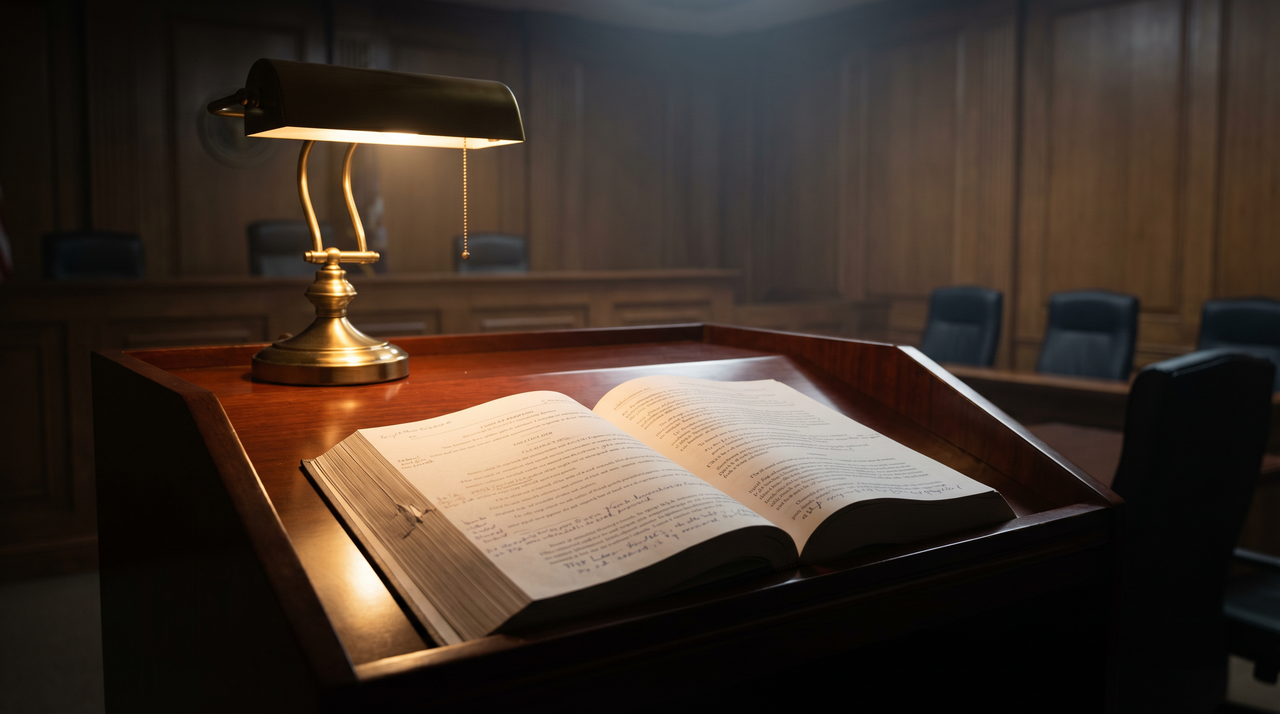
On the morning of 18 March 2026, Deborah Leslie stood at the lectern of the Supreme Court of Georgia, in downtown Atlanta, and tried to explain why several of the cases in her brief did not exist. Leslie was an Assistant District Attorney with Clayton County, assigned to appellate work and assets forfeiture, and she had filed papers opposing a new trial for Hannah Payne, a young woman convicted in 2023 of the murder of Kenneth Herring after a hit-and-run on a Clayton County road in 2019. Payne, then twenty-five, was serving life with the possibility of parole. Her lawyer, Brian Steel, had filed for a fresh trial on the grounds that her original counsel had failed to ask the jury to consider citizen's arrest as a defence. The state's response, signed by Leslie, ran to dozens of pages. It cited authorities. The authorities, in many places, were imaginary.
Chief Justice Nels Peterson did not bury the point. From the bench, he counted aloud: at least five citations to cases that did not exist, and at least five more to cases that existed but did not say what Leslie's brief claimed they said. The video of the exchange, which would later be viewed more than five million times across various clips, has the strangled politeness of a hearing that everyone in the room knows is going badly. Leslie initially suggested the citations might have been added to the version filed with the court rather than the one she had drafted. Peterson noted that the same non-existent cases appeared in the brief opposing Payne's motion below. The implication was unavoidable. The phantom citations were hers.
A week later, on 27 March, Clayton County District Attorney Tasha Mosley wrote to the Chief Justice. The letter, published shortly after by local outlets, conceded what was already obvious. Leslie had used artificial intelligence to draft the filing. She had not verified the output. The office had moved against her: a grievance with the State Bar of Georgia, suspension, a performance improvement plan, loss of privileges. In her own affidavit, Leslie said the errors were not intentional and that the references “were not independently verified before inclusion.” The Hannah Payne appeal, a case with a victim's family, a defendant on a life sentence, and a contested constitutional argument about the right to effective counsel, had been compromised by language a model invented in a few seconds at no cost.
The Georgia incident is not anomalous. It is the latest, most public entry in a list that legal scholar Damien Charlotin, who divides his time between Sciences Po Law School and HEC Paris, has been building since April 2025 in a database he started because he could not find anyone else doing the work. By the spring of 2026, his AI Hallucination Cases tracker had passed 1,200 documented incidents from courts around the world, with roughly 800 from the United States alone. On a single day in March 2026, he logged seventeen. The rate, Charlotin has said, is still rising. What began as a curiosity in late 2022, when ChatGPT first leaked into the workflows of overworked solicitors and overconfident litigants, has become a structural feature of contemporary legal practice. The machine is in the building. The machine lies. Sometimes the lies get caught. Sometimes they do not.
Lay this fact alongside another, less visible one. According to the Legal Services Corporation's 2022 Justice Gap study, conducted with NORC at the University of Chicago, ninety-two per cent of the substantial civil legal problems experienced by low-income Americans receive no, or insufficient, legal help. Seventy-four per cent of low-income households face at least one such problem in any given year. In England and Wales, Ministry of Justice statistics for the third quarter of 2025 showed that fifty-nine per cent of civil cases in the County Court involved at least one party with no legal representation. In state civil dockets across the United States, self-representation rates routinely exceed ninety per cent in housing, family, and consumer cases. The justice gap is not a metaphor. It is the operational reality of most non-criminal courtrooms in the English-speaking world.
This is the contradiction at the heart of the moment. Generative AI is the only piece of legal infrastructure that has, in living memory, become cheaper and more widely available rather than more expensive and more rationed. For the unrepresented mother fighting an eviction, the asylum seeker filling in a witness statement at midnight, the small employer hit with a discrimination claim, a free large language model is, on its worst day, more responsive than the legal aid hotline that has not picked up in three hours and, on its best day, capable of producing a coherent draft of a defence. The same technology, deployed by a tired prosecutor in a county DA's office or a partner under deadline at a magic-circle firm, can introduce phantom precedent into the foundations of a criminal appeal. AI is simultaneously democratising access and corrupting the evidentiary substrate. There is no clean way to keep one without the other.
The Hallucination Problem, Precisely
It helps to be technical about what is happening, because the loose language around “AI mistakes” understates the issue. A large language model does not retrieve. It predicts. Given a prompt, it generates the most statistically plausible next token, then the next, conditioned on its training data and on whatever it has just produced. When the prompt is “cite a case supporting the proposition that an officer's mistaken belief in probable cause is reviewed for objective reasonableness”, the model produces something that looks like a citation, because in the training data the answers to such prompts are followed by things that look like citations. Volume number, reporter, page, year, parenthetical court abbreviation. The format is the easy part. The model has internalised the format. What it has not internalised is the existence of the case.
This is why the hallucinations are so dangerous. They are not random. They are formally correct. A fabricated case will have a plausible volume number for the reporter, a sensible district, a year that lines up with the legal doctrine being argued, and often a holding that maps onto the proposition being supported. The fabrication is grammatical. The citation, considered in isolation, is indistinguishable from a real one until someone looks it up. The Stanford RegLab's preregistered study by Varun Magesh and Faiz Surani, published in the Journal of Empirical Legal Studies, gave the phenomenon a metric: even legal-specific tools hallucinated at startling rates. Westlaw's AI-Assisted Research generated incorrect or fabricated information thirty-three per cent of the time in their tests. LexisNexis's Lexis+ AI hallucinated seventeen per cent of the time. Thomson Reuters' Ask Practical Law AI sat near the same number. Premium products. Trained on real case law. Marketed to professionals. Still inventing.
The roll call of incidents starts with Mata v Avianca, the Manhattan personal-injury suit against the Colombian airline that became the founding text of the genre. In June 2023, Judge P. Kevin Castel of the Southern District of New York imposed sanctions of $5,000 on attorneys Steven Schwartz and Peter LoDuca, and on the firm Levidow, Levidow & Oberman, after Schwartz used ChatGPT to research a brief that ended up citing six cases that did not exist: Varghese v. China South Airlines, Martinez v. Delta Airlines, Shaboon v. EgyptAir, Petersen v. Iran Air, Miller v. United Airlines, and Estate of Durden v. KLM Royal Dutch Airlines. When opposing counsel pointed out that the cases could not be found, Schwartz had asked ChatGPT whether they were real; the model assured him they were and produced fabricated full texts. He had been a member of the New York bar since 1991. “It just never occurred to me”, he testified, “that it would be making up cases.”
Then came the parade. In late 2023, Michael Cohen, the former personal lawyer to Donald Trump, sent his attorney three citations he had pulled from Google's Bard, all fabricated, in support of a motion for early termination of supervised release. The judge declined to sanction Cohen but called the episode “embarrassing and certainly negligent”. In Texas, in November 2024, Judge Marcia Crone of the Eastern District sanctioned Brandon Monk in Gauthier v. Goodyear Tire & Rubber Co. after a brief produced with the help of Anthropic's Claude cited authorities that did not exist. In June 2025, the High Court of England and Wales handed down its joined judgment in Ayinde v London Borough of Haringey and Al-Haroun v Qatar National Bank QPSC, a decision that read less like a routine ruling and more like a public warning. The grounds for review in Ayinde, drafted by a barrister called Ms Forey, misstated section 188(3) of the Housing Act 1996 and cited five non-existent cases, including a phantom “El Gendi v Camden LBC”. In Al-Haroun, a solicitor's witness statement contained eighteen authorities that did not exist, with others misquoted or inapplicable, after the solicitor relied on his client's research without verifying it. The Divisional Court was blunt: GenAI does not extinguish professional responsibility, and Rule 11 equivalents in England and Wales apply with full force regardless of whether a human or a model produced the text.
Australia has produced its own running list. On 19 July 2024, before Justice Amanda Humphreys in Victoria, a solicitor in a marital dispute submitted a list of “relevant” prior cases that turned out to have been generated by AI. He became, that year, the first Australian lawyer formally sanctioned for AI-generated fabrications. He was barred from practising as a principal and required to work under supervision for two years. In August 2025, before the Supreme Court of Victoria, defence lawyer Rishi Nathwani, KC, apologised to Justice James Elliott for filing submissions in a teenager's murder trial that included fabricated quotes from a speech to the state legislature and non-existent citations purportedly from the same court. The errors caused a twenty-four-hour delay; Elliott eventually ruled the youth not guilty of murder by reason of mental impairment, but the embarrassment to the bar was complete. In the months that followed, a Western Australian solicitor was referred to that state's regulator for tendering documents citing four cases that either did not exist or were misreferenced.
South Africa joined the parade in 2025. In Mavundla v MEC: Department of Co-Operative Government and Traditional Affairs KwaZulu-Natal, the KwaZulu-Natal High Court found that of the nine authorities Mavundla's legal team had cited, only two were real. Among the fabrications was a confidently asserted “Hassan v Coetzee”, complete with a citation, a court, a year, and a tidy doctrinal proposition, none of which corresponded to any actual case. The court referred Mavundla's lawyers to the Legal Practice Council for investigation and ordered them to bear the costs of a hearing in which an inordinate amount of judicial and counsel time had been spent searching for cases that were never going to be found. The Cliffe Dekker Hofmeyr alerts that catalogued the affair noted, drily, that good intentions and apologies were no longer mitigation. They were table stakes.
Charlotin's tracker captures the cumulative shape. The early cases were almost all lawyers. By 2025, the share of pro se litigants caught submitting fabricated citations had grown sharply; Bloomberg Law reported that at least twenty-four self-represented litigants in the United States had been hit with monetary sanctions for AI-generated filings in the eighteen months following the second half of 2023. The trend in the data is unmistakable. The technology is not going away. The hallucinations are not going away. Adoption is outpacing verification, and the courts are catching up by issuing sanctions and warnings rather than by deploying any meaningful screening.
The Other Side of the Same Coin
Now consider who else is using these systems, and why. The New York State Bar Association published a piece on 10 February 2026 by its Pro Se Advocacy interest section titled “Pro Se Advocacy in the AI Era: Benefits, Challenges, and Ethical Implications”. The article does not pretend to resolve the contradiction. It frames it. It catalogues the practical uses to which an unrepresented person might put a chatbot: drafting letters to the court, preparing a defence to a parking ticket, navigating procedural requirements that the court itself communicates through forms a non-lawyer cannot reliably parse. It also notes the obvious risk: hallucinations that look like citations, advice that looks like guidance, and a tool that the client cannot themselves audit. The piece poses the question that the legal profession has, until very recently, been allowed not to answer: “Are the people, who otherwise would not have legal counsel, better served by at least having a chatbot to assist them?”
Similar commentary has come out of South Africa and Australia in the same window. The South African Daily Maverick ran a piece in July 2025 arguing that AI hallucinations were threatening the administration of justice in the country, while simultaneously acknowledging that the country's own access-to-justice gap, particularly in family and labour matters, had created a population for whom no realistic alternative to AI-mediated self-help existed. In one widely cited case, a self-represented litigant called Mr Makunga drafted heads of argument with the help of AI tools and online research, and the presiding judge commended the quality of his submissions, noting that some members of the practising bar had filed worse arguments than the AI-augmented ones. The South African legal profession is in the position of warning the public against the same technology that is, for many of those same members of the public, the only legal-adjacent help on offer. Australian commentators have made the same point, often more sharply: that decades of cuts to legal aid have produced a country where AI is not a luxury for the poor litigant but the default.
The numbers confirm what the rhetoric implies. The 2022 Justice Gap report from the Legal Services Corporation, the federally funded body responsible for funding civil legal aid in the United States, found that ninety-two per cent of the civil legal problems faced by low-income Americans received either no help or not enough. In 2021, LSC grantees were unable to provide adequate help on roughly 1.4 million of the 1.9 million problems brought to them. Across state civil courts, the New York City Bar Association has called the gap a “chasm”. In England and Wales, the Ministry of Justice's own statistics for July to September 2025 recorded that fifty-nine per cent of County Court civil cases involved an unrepresented party. In housing matters, in family proceedings, and in claims under £10,000, the proportion is higher still. The legal profession has been priced out of the lives of the people whom the legal system most often touches.
For those people, generative AI is not a fancy productivity tool. It is the only piece of legal infrastructure that scales to their need. A free model that responds in seconds, drafts in plain English, and produces something resembling a coherent argument is more meaningful in the life of an evicted tenant than a thirty-page government leaflet, a legal aid waiting list of nine months, or a self-help kiosk staffed by a volunteer who can offer information but not advice. The bar associations know this. They are also writing the practice notes that make their members liable for AI-generated errors. The result is a regulatory regime that, on paper, treats AI as a hazardous tool that licensed professionals must approach with caution, while in practice the same tool is being used as a substitute for those professionals by people the profession does not serve.
That asymmetry is not just uncomfortable. It is dangerous. When a lawyer files a brief with phantom citations, the lawyer is sanctioned, the judge is annoyed, the client may suffer reputational damage, and the firm pays the bill. Friction is built into the relationship. The lawyer has insurance, a regulatory body, a duty of competence. When a pro se litigant files the same brief, none of those scaffolds exist. The litigant is told, sometimes for the first time in their interaction with the system, that they have submitted falsehoods to a court. Their case is dismissed, or worse. Their credibility, which they did not choose to risk, is lost. They have no insurer, no body to pay sanctions, no firm to absorb the loss. They have a chatbot and the consequences.
Risk and Where It Lands
The doctrinal answer to “who bears the risk” is easy to state and brutal to apply. In every jurisdiction that has confronted the question, the answer has been: whoever signed the filing. Rule 11 of the United States Federal Rules of Civil Procedure binds the lawyer or the unrepresented party to the truth of every assertion. The Civil Procedure Rules in England and Wales impose comparable duties. The Legal Practice Council in South Africa has already announced that good intentions are not mitigation. Australian state bars have made the same point. The doctrinal posture is that the human is the author, the AI is the tool, and the tool's errors are the author's problem.
This makes intuitive sense for the represented client and their lawyer. It is much harder to defend in the case of the unrepresented. A pro se litigant who copies a fabricated case from a chatbot has not been negligent in the way a lawyer has been negligent. The lawyer is a trained professional with a duty of competence and an obligation to know that ChatGPT does not search; the litigant is a person who can read English and has been given a search box. The same conduct, on the same facts, attracts the same legal exposure but reflects radically different fault. Sanctions imposed on a pro se litigant for AI-generated falsehoods land on someone whose alternative was not better legal advice; their alternative was no advice at all. The system tells them, in effect, that they should have known not to use the tool that the system also will not give them an alternative to.
There are emerging cases that test the edges of this rule. On 4 March 2026, Nippon Life Insurance Company of America filed suit in the Northern District of Illinois against OpenAI Foundation and OpenAI Group PBC, alleging that ChatGPT, used by an opposing pro se litigant, had engaged in tortious interference with a settled contract, abuse of process, and the unlicensed practice of law. The Nippon complaint is one of the first attempts to push a portion of the risk back upstream, onto the maker of the tool, rather than letting it rest entirely on the user. It is far from clear whether the case will survive a motion to dismiss, and the substantive merits are contested, but the move is intellectually significant. If a chatbot purports to give legal advice to a litigant, and the advice is wrong, and the litigant's reliance produces real harm to a counterparty, then liability somewhere in that chain is unavoidable. The question is whether it stops at the user, where current doctrine puts it, or extends to the model, the deployer, or the platform.
State legislatures have begun to nibble at the same question. New York legislators are considering a bill that would expressly make companies liable for the unauthorised practice of law by their AI chatbots. The premise is that a tool that confidently advises a non-lawyer on the contents of a defence is, functionally, practising law without a licence; the licensing regime exists for a reason; and the licensing regime should bind the company that deploys the tool. The counter-argument, made vigorously by the deployers, is that disclaimers are visible, that the tool is a general-purpose system, and that holding the platform liable will simply shut the tool down for the very people who most need it. The argument is real on both sides. It is also, to borrow a WIRED instinct, a debate that exists because the legal system has refused to fund civil representation at the level the population requires.
The Patchwork of Rules
What courts have done in the meantime is improvise. Judge Brantley Starr of the Northern District of Texas issued the first published standing order on AI in court filings in 2023, requiring attorneys to certify either that no portion of the filing was drafted with generative AI or that any AI-drafted portion had been independently verified by traditional means. Filings without the certificate would be stricken. Starr's order travelled. By the end of 2025, Bloomberg Law's tracker had logged hundreds of standing orders, general orders, and local rules across federal and state courts in the United States addressing AI use in submissions. The orders are not uniform. Some require disclosure of the model used. Some require certification of independent verification. Some prohibit AI in particular categories of filing. Some are silent on pro se litigants and silent in different ways on legal aid clinics that use AI in supervised work.
In the United Kingdom, the Bar Council and the Solicitors Regulation Authority have issued guidance, and the Lord Chief Justice's office has updated its own guidelines for judges on the use of AI tools. The Ayinde judgment did most of the doctrinal work: lawyers are professionally responsible for everything they sign, AI cannot be invoked as an excuse, and serious cases will be referred to the regulators. In Australia, the Victorian Legal Services Board has begun to issue conditions on practising certificates for solicitors caught with fabricated citations. The South African Legal Practice Council has confirmed that referrals for AI-generated fabrications will be standard. None of these regimes is coordinated with the others. None deals systematically with the unrepresented litigant. All of them assume that the deterrent function of sanctions is sufficient, even though the data Charlotin is collecting suggests that sanctions are not, in fact, slowing the rate of submissions.
There is a distinct strand of proposal that goes beyond after-the-fact sanction. The most robust version is the “hyperlink rule” advocated in legal-technology circles, which would require every authority cited in a filing to be backed by a working hyperlink to the actual case in a recognised public database, with verification carried out before submission. Some jurisdictions have flirted with the idea. None has imposed it as a hard rule, in part because the doctrinal infrastructure for stable case URLs is patchy and in part because requiring hyperlinks puts an additional procedural burden on litigants who already cannot navigate the existing forms. A weaker version is the retrieval-augmented generation (RAG) requirement, in which AI tools used in legal practice must ground their outputs in a curated, court-vetted database of authorities rather than in the open internet. Westlaw, LexisNexis, and Thomson Reuters all market RAG-based products. The Stanford RegLab study showed that those products still hallucinate, just less often. RAG is mitigation, not solution.
A more interesting proposal, surfacing in academic work and in the most thoughtful sections of the New York State Bar Association's pro se commentary, is a two-tier disclosure regime. Lawyers using AI face one set of rules: they must disclose, certify, and verify, and they will be sanctioned if they fail. Pro se litigants face a different set: they must disclose, but the court will treat AI-generated errors as a procedural defect that triggers an opportunity to correct, not a sanctionable falsehood, provided the litigant did not knowingly file material they suspected to be fabricated. The justification is that the unrepresented litigant has a different epistemic position. They were not supposed to know. The system that did not give them a lawyer cannot then sanction them for the only substitute available. The objection is that the rule creates a second-class evidentiary regime in which the truth of submissions depends on who made them, and that asymmetry is its own injustice.
The Hardest Cases
It is worth sitting with the kinds of cases where this matters most. The Ayinde claimant, on whose behalf phantom cases were cited, had a real housing problem. The barrister's failure did not invent the homelessness. It complicated the record on which the homelessness would be adjudicated. In Mavundla, a real dispute about traditional leadership was filed alongside fabricated authorities, and the case was referred to the Legal Practice Council in part because the court could not separate the genuine claim from the contaminated argument. In the Hannah Payne appeal, the constitutional question, whether her trial counsel had been ineffective in failing to present a citizen's arrest defence, is genuine and consequential. Leslie's hallucinated brief did not change the facts of the underlying killing. It changed the texture of the appellate record, made the prosecution's argument less credible, and forced the Georgia Supreme Court to spend its time policing the inputs rather than weighing them.
For the unrepresented, the most painful version of the problem is not the high-stakes appeal. It is the small case that was always going to be hard. A tenant in Manchester or Atlanta or Cape Town files a defence to an eviction. The defence cites cases that do not exist. The landlord's counsel files a reply that catches the fabrication. The judge, depending on jurisdiction, either strikes the defence or grants it grudging weight. The tenant loses the home that they were trying to keep, in part because the only legal help they could afford was a model that lied to them. The fault lies, on every doctrinal account, with the tenant. The injury, on any honest account, is on the tenant and the tenant's children.
That kind of case rarely makes the Charlotin database. It does not produce a published opinion. It does not generate a sanctions order. It generates a default judgment, a removal, a debt. Some portion of the court orders that are entered against unrepresented defendants in the United States and the United Kingdom in 2025 and 2026 are now, almost certainly, downstream of AI-generated filings that were never identified as such because no one in the courtroom had time or expertise to check. The dark figure of AI's contribution to the justice gap is, by definition, invisible. The cases we know about are the ones in which someone, on the other side, had the resources to look up the citations. Where there is no other side with resources, there is no audit. Where there is no audit, there is no record.
What Should Be Done
This article will not pretend that there is a clean fix. WIRED's instinct, properly, is to take a position rather than to nod sympathetically at every party. The position is this. The legal profession's current posture, in which sanctions land on the human signatory regardless of context and AI tools are treated as neutral hazards, is intellectually consistent and morally untenable. It works only if the system also funds the legal representation that would let people avoid the hazardous tool. It does not. The same legislatures and bar associations writing tighter AI rules have, for thirty years, allowed civil legal aid to be eviscerated. They cannot now have it both ways.
There are concrete steps. Court-vetted, publicly funded retrieval-augmented systems, designed specifically for unrepresented litigants in jurisdictions where self-representation is the norm, would meaningfully reduce hallucination rates and shift some risk back to public infrastructure where it belongs. The technology exists. The cost is a fraction of what jurisdictions spend on courthouse construction. The political will is the obstacle. Two-tier disclosure regimes, in which courts adopt different sanctions postures for represented and unrepresented filers, would acknowledge the moral asymmetry the current rules ignore. Mandatory hyperlinking of authorities, with court-side automated verification, would let scale solve a scale problem. Liability that extends, where appropriate, to the deployer of a model marketed as a legal assistant, would give platforms an incentive to invest in accuracy that disclaimers do not.
None of these will fix the underlying issue, which is that justice is expensive and most people cannot afford it. Generative AI has revealed that fact in a particularly acute way: the cheapest available legal counsel is also the least reliable, and the most reliable counsel has never been cheap. Treating AI as either saviour or saboteur misses the structure of the problem. The technology is a mirror. It reflects, with terrifying efficiency, both the procedural form of legal argument and the unwillingness of states to fund the substance. The Georgia prosecutor and the Manchester tenant are using the same tool for related reasons: their respective systems have not given them what they need to do their work.
Phantom precedent is what happens when a pattern-matching machine is asked to do the job of a research lawyer. It is also, more deeply, what happens when courts pretend that everyone in front of them has equal access to the means of producing reliable arguments. They do not. They have never. The arrival of AI has made that gap visible in a new way, and the next decade of legal regulation will be measured by whether courts and legislatures respond to the visibility or to the symptom. If the answer is more sanctions, more warning notices, and more standing orders, the gap will widen. If the answer is funded counsel, vetted public tools, and a doctrinal reckoning with who actually bears the risk when a model lies, there is at least a route through. The contradiction will not resolve itself. Someone has to choose.
References
- CBS News Atlanta, “AI in Georgia courts raises new questions after Clayton County prosecutor admits citing fake cases”, 2026.
- Atlanta News First, “Chief justice: Attorney cites nonexistent cases in opposing new trial for woman convicted of murder”, 23 March 2026.
- Atlanta News First, “Attorney with Clayton County DA's Office apologizes for using AI, citing fake cases in court brief”, 30 March 2026.
- Damien Charlotin, AI Hallucination Cases Database, damiencharlotin.com/hallucinations, accessed April 2026.
- Eugene Volokh, “In One Day (Mar. 31), 17 U.S. Court Decisions Noting Suspected AI Hallucinations in Court Filings”, Reason, 6 April 2026.
- New York State Bar Association, “Pro Se Advocacy in the AI Era: Benefits, Challenges, and Ethical Implications”, 10 February 2026.
- Mata v. Avianca, Inc., 678 F. Supp. 3d 443 (S.D.N.Y. 2023), Opinion and Order on Sanctions, Judge P. Kevin Castel, 22 June 2023.
- NPR, “Michael Cohen says he unwittingly sent AI-generated fake legal cases to his attorney”, 30 December 2023.
- Gauthier v. Goodyear Tire & Rubber Co., E.D. Tex., Judge Marcia Crone, sanctions order, November 2024.
- Ayinde v London Borough of Haringey; Hamad Al-Haroun v Qatar National Bank QPSC and QNB Capital LLC, [2025] EWHC 1383 (Admin), judgment of the Divisional Court, June 2025.
- Information Age (Australian Computer Society), “First Australian lawyer penalised for AI blunder”, 2025.
- NBC News, “Australian lawyer sorry for AI errors in murder case, including fake quotes and made up cases”, 15 August 2025.
- Mavundla v MEC: Department of Co-Operative Government and Traditional Affairs KwaZulu-Natal and Others, [2025] ZAKZPHC 2.
- Cliffe Dekker Hofmeyr, “Another episode of fabricated citations, real repercussions: South African courts show no tolerance for AI-hallucinated cases”, 4 July 2025.
- Daily Maverick, “AI 'hallucinations' are threatening the administration of justice in South Africa”, 15 July 2025.
- Varun Magesh and Faiz Surani et al., “Hallucination-Free? Assessing the Reliability of Leading AI Legal Research Tools”, Journal of Empirical Legal Studies, Stanford RegLab, 2024.
- Legal Services Corporation, The Justice Gap: The Unmet Civil Legal Needs of Low-Income Americans, 2022 Report, NORC at the University of Chicago.
- Ministry of Justice (England and Wales), Civil Justice Statistics Quarterly, July to September 2025.
- New York City Bar Association, “The Justice Gap Has Become a Chasm”.
- Bloomberg Law, “Federal Court Judicial Standing Orders on Artificial Intelligence” comparison table, 2025.
- Legal Dive, “Federal judge seeks to prevent generative AI mistakes in briefs”, 2023, on Judge Brantley Starr's standing order.
- Vermont Law Review, “Mandatory AI Disclosures: Enforcing A Uniform Standard”, 2025.
- National Law Review, “Preventing Fabricated AI Legal Authorities: The Case for a Mandatory 'Hyperlink Rule'“.
- Bloomberg Law, “Big Law Grapples With AI-Fueled Pro Se Surge, Rising Legal Costs”, 2025.
- Georgetown Journal of Legal Ethics, “GPT, Esquire: How the Nippon Case May Shape the Future of AI in Pro Se Litigation”, 2026.

Tim Green UK-based Systems Theorist & Independent Technology Writer
Tim explores the intersections of artificial intelligence, decentralised cognition, and posthuman ethics. His work, published at smarterarticles.co.uk, challenges dominant narratives of technological progress while proposing interdisciplinary frameworks for collective intelligence and digital stewardship.
His writing has been featured on Ground News and shared by independent researchers across both academic and technological communities.
ORCID: 0009-0002-0156-9795 Email: tim@smarterarticles.co.uk
Listen to the free weekly SmarterArticles Podcast