Seven Million Songs a Day: AI Music and Vanishing Scarcity
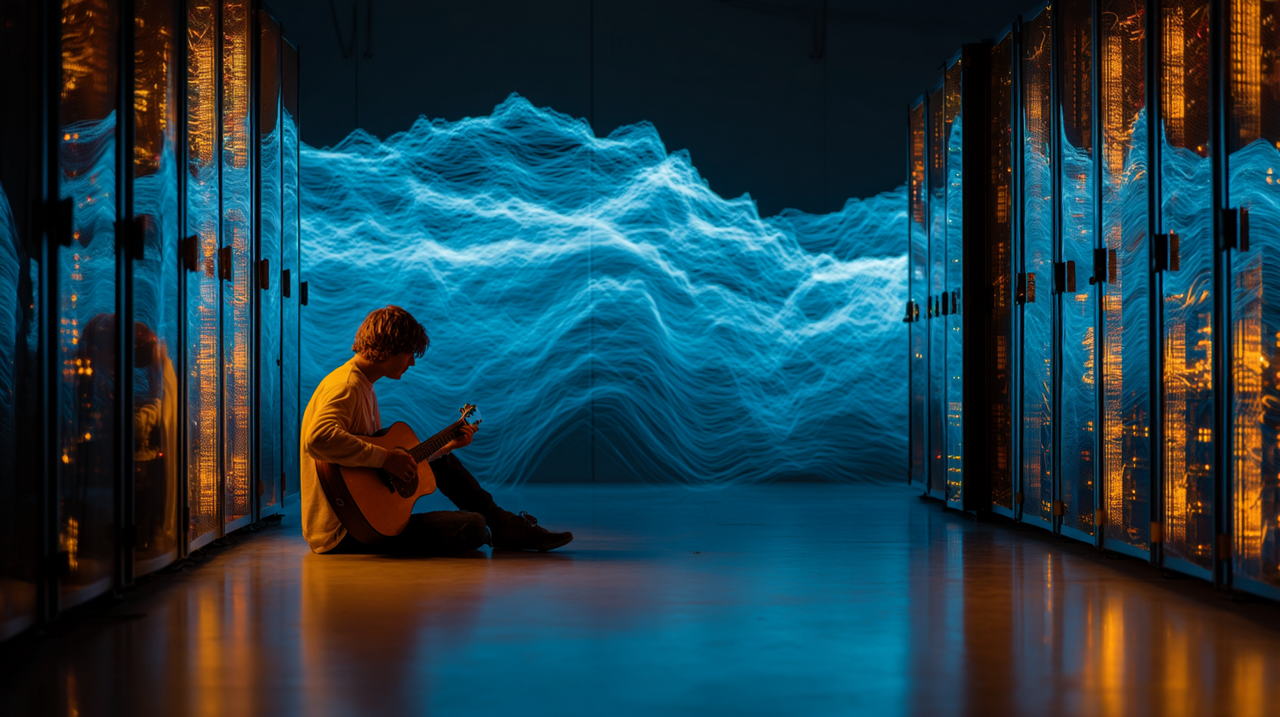
Somewhere in a bedroom in suburban Ohio, a teenager with no musical training opens Suno on a laptop, types a sentence about heartbreak and rain, and 22 seconds later receives a fully produced indie folk ballad with layered harmonics, fingerpicked guitar, and vocals that sound like they belong on a Spotify editorial playlist. The song is not exceptional. It is also not bad. It exists in a strange new territory that the music industry has no vocabulary for: technically competent, emotionally coherent, and created with less effort than it takes to boil an egg.
This is not a hypothetical future. This is the present. Suno, the generative AI music platform founded by former Meta researchers, now counts over 100 million users worldwide and generates roughly 7 million songs per day. That figure is worth sitting with. It means Suno's user base reproduces the equivalent of Spotify's entire 100-million-song catalogue approximately every two weeks. In November 2025 the company raised $250 million in its Series C round at a $2.45 billion valuation, and by early 2026 reported annual recurring revenue of around $300 million. Its competitor Udio, founded by former Spotify AI researchers, offers similar capabilities with a focus on granular production control. Both platforms charge around $10 per month for standard access.
The sheer volume is staggering, but it is the quality that forces the harder questions. In November 2025, Deezer and Ipsos conducted a survey of 9,000 people across eight countries and found that 97 per cent of respondents could not distinguish between AI-generated music and human-made music in a blind listening test. That same month, an AI-generated country track called “Walk My Walk,” credited to the anonymous project Breaking Rust, topped Spotify's Viral 50 USA chart and the Billboard Country Digital Song Sales chart. It was among the first AI-generated songs to top a Billboard ranking, though the milestone was narrower than the headlines suggested. Country Digital Song Sales is a low-volume metric: number one required only a few thousand purchases, and at roughly a dollar per download, around $3,000 in sales was enough to claim it. The track did not appear on the main streaming country charts, making it notable but not a mainstream hit.
These are not glitches in the system. They are the system working exactly as designed.
The Flood Has Already Arrived
The language of crisis has become unavoidable when describing what is happening on streaming platforms. Deezer, the French streaming service that has been the most transparent about the scale of the problem, has published a series of reports documenting a trajectory that looks less like gradual change and more like exponential inundation. In January 2025, the platform received approximately 10,000 fully AI-generated tracks per day, representing 10 per cent of all uploads. By April, that figure had doubled to 20,000 daily tracks and 18 per cent of uploads. By September, it was 30,000 tracks and 28 per cent. By November, 50,000 fully AI-generated tracks were arriving every single day, accounting for 34 per cent of all music delivered to the service. By January 2026, the number had climbed to 60,000 daily tracks, roughly 39 per cent of total daily intake. And by April 2026, nearly 75,000 fully AI-generated tracks were being uploaded each day, around 44 per cent of all new music arriving on the platform and more than two million synthetic tracks every month. Over the course of 2025, Deezer detected and tagged more than 13.4 million AI-generated tracks on its platform.
Spotify has been less forthcoming with its own figures but has acknowledged the problem in operational terms. In September 2025, the company revealed it had removed more than 75 million “spammy tracks” from its platform over the preceding 12 months. It now categorises uploads into three tiers: human-created, AI-assisted, and fully AI-generated. The platform named protecting artist identity a priority, and in March 2026 launched Artist Profile Protection, giving artists a pre-release approval queue to combat AI-generated tracks being misattributed to real musicians.
The fraud dimension is significant. Deezer found that up to 85 per cent of streams on AI-generated tracks were fraudulent in 2025, compared to an overall streaming fraud rate of 8 per cent across its entire catalogue. The motive is straightforward: generate thousands of tracks at near-zero cost, use bot farms to inflate stream counts, and siphon royalty payments from a pool that would otherwise go to human artists. When Deezer detects stream manipulation, it excludes those streams from royalty payments, but detection is a perpetual arms race.
The case of the Velvet Sundown illustrates how far the deception can travel before it is caught. In June 2025, a band with no prior public existence released a debut album called “Floating on Echoes” on Spotify. The music sounded like a peer of the Eagles and Led Zeppelin, a warm, analogue-textured blend of folk rock and psychedelia. Within weeks, the band had accumulated over 1.4 million monthly listeners via a verified Spotify account. Their track “Dust on the Wind” reached number one on Spotify's daily Viral 50 in Britain, Norway, and Sweden. It was only after Reddit users began investigating the band's curiously absent biographical details that a representative confirmed to Rolling Stone that the Velvet Sundown was created using Suno. The band's Spotify bio was quietly updated to describe it as “a synthetic music project guided by human creative direction, and composed, voiced, and visualized with the support of artificial intelligence.”
Roberto Neri, CEO of the Ivors Academy, warned that AI-generated bands like the Velvet Sundown, reaching large audiences without involving human creators, raise “serious concerns around transparency, authorship and consent.” The incident exposed what many in the industry had feared: that AI-generated music could not only pass as human but could build genuine fanbases before anyone thought to ask whether a human being had been involved at all.
The Aura Problem
In 1935, the German philosopher and cultural critic Walter Benjamin wrote what remains perhaps the most prescient essay on what happens to art when reproduction becomes frictionless. “The Work of Art in the Age of Mechanical Reproduction” argued that every artwork possesses an “aura,” a quality bound to its unique existence in time and space, its history, its provenance, and the ritual context in which it was created. “Even the most perfect reproduction of a work of art is lacking in one element,” Benjamin wrote. “Its presence in time and space, its unique existence at the place where it happens to be.” Mechanical reproduction, he argued, detaches the artwork from this context, substituting quantity for quality and exhibition value for cult value.
Benjamin was writing about photography and film. Nearly a century later, his framework maps onto AI-generated music with uncomfortable precision. If the aura of a work of art derives partly from the knowledge that a specific human being laboured to bring it into existence, that they made choices, overcame limitations, and embedded something of their lived experience into the work, then what happens when the labour disappears entirely? When the choices are delegated to a statistical model trained on the patterns of millions of prior works? When the limitation was merely not having opened an app yet?
The traditional pathway into music involved what might be called a filtration process built on friction. You learned an instrument. You studied song structure. You developed an ear over years of listening and playing. You made terrible music for a long time before making passable music, and passable music for even longer before making good music. This process did not merely produce technically proficient musicians. It produced people with knowledge, perspective, and something to say, artists who had been filtered by their own commitment and the inherent difficulty of the craft. The effort was not incidental to the art. It was constitutive of it.
This is the assumption that AI music tools are now dissolving. When someone with no musical background can generate a polished track in under a minute, the effort that historically served as a proxy for seriousness, for having earned the right to be heard, evaporates. And with it evaporates a set of cultural heuristics that listeners, critics, and the industry itself have relied upon for generations to distinguish signal from noise.
What the Listeners Say They Want
The data on listener attitudes reveals a population caught between what they experience and what they believe they should value. The Deezer-Ipsos survey found that while 66 per cent of music streaming users said they would listen to fully AI-generated music at least once out of curiosity, 45 per cent said they would like it filtered out of their streaming service, and 40 per cent said they would simply skip it without listening. Eighty per cent agreed that fully AI-generated music should be clearly labelled, and 73 per cent said they want to know if their streaming platform is recommending synthetic tracks. Sixty-nine per cent agreed that royalty payouts for fully AI-generated music should be lower than for human-made music. Seventy-three per cent of respondents believed it is unethical to use copyrighted material to generate new artificial music without permission from the original artists.
The British Phonographic Industry reached similar conclusions closer to home. Its “All About the Music 2025” survey of more than 1,750 UK consumers found that 80.1 per cent said human-made music is more valuable to them than AI-generated music, 81.5 per cent believe music generated solely by AI should be clearly labelled, and 82.7 per cent agreed that human creativity is essential to music. The pattern is a public that prizes the human story behind a song and wants the synthetic clearly marked apart from it, even as the sound itself becomes ever harder to tell apart.
Researchers have documented a phenomenon known as algorithm aversion in this context. Studies find that audiences consistently rate music less favourably once informed of AI authorship, even when the same piece was rated positively in a blind test. A 2025 preprint adds a caveat: this devaluation appears to be substantially mediated by listeners' pre-existing attitudes toward AI, rather than a clean, unconditional effect of authorship itself. Even so, the broader pattern holds. The perception of human effort and intentionality is not merely a contextual bonus but, for many listeners, a constitutive element of how they experience music as meaningful. The knowledge that a person struggled, chose, and cared does not just add value to the listening experience. For many listeners, it is the listening experience.
And yet, 97 per cent of those same listeners could not tell the difference. This is the paradox at the heart of the entire debate. People say they value human-made music. They say they want labels and filters and lower payouts for AI tracks. But when the labels are removed and the music stands on its own, nearly everyone is fooled. The question this raises is whether the value listeners place on human authorship is a genuine aesthetic preference or a social construction, a story people tell themselves about what matters because the alternative is too disorienting to contemplate.
The Industry Scrambles for Ground Rules
The institutional responses have been varied, reflecting an industry that recognises the magnitude of the shift but cannot agree on whether it represents a threat to be contained or an opportunity to be managed.
Deezer has taken the most aggressive stance among streaming platforms. It became the first major streaming service to explicitly tag AI-generated music in June 2025 and automatically removes fully AI-generated songs from algorithmic recommendations and editorial playlists. The company has developed an AI detection tool that it now sells to other companies, including Billboard, which uses it to determine which tracks in its charts are AI-generated.
In November 2025, iHeartMedia became the first major US radio group to codify its position against AI-generated content with its “Guaranteed Human” programme. An internal memo from Chief Programming Officer Tom Poleman established a formal directive: every voice heard on iHeart stations must be human. DJs must now include a line in their hourly legal IDs affirming that they are “Guaranteed Human.” The initiative bans AI-generated songs, AI disc jockeys, AI callers, and digital avatars from all its radio stations and podcasts. The company cited research indicating that roughly nine in ten consumers want the media they consume to be created by a real person, that 92 per cent say nothing can replace human connection, and that a similar share believe human trust cannot be replicated by AI.
The Recording Academy has attempted to navigate a middle path. CEO Harvey Mason Jr. has described the challenge of AI as “the toughest part of my job,” noting that he represents 40,000 Academy members trying to determine the right position. The Academy adjusted Grammy eligibility rules to permit the use of AI production tools whilst maintaining that Grammys will “continue to honour human creatives” and will not be “giving Grammys to AI artists or AI written songs.” Mason has said that “every” songwriter and producer he knows is now using AI in the studio in some capacity, citing artists including Pusha T, Charlie Puth, Teddy Swims, and Timbaland as public examples. In a March 2025 TED talk, Mason offered what he called a “survival guide” for human creators in the age of AI.
The legal landscape has shifted with remarkable speed. In January 2025, the US Copyright Office released a report concluding that works generated by AI based solely on text prompts are not protected under current copyright law, regardless of the complexity of the prompt. A federal appeals court affirmed this position in March 2025, ruling in Thaler v. Perlmutter that human authorship is a “bedrock requirement” for copyright registration. On 2 March 2026, the US Supreme Court denied certiorari in Thaler's appeal, leaving the human-authorship requirement as settled law. The practical implication is stark: the millions of tracks generated daily on Suno and Udio exist in a legal grey zone where their creators may have no intellectual property protections at all.
Meanwhile, the major labels have pursued a dual strategy of litigation and partnership that would be incoherent in any other industry. In June 2024, Universal Music Group and Sony Music Entertainment filed aggressive copyright lawsuits against both Suno and Udio, alleging that the platforms trained their models on copyrighted recordings without permission. But by October 2025, Universal had settled with Udio and announced a partnership. Warner Music Group settled with both Suno and Udio in November 2025 and signed licensing deals allowing the platforms to build future models using its catalogue. Sony and Universal's lawsuits against Suno remain active; UMG-Suno licensing talks reportedly stalled in spring 2026, and a pivotal fair-use ruling in the Sony cases is anticipated later in 2026.
Spencer Kornhaber, writing in The Atlantic, captured the dissonance of this moment in a piece titled “AI Is Democratizing Music. Unfortunately.” The case against AI music feels, to many, intuitive, he argued, but the implications of its popularity are much bigger than a few more cringe songs. The technology is warping the record industry in strange and foreboding ways, blurring the line between democratisation and degradation.
When Proficiency Stops Meaning Anything
For most of recorded music history, technical proficiency served as a reliable signal. A guitarist who could play complex chord voicings was assumed to have something to say. A vocalist with a distinctive timbre was presumed to have earned it through years of practice and performance. A producer who could achieve a particular sonic texture was credited with knowledge and taste that took time to acquire. These assumptions were never perfectly correlated with artistic merit, but they provided a rough sorting mechanism that helped listeners, labels, and critics allocate attention in a world of finite output.
That sorting mechanism is now broken. When AI can generate technically flawless guitar work, pitch-perfect vocals, and commercially polished production in seconds, technical proficiency ceases to function as a proxy for anything. It reveals nothing about the creator's knowledge, commitment, or artistic vision. It is simply a default output of the system.
This is not entirely unprecedented. The history of music technology is, in many ways, a history of lowered barriers. The electric guitar democratised volume. The synthesiser democratised sonic texture. The drum machine democratised rhythm. The digital audio workstation democratised production. Auto-Tune democratised pitch. At each stage, gatekeepers warned that the removal of a technical barrier would diminish the art form, and at each stage, the art form not only survived but expanded in directions no one had anticipated. Punk rock was a direct response to the perceived elitism of progressive rock. Hip-hop was born from repurposing existing recordings in ways the original creators never intended. Electronic music was built on machines that traditional musicians initially dismissed as toys.
But there is a qualitative difference between lowering a barrier and eliminating it entirely. Previous technologies reduced the effort required to achieve specific musical effects whilst still demanding substantial skill, creativity, and intentionality from the human operator. A drum machine freed a producer from needing a live drummer but still required the producer to programme patterns, make rhythmic choices, and integrate those choices into a larger creative vision. AI music generation reduces the human contribution to a text prompt. The difference is not one of degree but of kind.
The question this raises for the broader culture is whether effort and struggle are necessary conditions for artistic legitimacy or merely historical accidents, contingent features of a technological landscape that happened to make music creation difficult. If a song makes a listener feel something, does it matter whether a human being suffered to create it? If the emotional response is indistinguishable, is the insistence on human authorship a genuine aesthetic principle or a form of nostalgia dressed up as philosophy?
The Scarcity That Made Us Care
There is a compelling argument that scarcity itself has always been the hidden engine of cultural value in music. Not artificial scarcity of the kind imposed by record labels and streaming algorithms, but the natural scarcity that arises from the simple fact that creating good music is hard. It takes time. It requires talent, which is unequally distributed. It demands persistence through years of mediocrity. The result is that, historically, the supply of genuinely compelling music has always been limited relative to the demand for it. This scarcity gave music its weight. It made the discovery of a great new artist feel like an event. It made the relationship between artist and listener feel like something earned on both sides.
AI music generation threatens to dissolve this scarcity entirely. When 7 million tracks are generated on a single platform in a single day, the supply of technically acceptable music becomes essentially infinite. And when supply becomes infinite, the economics of attention shift in ways that disadvantage human creators. Algorithms optimise for engagement, not for the conditions under which a piece of music was created. A track that holds a listener's attention for three minutes generates the same revenue whether it was produced by a human artist over six months or by an algorithm in 22 seconds.
This is the dynamic that Deezer's data illuminates from the opposite direction. By April 2026, AI-generated tracks made up around 44 per cent of all uploads to the platform, yet they remained a small fraction of what people actually played: Deezer reported AI consumption in the low single digits, roughly 1 to 3 per cent of total streams. This suggests that, at least for now, the market is performing a kind of organic filtration, that listeners are gravitating toward human-made music even without explicit labels. But this filtration depends on the current ratio of AI to human content and on the current state of detection and labelling. As AI music improves and its volume increases, the question is whether this natural sorting will hold or whether the sheer weight of synthetic content will eventually overwhelm it.
The deeper concern is not that AI music will replace human music in listener preferences but that it will dilute the ecosystem to the point where human music becomes harder to find, harder to monetise, and harder to justify as a career. If the ocean of content grows tenfold while the pool of listener attention remains constant, the per-stream economics for every creator, human or otherwise, deteriorate. The musicians who can least afford this deterioration are precisely the independent and emerging artists who have always depended on streaming platforms as their primary route to an audience.
Redefining What Counts
If technical proficiency and market scarcity no longer serve as credible proxies for artistic legitimacy, what replaces them? Several possibilities are emerging, though none has yet consolidated into a new consensus.
The first is provenance as value. In this model, the identity and story of the creator become the primary markers of worth. Music made by a specific human being, with a documented history, a visible creative process, and a relationship with an audience built over time, commands a premium precisely because it can be traced to a real life. This is essentially what iHeartMedia's “Guaranteed Human” programme is betting on, and it aligns with the consumer sentiment captured by Deezer and the BPI: most listeners say they value human-made music more highly and want synthetic tracks clearly labelled. It represents a shift from evaluating music on the basis of what it sounds like to evaluating it on the basis of where it came from.
The second is liveness as legitimacy. If studio recordings become indistinguishable from AI output, the live performance becomes the last irreducible proof of human artistry. A person standing on a stage, singing and playing in real time, cannot be faked. Or at least not yet. This may explain why live music revenues have continued to climb even as recorded music enters a period of profound uncertainty. The concert becomes not just entertainment but verification, a demonstration of authenticity in a world where recordings can no longer provide it.
The third is curation as craft. In a world of infinite content, the ability to find, contextualise, and present music becomes a form of artistry in itself. Playlist curators, radio hosts, music journalists, and community tastemakers may assume a role analogous to art gallery directors, their selections conferring value not because of what the music sounds like in isolation but because of the context and intentionality of the presentation.
The fourth, and perhaps most radical, is the abandonment of authenticity as a relevant criterion altogether. In this view, the insistence that music must come from human suffering to be valuable is itself a form of gatekeeping, a Romantic-era ideology that has been selectively applied to protect incumbent interests. If people enjoy AI-generated music, this argument goes, then it has value, full stop. The philosopher's insistence on human authorship is no more defensible than the classical purist's insistence that electronic music is not real music.
Each of these frameworks has adherents, and none is likely to triumph completely. What seems more probable is a fragmentation, a cultural landscape in which different communities and platforms adopt different standards of value, and in which the question “Is this real music?” yields different answers depending on whom you ask.
The Recording That Knows It Is Being Recorded
Harvey Mason Jr. has described himself as “optimistic but scared” about AI's impact on the music industry. That formulation captures something essential about this moment. The optimism is real: AI tools have the potential to democratise music creation in ways that empower people who were previously excluded by the cost and complexity of traditional production. The fear is equally real: that democratisation, taken to its logical extreme, may produce a landscape in which the very concept of musical achievement loses its meaning.
The US Copyright Office's determination that purely AI-generated works cannot receive copyright protection introduces an additional wrinkle, one now reinforced by the Supreme Court's refusal in March 2026 to revisit the question. If the millions of tracks created daily on Suno and Udio have no legal intellectual property protections, they exist in a peculiar liminal space: culturally present but legally unprotected, commercially available but not commercially ownable. This may, paradoxically, reinforce the value of human-created music by creating a legal distinction that the ears alone cannot make. Copyright becomes not just a legal protection but a certificate of human origin.
What remains uncertain is whether any of these adaptations will be sufficient to preserve the economic conditions under which human musicianship can sustain a career. A projection from Sonarworks, an audio-software company, suggests AI-generated content could overtake human content in volume within roughly five years in an accelerated scenario, or about a decade in its base case. A December 2024 global economic study by CISAC and PMP Strategy estimated that music creators could lose up to 24 per cent of their revenue by 2028 for want of protections against AI competition, a cumulative loss of some €10 billion over five years. These are projections, not certainties, but they describe a plausible trajectory in which the lived experience of being a professional musician becomes increasingly untenable for all but the most established artists.
The Recording Academy's Human Artistry Campaign, Tennessee's ELVIS Act protecting artists' voices and likenesses, and the bipartisan NO FAKES Act represent legislative attempts to create guardrails. The NO FAKES Act has not yet passed; it remains pending in committee and was reintroduced in May 2026 as the NO FAKES Act of 2026, with new exemptions for libraries and researchers. But legislation moves slowly, and the technology does not.
The Sound of Something That Was Never Felt
In the end, the question AI-generated music poses is not really about music at all. It is about what happens when any form of human expression can be simulated at scale, when the observable output of creativity can be reproduced without the internal experience that traditionally gave it meaning. Music has always been valued not merely as sound but as evidence of human feeling, as proof that someone, somewhere, felt something strongly enough to shape it into a form that others could share. The effort was part of the message. The struggle was part of the song.
When that evidentiary chain is broken, when the sound persists but the feeling behind it was never there, we are left with a philosophical question that no amount of data can resolve. Is the beauty in the sound itself, or in the knowledge that a human being made it? Is the value in the experience of listening, or in the story of creation? And if we cannot tell the difference, does the difference still matter?
The 97 per cent who could not distinguish AI from human in a blind test already have their answer, even if they do not yet know it. The 80 per cent who say they value human-made music more are clinging to a different answer, one rooted not in perception but in principle. Both answers are honest. Both are incomplete. And the space between them is where the future of music will be negotiated, one stream, one song, one difficult question at a time.
References and Sources
- Suno platform statistics: 100 million users, 7 million daily generations, $250 million Series C, $2.45 billion valuation, and roughly $300 million in annual recurring revenue. Business of Apps, “Suno Revenue and Usage Statistics (2026).” https://www.businessofapps.com/data/suno-statistics/
- Deezer and Ipsos survey of 9,000 respondents across eight countries finding 97 per cent could not distinguish AI from human music, alongside listener attitudes on labelling, filtering and royalty payouts. Deezer Newsroom, November 2025. https://newsroom-deezer.com/2025/11/deezer-ipsos-survey-ai-music/
- Deezer AI upload statistics: 10,000 daily tracks in January 2025 (10 per cent), rising to 18 per cent by April and 30,000 (28 per cent) by September 2025. Deezer Newsroom, September 2025. https://newsroom-deezer.com/2025/09/28-fully-ai-generated-music/
- Deezer January 2026 update: 60,000 daily AI tracks, 13.4 million AI tracks detected in 2025, up to 85 per cent of AI streams fraudulent against an 8 per cent overall fraud rate, demonetisation of fraudulent streams, and the sale of Deezer's AI-detection tool (used by Billboard). Deezer Newsroom, January 2026. https://newsroom-deezer.com/2026/01/ai-generated-music-deezer-selling-detection-tool/
- Deezer April 2026 update: nearly 75,000 AI tracks uploaded per day, around 44 per cent of new uploads, more than two million synthetic tracks per month, the full upload-volume timeline, 13.4 million tracks detected in 2025, up to 85 per cent of AI streams fraudulent and demonetised, and AI consumption at roughly 1 to 3 per cent of total streams. Deezer Newsroom, April 2026. https://newsroom-deezer.com/2026/04/ai-generated-tracks-represent-44-of-new-uploaded-music/
- Spotify removal of 75 million spammy tracks and new three-tier AI categorisation policy. Music Ally, September 2025. https://musically.com/2025/09/25/spotify-reveals-its-latest-measures-to-handle-ai-music/
- Spotify launch of Artist Profile Protection to stop AI tracks being misattributed to real artists. TechCrunch, March 2026. https://techcrunch.com/2026/03/24/spotify-tests-new-tool-to-stop-ai-slop-from-being-attributed-to-real-artists/
- Breaking Rust “Walk My Walk” topping Spotify Viral 50 USA and Billboard Country Digital Song Sales (with context on its low sales volume and absence from main streaming charts), and the broader AI music litigation timeline covering UMG and Sony lawsuits against Suno and Udio and the Warner Music settlements. Billboard, 2025. https://www.billboard.com/lists/biggest-ai-music-stories-2025-suno-udio-charts-more/
- The Velvet Sundown confirmed to a representative as an AI project created using Suno. Rolling Stone, 2025. https://www.rollingstone.com/music/music-features/velvet-sundown-ai-band-suno-1235377652/
- Walter Benjamin, “The Work of Art in the Age of Mechanical Reproduction” (1935). Available at MIT: https://web.mit.edu/allanmc/www/benjamin.pdf
- BPI “All About the Music 2025” survey of 1,750+ UK consumers: 80.1 per cent value human-made music more, 81.5 per cent want AI music clearly labelled, 82.7 per cent agree human creativity is essential. The BPI, 2025. https://www.bpi.co.uk/news-analysis/new-survey-reveals-uk-fans-want-greater-transparency-over-ai-generated-music
- Algorithm aversion and the mediating role of pre-existing attitudes toward AI in perceptions of AI-generated music. arXiv preprint, December 2025. https://arxiv.org/html/2512.02785v1
- iHeartMedia “Guaranteed Human” programme banning AI-generated content, including the legal-ID requirement, Tom Poleman's memo, and the supporting consumer research that roughly nine in ten consumers want media made by real people and 92 per cent say nothing replaces human connection. Billboard, November 2025. https://www.billboard.com/pro/iheartradio-bans-ai-music-podcasts-radio-djs-new-program/
- Recording Academy CEO Harvey Mason Jr. on AI as “the toughest part of my job,” representing 40,000 members, noting that every songwriter and producer he knows uses AI, and the adjusted Grammy eligibility rules. Billboard, 2025. https://www.billboard.com/music/awards/grammy-ai-harvey-mason-jr-recording-academy-1236126346/
- US Copyright Office report on copyrightability of AI-generated works, concluding that outputs generated solely from text prompts are not protected. US Copyright Office, January 2025. https://www.copyright.gov/ai/
- Federal appeals court ruling in Thaler v. Perlmutter affirming human authorship requirement. CNBC, March 2025. https://www.cnbc.com/2025/03/19/ai-art-cannot-be-copyrighted-appeals-court-rules.html
- US Supreme Court denial of certiorari in Thaler v. Perlmutter, 2 March 2026, leaving the human-authorship requirement intact. Reed Smith, March 2026. https://www.reedsmith.com/our-insights/blogs/viewpoints/102mlpl/supreme-court-denies-certiorari-in-thaler-v-perlmutter-human-only-rule-for-ai/
- UMG and Suno settlement talks reaching an impasse in spring 2026. Digital Music News, April 2026. https://www.digitalmusicnews.com/2026/04/09/suno-universal-music-lawsuit-settlement-impasse/
- Spencer Kornhaber, “AI Is Democratizing Music. Unfortunately.” The Atlantic, December 2025. https://www.theatlantic.com/culture/2025/12/ai-music-suno-warner-bros/685331/
- Roberto Neri, CEO of the Ivors Academy, on Velvet Sundown raising “serious concerns around transparency, authorship and consent,” and the band approaching 1.4 million monthly Spotify listeners. RouteNote, 2025. https://routenote.com/blog/music-industry-calls-for-greater-ai-transparency-from-dsps-after-the-velvet-sundown-controversy/
- Sonarworks projection that AI-generated content could overtake human content within roughly five to ten years, from the company's CEO keynote on AI in music. Sonarworks Blog, 2025. https://www.sonarworks.com/blog/research/ceo-keynote-ai-in-the-music-industry-2025
- CISAC and PMP Strategy global economic study estimating generative AI could put 24 per cent of music creators' revenues at risk by 2028. CISAC, December 2024. https://www.cisac.org/Newsroom/news-releases/global-economic-study-shows-human-creators-future-risk-generative-ai
- Tennessee ELVIS Act protecting artists' voices and likenesses. Recording Academy advocacy. https://www.recordingacademy.com/advocacy/news/tennessee-victory-bill-lee-elvis-act
- NO FAKES Act reintroduced in May 2026 as the NO FAKES Act of 2026, with new library and researcher exemptions; remains pending. IPWatchdog, May 2026. https://ipwatchdog.com/2026/05/20/no-fakes-reintroduced-with-more-protections-for-libraries-and-researchers/
- Human Artistry Campaign principles for responsible AI in music. https://www.humanartistrycampaign.com

Tim Green UK-based Systems Theorist & Independent Technology Writer
Tim explores the intersections of artificial intelligence, decentralised cognition, and posthuman ethics. His work, published at smarterarticles.co.uk, challenges dominant narratives of technological progress while proposing interdisciplinary frameworks for collective intelligence and digital stewardship.
His writing has been featured on Ground News and shared by independent researchers across both academic and technological communities.
ORCID: 0009-0002-0156-9795 Email: tim@smarterarticles.co.uk
Listen to the free weekly SmarterArticles Podcast