Ten Thousand Tasmanians Said Wait: AI Data Centres Kept Building Anyway
On the morning of Wednesday 2 September 2026, a document was carried into the Tasmanian House of Assembly and laid on the table. It was an electronic petition, closed two days earlier, bearing 10,035 signatures. It asked the Parliament of Tasmania to impose a moratorium on any AI and data facility not already complete, and to keep that moratorium in place until five specific things existed: planning legislation written for these facilities rather than adapted to them, a public register of their energy and water consumption, a mechanism giving Parliament oversight of anything drawing more than fifty megawatts, a guarantee of permanent local employment, and a protection for Tasmanian households against utility price rises caused by connecting them.
Ten thousand and thirty-five is not a large number in absolute terms. In a state whose estimated resident population sat at roughly 579,000 at the end of 2025, it is a shade under two per cent of everybody, including infants. But Tasmanian parliamentary petitions do not usually reach four figures. This one closed on 31 August as one of the largest ever presented to the state's lower house.
What makes the petition worth reading closely is not its size but its specificity. It does not object to artificial intelligence, or to computing, or to industry. It is a procurement complaint. It says that decisions with multi-decade consequences for a small island grid and a small island water system have been taken in rooms the petitioners were not in, on the basis of information they have not seen, and that the machinery supposed to let them find out has not worked. It asks for the sequence to be reversed: rules first, then facilities.
That sequence has not been reversed. In the six months before the petition was tabled, one Firmus facility went into construction at St Leonards outside Launceston, a second was approved by the George Town Council at Bell Bay on 25 August by six votes to one, and a third was lodged with Latrobe Council for Wesley Vale. Together the three sites add up to something over 400 megawatts, all of it sought by a single Singapore-headquartered company. A week after the petition was tabled, the government listed six more proposals without saying whose they were.
What Ten Thousand People Were Actually Asking For
The petition was posted to the Tasmanian Parliament's e-petitions portal on 22 June 2026 and sponsored by Cecily Rosol, the Greens member for Bass, a former registered nurse who ran a counselling practice in Launceston before her election in March 2024. Its preamble states that Tasmanians have not been adequately consulted on the future of resource-intensive AI and data facilities before public resources were committed to large technology companies. That is the load-bearing sentence. Everything else follows from it.
Under the standing orders governing House of Assembly petitions, a tabled petition triggers one obligation: the government must table a response within fifteen sitting days of receipt by the Premier. That is the entire formal consequence. There is no threshold above which a petition compels a debate, no count that converts it into a binding instruction, no mechanism by which ten thousand names outrank ten. What the petitioners bought, with three months of organising, was a letter.
Tabatha Badger, the Greens member for Lyons and the party's spokesperson for science and information technology, put it plainly when the petition was tabled. More than ten thousand signatures was no surprise, she said, because Tasmanians were deeply concerned and being kept in the dark. She then identified the specific darkness: the latest AI factory proposed for Wesley Vale was about to go to planning assessment, and the Office of the Coordinator General was speaking to other proponents behind closed doors. Rosol framed it as a consent problem, saying the community had made clear how concerned it was about AI data factories proceeding without the government consulting them or putting guardrails in place.
The Office of the Coordinator General sits inside the state government as an investment attraction and facilitation body. On the government's own account, it has supported data centre proponents with site identification and stakeholder engagement. Its function is to make deals happen, and commercial negotiation of that kind is by nature confidential. The complaint is not that the office exists. It is that the office is the only part of the system holding a complete picture, and that picture is unavailable to anyone else, including the Parliament. When the House ordered the information tabled, the names still did not appear, and the Premier defended keeping them confidential.
An Island That Already Imports Its Own Electricity
Tasmania's pitch to the AI industry is hydroelectricity. The state has more than 2,600 megawatts of hydro capacity across roughly thirty power stations and more than fifty major dams, it reached a legislated one hundred per cent renewable generation target early, and it has a strategy branded the Battery of the Nation, underwritten by the proposed 1,500 megawatt Marinus Link interconnector to Victoria, whose first 750 megawatt stage is targeted for around 2030. Premier Jeremy Rockliff, announcing a world-first AI Factory Zone in northern Tasmania in June 2025 alongside Firmus co-chief executives Tim Rosenfield and Oliver Curtis, said Tasmania was set to lead the world in sustainable artificial intelligence. Rosenfield described the output as a new kind of green AI token.
The official numbers complicate the pitch. The Tasmanian Economic Regulator's Energy in Tasmania report for 2024-25, published in February 2026, records generation of 8,704 gigawatt hours against consumption of 10,671. Hydroelectricity contributed 6,343 gigawatt hours of that, down from 8,232 two years earlier. Basslink imports were 2,509 gigawatt hours; exports were 542. The regulator notes that Tasmanian consumption was met by on-island generation only during parts of September and October 2024.
That is the fact structuring everything else. In the most recent full year for which official figures exist, Tasmania consumed roughly 1,967 gigawatt hours more electricity than it generated and made up the difference by importing from the mainland over a cable. The battery of the nation was, that year, a net drain on the nation.
Now apply the arithmetic. Firmus has asked Hydro Tasmania for 450 megawatts across its three sites, equivalent to roughly 30 per cent of the state's current energy use, with a decision expected by the end of 2026. Take the slightly lower figure of 440 megawatts of continuous load: at a plausible high utilisation for AI training and inference, that works out at somewhere between three thousand and three and a half thousand gigawatt hours a year. Against 8,704 gigawatt hours of state generation, that is between roughly 35 and 40 per cent. Hydro Tasmania has gone to market seeking offtake for up to 1,500 gigawatt hours a year of new wind and solar, targeted to begin operating within five to six years: roughly half the load in question, arriving at best at the end of the decade. Firmus has said it will match its initial power use with renewable energy credits and finance suppliers to build double the renewable capacity it consumes. Badger's response to that has been consistent and difficult to argue with: the discussions, the applications and the processes for those renewable projects need to be under way as well, and they are not.
What Is Actually Being Built, And Where
Project Southgate, the flagship, is under construction at St Leonards outside Launceston. The company describes an initial 44 megawatt stage by 2026, doubling to 90, with a further 300 megawatt stage subject to approval, and investment of up to 2.1 billion Australian dollars over twelve months for the first tranche. Firmus secured a 104 megawatt power arrangement with Aurora Energy, the state-owned retailer. The design is fully liquid-cooled, which the company says uses up to sixty per cent less energy than conventional approaches.
Bell Bay is the big one. The 288 megawatt facility sits on the old Gunns pulp mill site at Long Reach. It attracted 349 public submissions and a separate electronic petition of nearly six thousand signatures, and around eighty protesters gathered outside the council building on the day of the vote. Councillors approved it six to one, with Winston Archer the sole dissenter, and attached thirteen pages of conditions: a noise survey within sixty days of operations commencing, an air quality assessment within twelve months, an updated bushfire and emergency plan covering the site's 276 diesel backup generators, and a twenty-four-hour annual cap on simultaneous multi-generator operation.
That generator condition, Condition 13, is the one Firmus has chosen to fight. It confines the diesel sets to unscheduled outages, routine maintenance between 8am and 6pm on weekdays, and genuine emergencies. On 10 September the company lodged its own appeal with the Tasmanian Civil and Administrative Tribunal, calling the condition unreasonable and asking to run the generators for limited augmentation of mains supply, to offset curtailment, manage energy security and maintain reliability during periods of energy market stress. Asked how often it expected to do so, Firmus declined to comment. A company selling green hydro AI is seeking permission to burn diesel when the grid runs short, which is the energy arithmetic above, conceded in a planning appeal.
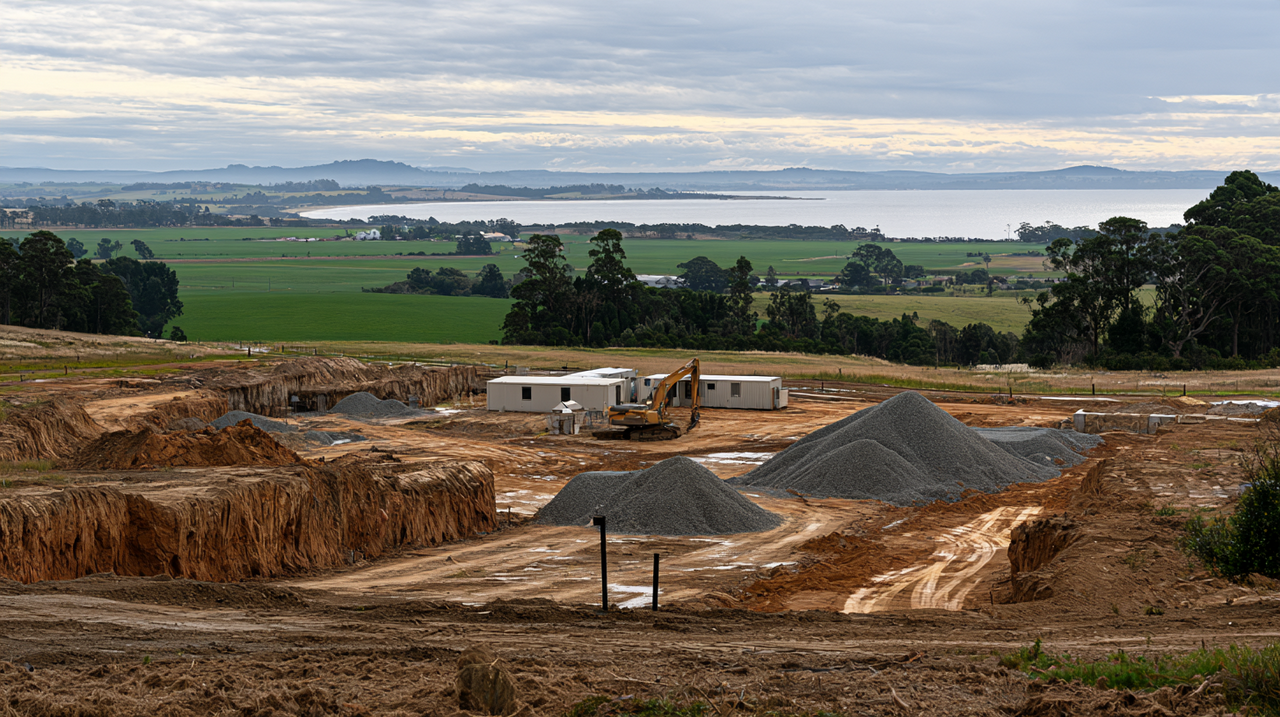
Wesley Vale is the smallest and the most revealing. Fifty-two megawatts on the site of the former Wesley Vale pulp mill, with a 2,689 square metre data hall and forty diesel generators. Its cooling plan, as lodged, is rainwater capture supplemented by water delivered by truck during dry periods. Firmus had intended to draw from Tasmanian Irrigation, but that arrangement turned out not to be legally available for data centre use. The company says cooling is only required above 26 degrees Celsius, that trucking should be needed only in extreme dry periods, and has elsewhere said its facilities use less water than one restaurant. In early September Latrobe Council deferred its decision and asked Planning Minister Kerry Vincent to declare the proposal a major project, so that the state would assess it. The State Planning Office has said it is considering the request.
The one-restaurant claim is exactly the kind of statement a public transparency register, of the sort the petition asks for, exists to test. Nobody in Tasmania can currently verify or falsify it, because no standardised, published, audited figure for the water consumption of these sites exists. Which brings us to the research.
Measuring The Heat Nobody Priced In
In March 2026 a group of researchers led by Andrea Marinoni at the University of Cambridge, working with colleagues at Nanyang Technological University, Grenoble, INRIA, the University of Genoa and City University of Hong Kong, posted a paper to arXiv with an unshowy title and a genuinely startling result. They called the phenomenon the data heat island effect.
The method is simple to explain and hard to dismiss. The team took a reconstructed NASA MODIS land surface temperature dataset covering the whole world from 2004 to 2024 at 500 metre resolution, aggregated it to monthly values, stripped out seasonality and outliers, and overlaid the locations of data centres drawn from a commercial database of more than eleven thousand sites. Crucially, they discarded everything inside dense urban areas, whose surface temperatures are contaminated by roads, manufacturing and domestic heating. That left 8,472 locations and, after cleaning, 6,733 usable data points. For each site they calculated the difference between monthly temperature and the preceding average, then aligned every site on a common timeline whose zero point was the month that facility began operations.
The result is a step function. Averaged across the sites, land surface temperature rises by 2.07 degrees Celsius after operations begin, with a minimum of 0.3 and a maximum of 9.1. The finding is robust to the baseline window, holding between 2.03 and 2.12 degrees whether the comparison period is twelve months or ten years. For context, the classic urban heat island effect, the accumulated thermal signature of an entire city, has been estimated at between four and six degrees. A single category of industrial facility is producing between a third and a half of that.
It does not stay on site. The researchers ran the same calculation in expanding rings and found the signal reaching up to ten kilometres out, with a full degree still measurable at 4.5 kilometres. Overlaying gridded population data, they estimate up to 343 million people worldwide live within ten kilometres of a facility producing some level of this effect, and they identify three regions where previously unexplained warming trends line up with data centre clustering: the Bajío region of Mexico, Aragón in Spain, and Ceará and Piauí in north-eastern Brazil.
Now put Anne-Marie Bastian and Nicholla Thompson on that map. They are the president and secretary of the newly formed Environmental Awareness Association, and they live at Rowella, about two kilometres from the Bell Bay site: well inside the radius at which the Cambridge-led study measures a full degree of sustained warming. None of this appeared in the planning assessment, because there is no head of consideration in Tasmanian planning law under which it could have.
Trucked Water And A Number Called WCI
The second paper, posted to arXiv in June 2026 by Basit Akinade, Amobichukwu Amanambu and Jonathan Frame with Shaolei Ren, does something structurally similar for water. Its central move is to reject the framing in which data centre water use is a national volumetric question. Nationally, the United States aggregate looks modest. The authors argue that aggregation is precisely what conceals the problem, because burden is local and varies enormously.
They formalise what they call the Water and AI Feedback Loop, in which cooling demand consumes water, water scarcity constrains where facilities can go, and AI tools are simultaneously sold as a way to improve water system efficiency. Then they introduce a single diagnostic number, the Water Consumption Impact index, defined as a facility's peak-day consumptive water use divided by the maximum deliverable capacity of the public water system hosting it. A value above one means that on its worst day, one facility's cooling demand would exceed everything the utility can physically deliver to everybody.
Applied to ten United States sites where utility and facility data can be assembled from environmental reports, permit filings and public records, the index spans nearly three orders of magnitude. Henderson, Nevada, served by the vast Southern Nevada system, registers 0.002. Lebanon, Indiana, registers 1.34, meaning peak-day consumptive demand already exceeds the host utility's entire 17.4 megalitre per day capacity. Expressed in household terms, Council Bluffs in Iowa carries the largest absolute footprint at around 9,220 household equivalents.
The elegant part is the decomposition. The index factorises into three components: demand scale relative to the host system, the consumptive ratio set by cooling technology, and a peaking factor reflecting how spiky demand is. Each maps to a different policy lever, and the binding constraint differs by site. At Lebanon and Council Bluffs the peaking factor dominates, so workload scheduling and thermal storage would move the number. At Mayes County and The Dalles it is sheer demand scale, fixed at the moment of siting. Dry cooling can eliminate consumptive use almost entirely, but at a power penalty of 25 to 35 per cent, which is the trade the Wesley Vale application is implicitly making by proposing rainwater and trucks. Projecting forward at a conservative thirteen per cent annual growth rate, the authors find Council Bluffs and Mayes County crossing the hundred per cent threshold by 2029.
There is a counterexample Tasmanian readers should sit with. The Potomac basin hosts the densest concentration of data centres on earth, roughly 5,400 megawatts across more than 290 facilities, and American Rivers named it the most endangered river in the United States in 2026 citing that build-out. Yet its community-scale index comes out at around 1.9 per cent, below the small-town sites, because the metropolitan utilities serving it are enormous. Burden is a ratio, not a volume.
Tasmania is a small system. The honest caveat is that nobody can currently compute this index for Bell Bay or Wesley Vale, because neither the denominator, the host utility's peak-day deliverable capacity, nor the numerator, the facility's peak consumptive demand, is published. That absence is not a gap in the research. It is the thing the petition asks to be fixed.
Why Concentration Is The Variable That Matters
The third paper, from Danbo Chen and colleagues including Yongyang Cai and Ani Katchova, takes the question up a level. It builds what the authors call an AI-energy coupling framework, combining large language model analysis of corporate disclosures, policy documents and media reporting with conventional energy-system modelling, to forecast data centre electricity demand from 2025 to 2030.
Its headline findings get quoted: more than ninety per cent of projected compute capacity concentrated in North America, Western Europe and the Asia-Pacific; the six leading firms' combined electricity consumption rising from roughly 118 terawatt hours in 2024 to between 239 and 295 by 2030. But the useful instrument is the Power Stress Index, projected data centre demand divided by total projected regional generation capacity, with thresholds at 0.10, 0.25 and 0.40. Ireland approaches 0.5, implying AI-related consumption could absorb nearly half of local generation. Oregon exceeds 0.25. Virginia, Nebraska and Washington sit between 0.20 and 0.30.
And then there is this: the paper lists Australia, along with Texas and Japan, among the diversified systems maintaining an index below 0.10, absorbing new load comfortably.
That number is correct at the national scale and misleading at the scale that matters. Australia's National Electricity Market is a continental system. Tasmania is a small, hydrologically constrained region connected to it by a single cable, which in 2024-25 it used to import nearly a fifth of what it consumed. Run the same index on Tasmania alone using the regulator's own figures, and 440 megawatts against 8,704 gigawatt hours of state generation produces a ratio north of 0.35, between the paper's moderate and high stress thresholds and in the same territory as Oregon. The framework does not fail here. It succeeds, in that its central argument, that concentration produces regional disparities invisible in national averages, applies recursively. Tasmania is the sub-national case hiding inside the national case that was hiding inside the global one.
The Machinery That Keeps The Decision Out Of Sight
None of the three research findings, on heat, on water, or on regional grid stress, is a legally relevant consideration in the assessment of a Tasmanian data centre application. This is not an oversight by any official. It is a structural feature of the instrument being used.
The Land Use Planning and Approvals Act 1993 is the framework under which George Town Council assessed a 288 megawatt AI facility. Bastian put it neatly when explaining why her association was preparing an appeal, saying that using a 33-year-old ruler to measure something as futuristic as a data centre was inappropriate. Mayor Greg Kieser, who voted for approval, was equally direct from the other side, saying the council could not see any grounds to do anything more than approve it in terms of the local planning scheme. Latrobe's mayor, Peter Freshney, considering Wesley Vale, observed that the legislation was written when data centres would not even have been considered feasible.
What a council can assess is land-use compatibility. What it cannot assess is the cumulative impact of three facilities on one grid, the state-level consequences for electricity supply and price, the water system effects beyond the immediate connection, or anything resembling social licence. The 349 submissions on Bell Bay were, in the great majority, about matters the decision-maker had no lawful power to weigh. That is not conspiracy; it is jurisdiction. And it works everywhere.
Opacity is reinforced upstream by the commercial layer. Internationally the instrument of choice is the non-disclosure agreement. Researchers at the University of Mary Washington in Virginia found that of thirty-one localities with an existing, approved or proposed data centre, twenty-five had NDAs making it difficult or impossible for residents to obtain information, and a review of more than thirty proposals across fourteen states found officials routinely signing NDAs and negotiating with what appeared to be shell companies. The agreements typically prohibit disclosure that any discussions are occurring at all, and treat the existence of the NDA as itself confidential. Developers offer a genuine defence: for a publicly traded company, a prospective campus is material non-public information, and an NDA protects local officials from inadvertently breaching insider trading rules. That explains why a confidentiality regime exists. It does not explain why it survives the deal.
There is no public evidence that Tasmania's Office of the Coordinator General uses NDAs in the American manner, and it would be wrong to assert otherwise. What is documented is similar in effect: an investment facilitation body in confidential discussions with proponents whose identities stayed confidential even after the House ordered the information produced.
What Communities Elsewhere Have And Have Not Won
The Tasmanian petitioners are late arrivals to a fight that has been running for the better part of a decade, and the international record is instructive precisely because it is mixed.
Ireland is furthest along and least encouraging. Data centres account for roughly half of electricity demand in the Dublin region, and the transmission operator effectively stopped offering new connections there, a position understood to extend to at least 2028. But when the Commission for Regulation of Utilities came to formalise policy, it explicitly declined to impose a moratorium, calling it neither appropriate nor proportionate, and instead adopted connection measures under which data centres must meet at least eighty per cent of annual demand with additional renewable generation built in Ireland, for applications lodged after 12 December 2025. A de facto freeze became a conditional yes.
The Netherlands went further and got more. A nine-month national moratorium on new hyperscale construction was imposed while planning rules were rewritten, and the rewritten rules took licensing away from local authorities and gave it to national government. Facilities above seventy megawatts of IT capacity or ten hectares are now banned across most of the country, with limited northern exceptions. Meta's 200 megawatt Zeewolde campus, which already had planning permission, died when the Senate refused to sell the state-owned land it needed, and the site has since been rezoned so it cannot be used for data centres at all.
Chile shows what litigation can achieve and what it cannot. Residents of Cerrillos in Santiago formed a group called MOSACAT after learning of Google's proposed 200 million dollar project in 2019, protested through to 2023, and in early 2024 an environmental court partially reversed the permit, requiring the application to be revised to account for climate change. The design as originally lodged would have drawn 7.6 million litres of potable water a day from a drought-stressed aquifer. Google paused and redesigned to air cooling. The community changed the machine. It did not stop the building.
Tucson is the sharpest lesson. In August 2025 the city council voted unanimously to reject Project Blue, a 290-acre development linked to Amazon that would have become the largest customer of both the local electricity and water utilities. It was an unambiguous democratic victory. The developer then obtained the zoning it needed from Pima County instead, announced an air-cooled design, and proceeded. The venue changed; the project did not.
And outside Memphis, where xAI's Colossus 2 data centre draws power from a gas turbine plant just across the state line in Southaven, Mississippi, the NAACP sued xAI and its subsidiary MZX Tech in April 2026 over twenty-seven gas turbines running without an air permit. In June the United States Department of Justice moved to intervene, seeking dismissal on national security grounds, with a Defense Department official arguing that Grok was one of only four frontier models able to support national security applications.
The Tools In The Box And What Each One Does
The instruments available to a community in the path of this build-out form a ladder, and every rung has a known failure mode.
Petitions generate a mandatory written response and nothing else. Their real function is evidentiary: they establish, in a form a parliament cannot ignore, that opposition is broad rather than the work of a handful of activists. Ten thousand signatures did not stop Bell Bay. They did make the claim that the community is relaxed about this much harder to sustain, and Kieser's remark that there was no formal polling but the overwhelming message received was supportive with caveats sits awkwardly beside them.
Planning objections are the most concrete tool and the most narrowly bounded. The 349 Bell Bay submissions produced thirteen pages of conditions, which is a real outcome. What they could not produce was refusal, because the grounds that would justify refusal are not grounds the scheme recognises.
Merits appeals sit one rung up and cost money. Bastian and Thompson faced an estimated twenty to fifty thousand dollars to challenge the approval at the Tasmanian Civil and Administrative Tribunal, within a fourteen-day window, and lodged anyway: Thompson and five neighbours, Bastian among them, brought one of five community appeals, citing light and noise pollution, quality of life, tourism and air quality. A tribunal reviews the decision against the same planning scheme that produced it, so unless the council erred in applying that scheme the appeal fails, however strong the underlying case about water or heat or grid capacity. Right to information requests hit the commercial-in-confidence exemption exactly where the interesting material lives. Judicial review polices process, not substance. Local elections can change a council but not its statutory powers, and in Tucson the county simply approved what the city had refused.
Which leaves the two instruments that actually bind: legislation, and a moratorium imposed by whoever holds the pen. The Netherlands demonstrates that both work, and demonstrates the precondition, which is a national government willing to strip the decision away from the local level and take the political cost of doing so.
What A Non-Binding Motion Changes
The Tasmanian Parliament has produced two things that are more than gestures. The first is the inquiry. The House of Assembly's Standing Committee on Government Administration A commenced an inquiry into AI data centres on 5 August 2026, and submissions closed on 21 September. Its terms of reference are broad in exactly the way the planning system is narrow: to recommend legislation or regulation needed to protect public resources and the environment, improve planning arrangements, increase parliamentary oversight and transparency, provide for community consultation, and ensure the state receives tangible benefits. Its recommendations will be non-binding. Federally, the Senate Environment and Communications References Committee is running a parallel inquiry referred on 13 May 2026, reporting on 16 November, and the Australian government has signalled national AI legislation in early 2027.
The second is the motion. On 20 May 2026 a Greens motion ordering the government to reveal its funding and resourcing commitments to Firmus, the advice it had received about the AI factory, and the details of water consumption arrangements, passed the House of Assembly unanimously. A later Greens motion required the government to table, by 8 September, details of every AI data proponent working with the Office of the Coordinator General, with their locations and estimated power and water needs. The government complied, in form. Its document disclosed six confidential proposals beyond Firmus's three: two at feasibility stage with a preferred site selected and four at concept stage, including one at each stage estimated at 200 to 300 megawatts and a 50 megawatt concept that had expressed interest in the closed Liberty Bell Bay manganese smelter site, together at least 500 megawatts. It named none of the proponents. Omitted information, the document explained, was either not yet available, not sufficiently settled, not capable of reliable estimation, or had been provided to the office in confidence. Firmus said it was behind none of the six.
What did the May motion change? Less than its unanimity suggests. It passed in May. In June, Firmus lodged for Wesley Vale. In August, Bell Bay was approved. In September, the government answered the second motion with a document that counted the other proponents and withheld their names. An order of the House to produce documents is not self-executing, and compliance can be complete in form and empty in substance. It is a political question, and a government that judges the cost of non-compliance lower than the cost of disclosure will simply absorb it.
The government's own answer has arrived in the same register. Felix Ellis, the minister responsible for the digital economy, had told Parliament in August that the government would not consider a moratorium. What it offers instead is a draft Statement of Expectations for Data Centres and AI Infrastructure, issued by Ellis and Energy Minister Nick Duigan, covering community engagement, responsible water use, support for the energy system and renewable generation, network cost sharing, energy security and compliance with existing approvals. It is non-statutory, and public feedback closes on 12 October. Set beside the petition's five asks, it answers each with an expectation rather than a rule. Badger called it an absolute joke.
This is the uncomfortable finding. Two parliamentary orders for transparency, a ten-thousand-signature petition, a standing committee inquiry, a federal inquiry and three studies quantifying heat, water and grid impacts have collectively not altered the sequence in which anything is happening. The construction schedule is the only clock keeping time.
Ten Thousand Signatures Against A Construction Schedule
What the Tasmanian case exposes is a mismatch between the speed of the tools and the speed of the build. A parliamentary inquiry takes months to report and its recommendations are advisory. National legislation is flagged for 2027. Marinus Link's first stage arrives around 2030. Hydro Tasmania's new wind and solar offtake begins in five to six years. Every governance response is measured in years. The facilities are measured in months: Firmus described Project Southgate's first 2.1 billion dollar tranche as a twelve-month build.
At Wesley Vale the build did not wait for the paperwork. Less than three weeks after Latrobe Council asked the state to take over the assessment, the ABC reported excavation beyond the scope of the approved forest practices plan, transportable buildings, and piles of dirt and blue metal on a site with no planning permit. Firmus said the activities did not require planning approval and would take about four weeks. Freshney, pointing to a written commitment from the company, said undertaking work without permits was not consistent with it. Firmus agreed to stop while the council assesses.
That asymmetry is not accidental and not unique to Tasmania. It is the operating logic of the global build-out, visible in Ireland's connection queue, in Zeewolde, in Cerrillos, in Tucson's county rezoning, in the unpermitted turbines at Southaven. Infrastructure gets built inside the window during which the rules governing it are still being drafted, and once built, the rules are written around it rather than applied to it. The warning that AI infrastructure has stopped being a marginal digital service and become a structural component of power system dynamics is a statement about planning horizons as much as about electricity.
There is a version of this story in which the petitioners are wrong about the substance. Firmus may be right that liquid cooling makes its facilities dramatically more efficient, that rainwater capture is adequate at Wesley Vale, that renewable credits and financed generation will more than cover the load. The 115 permanent positions at Bell Bay and the 380 construction jobs are real jobs in a region that lost the pulp mill those sites once hosted. Nothing in the three studies proves that any specific Tasmanian facility will produce a two-degree heat island or breach a water utility's peak capacity, and it would be dishonest to claim otherwise.
But that is the petition's point, and it is procedural rather than technical. Every one of those propositions is testable. None has been tested by anyone independent of the proponent, because the register that would allow testing does not exist, the legislation that would require it has not been written, and the oversight mechanism the petitioners asked for over anything above fifty megawatts is not on any government's timetable. The community is being asked to accept, on the word of a company and a facilitation office it cannot see inside, claims that a published number would settle in an afternoon.
Ten thousand and thirty-five people worked out that this was the actual question and put their names to it. The formal reward is a government response within fifteen sitting days, whose headline a minister had already delivered on the floor. The informal reward is that the argument has moved, permanently, from whether Tasmanians care to what the government is prepared to disclose. That is smaller than the petitioners wanted and larger than the mechanism was designed to deliver. Whether it arrives before the concrete does is a different question, and on current evidence the concrete is winning. At Wesley Vale, the blue metal arrived before the permit.
References
- Parliament of Tasmania. “AI Data Facilities in Tasmania, e-petition 147-26.” Posted 22 June 2026, closed 31 August 2026. https://haepetitions.parliament.tas.gov.au/haepet/Home/PetitionDetails/147
- Tasmanian Greens MPs. “Greens Table Massive AI Data Centre Moratorium Petition.” 2 September 2026. https://tasgreensmps.org/media-releases/greens-table-massive-ai-data-centre-moratorium-petition/
- Tasmanian Greens MPs. “Greens' Motion for AI Answers Passes Parliament.” 20 May 2026. https://tasgreensmps.org/media-releases/greens-motion-for-ai-answers-passes-parliament/
- Parliament of Tasmania. “E-Petitions, House of Assembly.” https://www.parliament.tas.gov.au/petitions/hoa/e-petitions
- Parliament of Tasmania, Standing Committee on Government Administration A. “Inquiry into AI Data Centres in Tasmania.” 2026. https://parliament.tas.gov.au/committees/house-of-assembly/standing-committees/government-administration-committee-a/inquiries/inquiry-into-ai-data-centres-in-tasmania
- ABC News. “Firmus 288-megawatt AI data centre at Bell Bay, Tasmania gets approval after 6-1 council vote.” 25 August 2026. https://www.abc.net.au/news/2026-08-25/firmus-ai-bell-bay-receives-george-town-council-approval/107074336
- ABC News. “Northern Tasmanians prepare to fight George Town Council AI data centre approval.” 30 August 2026. https://www.abc.net.au/news/2026-08-30/ai-data-centre-tasmania-firmus-technology-george-town/107089468
- ABC News. “Firmus plans to truck water in and use rainwater to cool proposed Wesley Vale AI data centre.” 27 August 2026. https://www.abc.net.au/news/2026-08-27/firmus-truck-water-rainwater-cool-wesley-vale-ai-data-centre/107083230
- ABC News. “Firmus wants to build three AI data centres in Tasmania, but can the state handle them?” 3 July 2026. https://www.abc.net.au/news/2026-07-03/firmus-ai-data-centres-is-tasmania-ready/106869862
- ABC News. “Six new AI data centres proposed for Tasmania, but companies behind them are being kept secret.” 9 September 2026. https://www.abc.net.au/news/2026-09-09/six-new-confidential-data-centre-proposals-tasmania-revealed/107131974
- ABC News. “AI data centre company Firmus lodges TASCAT appeal against restrictions on generator use.” 15 September 2026. https://www.abc.net.au/news/2026-09-15/firmus-technologies-lodge-tascat-appeal-for-generator-use/107144572
- ABC News. “AI data centre company Firmus starts development work at Wesley Vale without permit.” 26 September 2026. https://www.abc.net.au/news/2026-09-26/firmus-starts-development-work-without-permit-wesley-vale/107198264
- Pulse Tasmania. “Greens call Tasmania's new data centre expectations 'an absolute joke'.” 7 September 2026. https://pulsetasmania.com.au/news/greens-call-tasmanias-new-data-centre-expectations-an-absolute-joke/
- Firmus. “Tasmanian world-first AI Factory Zone clears path for Firmus' Project Southgate.” June 2025. https://firmus.co/newsroom/tasmanian-world-first-ai-factory-zone-clears-path-for-firmus-project-southgate
- Tasmanian Economic Regulator. “Energy in Tasmania Report 2024-25.” February 2026. https://www.economicregulator.tas.gov.au/Documents/26%201689%20CORRECTED%20Energy%20in%20Tasmania%20Report%202024-25.PDF
- Hydro Tasmania. “Marinus Link is key to unlocking Battery of the Nation.” https://www.hydro.com.au/articles/media-releases/marinus-link-key-unlocking-battery-nation
- Andrea Marinoni, Erik Cambria, Weisi Lin, Mauro Dalla Mura, Jocelyn Chanussot, Edoardo Ragusa, Chi Yan Tso, Yihao Zhu and Benjamin Horton. “The data heat island effect: quantifying the impact of AI data centers in a warming world.” arXiv:2603.20897, 21 March 2026, revised 21 April 2026. https://arxiv.org/abs/2603.20897
- Basit A. Akinade, Amobichukwu C. Amanambu, Jonathan M. Frame and Shaolei Ren. “AI Data Centers and the Water Use Feedback Loop.” arXiv:2606.21760, 19 June 2026. https://arxiv.org/abs/2606.21760
- Danbo Chen, Zijun Zhou, Yongyang Cai, Jiahong Qin, Ani Katchova and Lei Chen. “Concentrated siting of AI data centers drives regional power-system stress under rising global compute demand.” arXiv:2604.06198, 13 March 2026. https://arxiv.org/abs/2604.06198
- Commission for Regulation of Utilities, Ireland. “Large Energy User Connection Policy, decision paper.” December 2025. https://www.cru.ie/about-us/news/the-cru-publishes-its-decision-on-new-electricity-connection-policy-for-data-centres/
- Data Center Dynamics. “The ongoing impact of Amsterdam's data center moratorium.” https://www.datacenterdynamics.com/en/analysis/the-ongoing-impact-of-amsterdams-data-center-moratorium/
- Data Center Dynamics. “Chile partially reverses Google data center permit over water use concerns.” 28 February 2024. https://www.datacenterdynamics.com/en/news/chile-partially-reverses-google-data-center-permit-over-water-use-concerns/
- NPR. “NDAs are hiding data center deals, drawing ire from locals and attention from lawmakers.” 27 August 2026. https://www.npr.org/2026/08/27/nx-s1-5879528/data-center-nda-disclosure-louisiana
- AZ Luminaria. “Tucson City Council rejects Project Blue data center amid intense community pressure.” 6 August 2025. https://azluminaria.org/2025/08/06/tucson-city-council-rejects-project-blue-amid-intense-community-pressure/
- Utility Dive. “DOJ intervenes on behalf of xAI in data center gas turbine lawsuit.” 18 June 2026. https://www.utilitydive.com/news/doj-intervenes-xai-data-center-gas-turbine-lawsuit/823267/

Tim Green UK-based Systems Theorist & Independent Technology Writer
Tim explores the intersections of artificial intelligence, decentralised cognition, and posthuman ethics. His work, published at smarterarticles.co.uk, challenges dominant narratives of technological progress while proposing interdisciplinary frameworks for collective intelligence and digital stewardship.
His writing has been featured on Ground News and shared by independent researchers across both academic and technological communities.
ORCID: 0009-0002-0156-9795 Email: tim@smarterarticles.co.uk
Listen to the free weekly SmarterArticles Podcast