The AI Was the Conservative Part: Unmixing the Last Beatles Record
Since 2 August 2026, Article 50 of the EU AI Act has been enforceable. Providers of generative systems must mark their outputs in a machine-readable format so that synthetic audio, video and text can be detected as artificially generated. Deployers of deepfakes, defined in the Act as AI-generated or manipulated content resembling real persons, objects or events and appearing authentic, must disclose what they have done. Penalties reach 15 million euros or three per cent of global annual turnover. The marking duty itself is arriving in stages: under the AI Omnibus provisional agreement reached on 7 May 2026, providers whose generative systems were already on the market before 2 August have until 2 December 2026 to embed the machine-readable markings and supply a detection mechanism. Everything else in Article 50 applies now.
Buried in Article 50(2) is a carve-out that will decide more cases than the headline rule. The marking obligation does not apply, the text says, “where the AI systems perform an assistive function for standard editing or do not substantially alter the input data.”
Read that again with an audio engineer's ear. European law now turns, in a large and commercially significant class of cases, on whether a machine-learning system substantially altered the material it was given. That is a question about the internals of a process, asked of an artefact that carries no record of its own manufacture. It is the question the music industry has spent four years answering with a shrug and a press release.
The most celebrated answer arrived on 2 November 2023, in the form of a four-minute single credited to a band that had not recorded together since 1970.
What Was Actually On The Cassette
In January 1994, around the time Paul McCartney inducted John Lennon into the Rock and Roll Hall of Fame, Yoko Ono handed McCartney a set of home cassettes. One of them, according to the surviving Beatles' own account, had “for Paul” scrawled on it in Lennon's handwriting. The tapes contained four demos recorded in Lennon's New York apartment in the late 1970s: “Free as a Bird”, “Real Love”, “Grow Old With Me” and “Now and Then”.
Two became records. Working with Jeff Lynne during the Anthology sessions of 1994 and 1995, McCartney, George Harrison and Ringo Starr built new arrangements around the Lennon vocals on “Free as a Bird” and “Real Love”, the latter requiring substantial preparation in Lynne's studio before overdubs could be added at all. “Now and Then” was attempted and abandoned. There was an electrical buzz on the tape, and, more fundamentally, Lennon had sung while playing piano into a single microphone, welding voice and piano into one mono signal. Every attempt to raise the vocal raised the piano with it. McCartney has put it plainly: they could not lift John's voice without lifting the piano, and the piano clouded the picture.
The tool that eventually solved it was not built for the Beatles at all. It was built for a documentary. During production of The Beatles: Get Back, released in 2021, Peter Jackson's WingNut Films Productions needed to make the 1969 fly-on-the-wall tapes intelligible, much of it mono material with dialogue, instruments and room noise hopelessly entangled. Emile de la Rey, a Wellington-based composer and sound editor who joined WingNut as a machine learning engineer, led development of a de-mixing system the team named MAL, a nod to “machine assisted learning”, to Mal Evans, the Beatles' road manager, and to HAL in 2001: A Space Odyssey. De la Rey worked with the machine learning researcher Paris Smaragdis at the University of Illinois Urbana-Champaign, building the thing from the academic source-separation literature upwards and generating their own training data as they went. The Get Back sound team won an Emmy and an MPSE Golden Reel in 2022.
MAL was then pointed at the catalogue. Giles Martin used it in 2022 to produce a genuine stereo mix of Revolver from four-track masters on which guitar, bass and drums shared a single track, a job that had been considered impossible for fifty-six years. It was used again on the 2023 reissues of the Red and Blue compilations. And it was used on the Lennon demo, extracting a usable vocal from the piano that had defeated Jeff Lynne.
“Now and Then” went to number one in the UK on 10 November 2023, the band's eighteenth British chart-topper and their first since “The Ballad of John and Yoko” in 1969. The Official Charts Company noted that the gap of fifty-four years between number ones broke Kate Bush's record, and that sixty years and six months had elapsed since “From Me To You” first took the band to the top. At the 67th Grammy Awards on 2 February 2025 the record won Best Rock Performance, with Sean Ono Lennon accepting; it lost Record of the Year to Kendrick Lamar's “Not Like Us”. Billboard described it as the first AI-assisted recording to receive a Grammy nomination.
McCartney's framing throughout was consistent and emphatic. Nothing, he said, had been artificially or synthetically created. It was all real, and they all played on it.
That sentence is the restoration alibi in its purest form, and it is worth taking seriously before taking it apart.
A Mask Is Not A Microphone
Source separation became a consumer technology in November 2019, when Deezer's research group released Spleeter under an MIT licence, a TensorFlow library shipping pre-trained models for two, four and five stems. Spleeter works in the frequency domain. It converts audio to a spectrogram, treats separation as something close to an image segmentation problem, and estimates a mask: a set of coefficients deciding, for every time-frequency cell, what proportion of the energy in that cell belongs to the vocal, the bass, the drums, the rest. It then reapplies the phase of the original mixture, because it never estimated phase in the first place. The characteristic failures follow directly from that architecture: metallic ringing, watery smearing, and faint ghosts of one instrument haunting another's stem.
Meta's Demucs took a different route, operating on the raw waveform and later hybridising waveform and spectrogram paths. The 2022 Hybrid Transformer Demucs paper reports a signal-to-distortion ratio of 9.20 dB on the MUSDB benchmark, a substantial margin over spectrogram-only approaches. The competitive frontier moved again at the Sound Demixing Challenge 2023, where a band-split transformer architecture, BS-RoFormer, took first place in the music separation track after training on MUSDB18-HQ plus five hundred additional songs. Commercial services proliferated: AudioShake, which says it won Sony's demixing challenge and whose stems have been used on archival projects involving the Jackson 5, Nina Simone and Whitney Houston; MVSep; and the machine-learning rebalancing module in iZotope RX, now standard equipment in post-production.
Here is the load-bearing point. A mask is a filter. It redistributes energy already present in the mixture; it cannot manufacture information the microphone did not capture. Where two sources occupy genuinely distinct regions of the time-frequency plane, masking approaches truth. Where they overlap exactly, which happens constantly with a voice and a piano playing the same notes in the same room through the same microphone, the mask apportions a shared quantity according to a learned prior about what voices and pianos usually do. It is guessing a ratio. Sometimes it guesses well. The residue of bad guesses is the artefact vocabulary every engineer recognises: bleed, musical noise, pre-echo, transient smear.
This is subtractive work, and it is bounded by the recording. Whatever else you say about it, a masked stem is a rearrangement of evidence.
The second family of techniques is not bounded that way. Diffusion-based refinement, of the sort explored in a body of research published through 2024 and 2025, takes a separated stem and resynthesises it, using a generative model trained on how the target source sounds in general. The stated aim of the better papers is fidelity: consistency constraints are added specifically to keep the refined output anchored to the observed mixture rather than drifting into invention. But the mechanism is categorically different. The model is not filtering the recording. It is producing audio conditioned on the recording. When the evidence thins, as it does in a cassette's collapsing high frequencies or a passage buried under tape hiss, the model supplies what is statistically plausible. Bandwidth extension does the same thing more openly, hallucinating high-frequency detail a domestic cassette deck never captured, because the model has heard ten thousand voices that had it.
The distinction between the two regimes is real, sharp and technically meaningful. It is also invisible in the output. Both processes hand you a file called vocals.wav. Nothing in the waveform announces whether a given millisecond was recovered or inferred. There is no provenance metadata by default, no chain of custody, no equivalent of the raking-light photograph a paintings conservator takes before touching anything.
So when McCartney says nothing was synthetically created, he is making a claim about a process that cannot be audited from the record. He may well be right; everything published about MAL is consistent with masking rather than generation. But the listener is being asked to take a technical assurance on trust, which is a strange basis for settling a question of authenticity.
As it turns out, the assurance is also aimed at the wrong part of the record.
The Beatles Told On Themselves
Giles Martin, who produced “Now and Then” with McCartney, has been refreshingly specific about how the finished track was built, and what he describes is not restoration by any definition a conservator would accept.
The backing vocals are the giveaway. Rather than record new harmonies or generate them, Martin lifted them from elsewhere in the catalogue. “I'm literally taking the multitrack tapes of Eleanor Rigby, some stuff from Because and Here, There, and Everywhere,” he told MusicTech in November 2023. Asked whether AI had been involved in that process, he was blunt: “No, it's not artificial or intelligent.” And on why: “It might have been easier if I used AI, but I didn't.” His justification for the result is a small masterpiece of category confusion. “They feel like they're from the Beatles, and they are from the Beatles.”
They are indeed from the Beatles. They are from three different Beatles songs, recorded between 1966 and 1969, none of which is “Now and Then”. Martin used the same technique he had deployed on Love, the 2006 mash-up album made with his father George for Cirque du Soleil, which nobody has ever mistaken for restoration. Add a string arrangement written in the 2020s by McCartney, Martin and Ben Foster, guitar parts Harrison recorded in 1995 for a song that was then shelved, and a slide guitar solo McCartney played in deliberate imitation of his dead friend's style.
Set out plainly, the 2023 record contains: a vocal captured on a domestic cassette in New York in the late 1970s and separated from its accompaniment by machine learning; drums and bass recorded roughly forty-five years later; rhythm guitar from an abandoned 1995 session; vocal harmonies excised from the multitracks of three unrelated 1960s recordings; an orchestral arrangement composed half a century after the demo; and a pastiche solo in the manner of a musician who died in 2001.
That is not a restored artefact. It is a new composition assembled from authenticated fragments, which is a perfectly respectable thing to be and arguably a beautiful one. But notice the inversion at its heart. The AI operation was the most conservative act on the record: it recovered a signal that genuinely existed on the tape. Every piece of real conjecture was performed by human beings with tape and faders. The moral geometry the public applies here, in which AI equals fakery and human hands equal authenticity, is exactly orthogonal to what happened.
McCartney's defence, that nothing was synthetically created, is true and irrelevant. Nothing was synthesised. Almost everything was composed.
Art Conservation Settled This Argument Sixty Years Ago
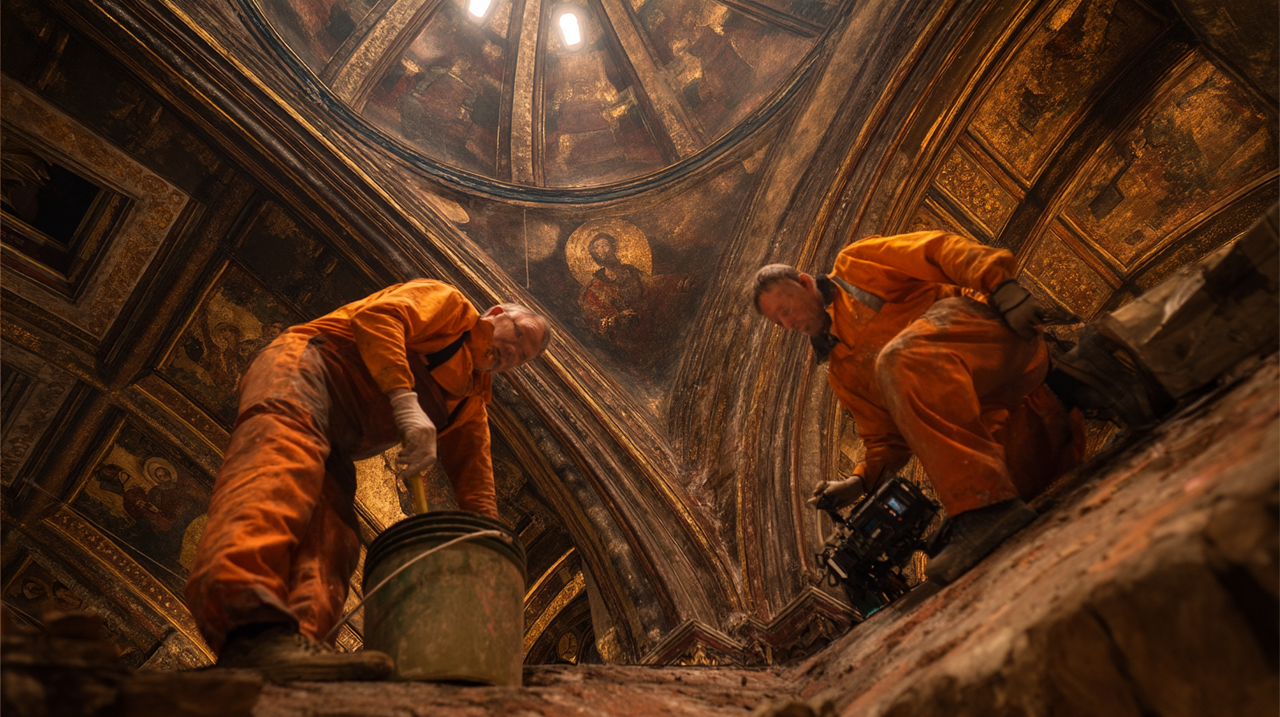
Recorded sound has no ethics of intervention. Painting, sculpture and architecture have had one since 1964.
The International Charter for the Conservation and Restoration of Monuments and Sites, drafted in Venice in May 1964 and adopted by ICOMOS the following year, does not attempt to define restoration as ontologically distinct from creation. It concedes the blur immediately and responds procedurally. Article 9 states that restoration “must stop at the point where conjecture begins, and in this case moreover any extra work which is indispensable must be distinct from the architectural composition and must bear a contemporary stamp.” Article 12 requires that replacements of missing parts “must be distinguishable from the original so that restoration does not falsify the artistic or historic evidence.” Article 16 requires precise documentation of every stage, deposited “in the archives of a public institution and made available to research workers”, with publication recommended.
Three obligations, then: stop where you start guessing; if you must guess, make the guess legible as a guess; and write down everything you did, in public. The charter's companion principle, developed through subsequent conservation practice, is reversibility, or as the field now more honestly puts it, retreatability. You should be able to get back to where you started, and where you cannot, you should say so.
The Sistine Chapel shows why documentation matters more than doctrine. The Vatican's cleaning of Michelangelo's frescoes, funded by Nippon Television Network Corporation and running from 1980 to 1994, produced colours so unexpectedly brilliant that they revised art-historical understanding of the artist. James Beck, professor of art history at Columbia University and founder of ArtWatch International, argued the restorers had removed more than soot: that Michelangelo had modified the dried fresco with a secco shadows in a glue medium, and that these finishing touches, indistinguishable by eye from glue-trapped grime, had been stripped away. The Vatican's team disputed it. The argument cannot be settled by looking at the ceiling, because if Beck was right the evidence went into the sponge. Only the documentation can adjudicate, and its adequacy is itself contested.
At the other end of the scale sits the Sanctuary of Mercy at Borja, in Aragón. In 2012 an elderly parishioner, Cecilia Giménez, attempted to touch up a modest 1930s Ecce Homo by Elías García Martínez and produced something so far from the original it became a global meme. It also transformed the town: reported visitor numbers rose from around 6,000 a year to roughly 57,000 by 2016, with accounts of the peak varying wildly above that, and revenue from three-euro tickets and donations funds the church, its guides and the local elderly home. The surge did not hold. Recent reporting puts annual visits back at somewhere between sixteen and twenty thousand. The intervention destroyed the evidentiary value of the object and created enormous new cultural value in the same brushstroke, and of the two only the loss turned out to be permanent. Restoration and creation are not opposites. They are the same act described by people with different interests.
Audio has no equivalent framework. The Audio Engineering Society publishes standards on archival formats, migration and metadata, all excellent and all concerned with carriers rather than interventions. No clause anywhere in the discipline says a de-mixed stem must be distinguishable from a natively isolated one, or that the untouched source must be deposited where a researcher can hear it. The industry's operative doctrine is a producer's word in a press interview.
The Law Pays You For Guessing
If you wanted to design a legal regime that penalised faithful restoration and rewarded invention, you would design the one the United States currently has.
On 20 August 2018 the Ninth Circuit decided ABS Entertainment, Inc. v. CBS Corporation, reversing summary judgment and holding that digitally remastered versions of pre-1972 analogue recordings were not automatically new copyrightable derivative works. To earn a fresh copyright, the court reasoned, a derivative work must be original to its author and non-trivial. Engineering judgment applied in service of an accurate reproduction of an existing performance does not clear the bar. Careful, faithful, expensive restoration produces, in law, nothing you can own.
Then, on 29 January 2025, the US Copyright Office published Part 2 of its report on copyright and artificial intelligence. Its conclusions were narrow and sensible: existing law suffices; prompts alone do not confer authorship, because they do not give sufficient control over the expressive result; but human authors retain copyright in their perceptible contributions within AI-generated outputs, in creative selection, coordination and arrangement, and in creative modifications of outputs.
Put the two together and the incentive is unmistakable. A perfect de-mix of a Lennon cassette is legally inert. A de-mix plus a new string arrangement plus harmonies spliced from three other records plus a pastiche solo is a protectable work with fresh copyright and a fresh royalty stream. Copyright pays for conjecture and refuses to pay for care. That is the precise inverse of the Venice Charter's professional hierarchy, in which the least intervention is the highest standard.
The publicity-rights regime, meanwhile, has been growing at speed, and it asks an entirely different question. Tennessee's ELVIS Act, signed on 21 March 2024 and effective from 1 July 2024, made voice a protected property right, expressly including simulations as well as the actual thing, backed by civil action and Class A misdemeanour liability, and extended to anyone making available a tool whose primary purpose is producing unauthorised voice replicas. California followed with a pair signed together on 17 September 2024 and in force together from 1 January 2025: AB 2602, which voids contract terms permitting digital replicas unless the performer received a reasonably specific description of the intended uses and was represented by counsel or a union; and AB 1836, which creates a cause of action for exploiting a deceased personality's digital replica without estate consent, with a 10,000 dollar statutory minimum and exceptions for news, comment, criticism, scholarship, satire and parody.
Post-mortem protection remains a patchwork. New York's Civil Rights Law section 50-f, in force since 29 May 2021, runs forty years after death, covers only those domiciled in the state at death, reaches digital replicas mainly where they are deceptive and lack a conspicuous disclaimer, and confers no cause of action at all until the estate has registered the claim with the New York Secretary of State. Indiana and Oklahoma run to a hundred years. Some states offer nothing.
Federal law may finally arrive. The NO FAKES Act of 2026, S.4591, was advanced by the Senate Judiciary Committee on 18 June 2026 by unanimous voice vote and awaits floor time. It would create a federal, licensable property right in voice and visual likeness, unassignable during life but surviving death for an initial ten years, renewable in five-year increments up to seventy years provided the rights holder can demonstrate active and authorised public use. It layers on a DMCA-style notice and counter-notice procedure, a 25,000 dollar penalty for knowing misrepresentation, and exclusions for nonprofit libraries, archives and accredited educational institutions. It would pre-empt future state digital replica laws while leaving causes of action existing as of 2 January 2025, including the ELVIS Act, intact.
The United Kingdom has taken the slowest road, and still has no general personality right; claimants rely on passing off and data protection. The government's Report on Copyright and Artificial Intelligence, published on 18 March 2026 under section 136 of the Data (Use and Access) Act 2025, abandoned the previously favoured broad commercial text and data mining exception with rights-holder opt-out after fierce creative-sector opposition. The narrow non-commercial research exception stands, and the stated preference is now licensing-first, supported by statutory transparency duties. Sony Music's submission to that consultation disclosed that it had issued more than 75,000 takedown requests against AI deepfakes of its artists, a figure Music Business Worldwide later reported had passed 135,000.
Notice what none of this legislation asks. Not one provision anywhere in this stack asks whether a work is a restoration or a creation. Every provision asks whether an identity was used with permission. The law has quietly concluded that the interesting question is consent rather than ontology.
The law is right. But consent does not make a record true, and that gap is where the damage will happen.
The Studio Was Always A Fiction Machine
The strongest objection to everything above is that the restoration and creation distinction was never stable, that recorded music has been synthetic since roughly the invention of magnetic tape, and that the current anxiety is nostalgia wearing a lab coat. This objection deserves to be taken seriously, because it is largely correct.
Glenn Gould made the argument in 1966, in an essay for High Fidelity called “The Prospects of Recording”. He described recording the A minor fugue from Book I of Bach's Well-Tempered Clavier a decade earlier, producing two technically acceptable complete takes, numbers six and eight, and then discovering that both shared a defect he had not noticed in the studio: both were monotonous. The released performance is a splice of the two. Gould knew perfectly well that purists called such editing dishonest and dehumanising, and he answered with a line that has not been improved on since. One cannot ever splice style, he wrote; one can only splice segments which relate to a conviction about style.
Teo Macero industrialised the idea. In a Silent Way was recorded in a single session on 18 February 1969 and then constructed in the edit; Macero described reducing dozens of reels of quarter-inch master to about eight and a half minutes a side. On Bitches Brew, by one detailed account of the session tapes, “Pharaoh's Dance” contains seventeen edits, its stop-start opening theme assembled in post-production from looped fragments of fifteen and thirty-one seconds. Miles Davis played the notes. Macero wrote the record. Dub producers made the mixing desk an instrument; hip-hop made other people's records the raw material; comping and pitch correction finished the job. The idea that a commercial recording documents an event that occurred died some time around 1950 and has been receiving flowers ever since.
So yes: the distinction is unstable, and always was. But the conclusion is not that it is meaningless. It is that it was never a claim about the ontology of the object. It was a claim about a process, and process claims are verifiable only if documented.
What genuinely changed is not metaphysics. It is cost and asymmetry. Macero needed Miles Davis in a room. Giles Martin needed a cassette. Separation has collapsed the marginal cost of extracting a usable performance from any recording ever made, which means the constraint that used to enforce collaboration, namely that you had to book the artist, has gone. And the artist, in almost every case that matters, is dead.
Consent Has A Sell-By Date And Everybody Knows It
Prince told Guitar World in 1998 that performing alongside a hologram of a dead musician would be, in his phrase, the most demonic thing imaginable. Twenty years later, when reports circulated that Justin Timberlake would summon him at the Super Bowl LII halftime show in Minneapolis, Sheila E. stated publicly that Prince had told her he did not want a hologram of himself used, and that Timberlake had agreed not to use one. The estate's account replied with a flat “No”. That is about as close to documented refusal as the record industry gets, and it held.
Contrast the Zappa Family Trust, which in 2019 authorised “The Bizarre World of Frank Zappa”, a hologram tour built by Eyellusion around vault recordings from 1974 and staged with surviving members of the Mothers of Invention. Ahmet Zappa, co-trustee, presented it as a world premiere of his father's compositions. Same technology class, same posthumous subject, opposite decisions, both legitimate. The variable is not the tool. It is who inherited the answer.
The cleanest case in this field is also the most generative, which ought to end the argument about whether generativity is what matters. Randy Travis lost the ability to speak and sing after a stroke in 2013 left him with aphasia. In late 2023 his longtime producer Kyle Lehning pulled isolated vocal stems from recordings Travis had made between 1985 and 2013 and sent them to a London-based technology firm, which built two bespoke models, one trained on twelve stems and one on forty-two. The scaffolding underneath was not newly recorded. The country singer James Dupré had cut the song with Lehning around 2011, and that existing take became the base over which the model rendered Travis's voice, credited by Warner Music Nashville as a “vocal bed”, reportedly the first outing for the term. Dupré learned what had been done with his old vocal when he heard the finished record. “I really just thought he recorded it years ago and I never knew about it,” he told Rolling Stone. “Where That Came From” was released on 3 May 2024; a second single, “Horses in Heaven”, followed. Lehning has said the models took about five minutes to analyse the demo vocal once it went in, after which he and the engineer Casey Wood spent the real labour by hand, adjusting vibrato speed and the timing of phrases until the delivery sat where Travis would have put it.
Every note of that vocal is synthetic. Nothing was recovered from anything. By the ontological test it is pure fabrication, and by any reasonable ethical test it is unimpeachable, because Travis is alive, understood what was proposed, and wanted it. The one person who does not appear to have been asked in advance is the living singer underneath. Meanwhile “Heart on My Sleeve”, the Ghostwriter track imitating Drake and The Weeknd that went viral in April 2023, was pulled after Universal takedown notices, submitted for Grammy consideration, declared eligible by Recording Academy chief executive Harvey Mason Jr, and then declared ineligible on the ground that it was no longer commercially available. Nothing about the artefact changed between those two announcements. Its distribution status did.
Consent, permission, availability. The industry's own behaviour has already conceded that the ontological question is not the operative one.
Your Stems Are Already In The Cloud
The forward-looking half of the question answers itself once you look at how contemporary sessions are actually stored.
Nobody will need to de-mix a 2026 recording. It arrives pre-separated. Vocal comps live in their own folders; multitracks are delivered as stems for sync and immersive mixes; Atmos deliverables ship object by object. The archive of the future is not a degraded cassette with a piano welded to a voice. It is a project file in which the voice was never mixed in the first place. The technical alibi that carried “Now and Then”, the claim that only what genuinely existed was recovered, will be trivially satisfiable for every artist working now. When everything is recoverable, recoverability stops distinguishing anything.
The market has already moved to the only question that remains. In November 2025 ElevenLabs launched its Iconic Marketplace, a licensing platform for recognisable voices, announced alongside partnerships with Michael Caine and Matthew McConaughey and populated with more than twenty-five further voices including those of John Wayne, Judy Garland, Laurence Olivier, Liza Minnelli and Maya Angelou. On 27 May 2026 the company added Stan Lee, licensed through Stan Lee Universe, the joint venture between Genius Brands and POW! Entertainment, for use across its creative tools and a narrated book club opening with Treasure Island. It is buying estates methodically.
The record business has followed the same logic. Warner, Universal and Sony have each negotiated licences with the AI music company Klay Vision; ElevenLabs signed training licences with Merlin, representing tens of thousands of independent labels, and with Kobalt on opt-in terms with royalties attached. The majors' 2024 infringement suits against Suno and Udio have resolved only in part, and only where a price could be agreed. Universal settled with Udio in October 2025, on terms that turned the service into a walled garden from which AI-generated music cannot be exported; Warner settled with Suno in November 2025, committing to a licensed model with artist opt-in over voice and likeness. Universal and Sony are still suing Suno. Settlement talks hit an impasse in April 2026, and in May the two labels moved to expand the case from 560 recordings to 61,026 after discovery indicated Suno had trained on millions of their tracks. Consent is being priced rather than conceded, and where the price fails the litigation simply resumes. Live experience is licensed the same way. Elvis Evolution, produced by Layered Reality under an agreement with Authentic Brands Group, which owns the Presley estate, opened at Immerse LDN at ExCeL in London on 18 July 2025 after a delay, and was received poorly.
Estate consent has become the sufficient condition, for the simple reason that it is the only condition that is transactable. An heir can sign. Authenticity cannot.
What A Charter For Recorded Sound Would Have To Say
The distinction between restoration and creation is meaningless as metaphysics and indispensable as procedure. Those two claims are not in tension; the second follows from the first. Because you cannot determine from the artefact what was done to it, the only version of the distinction that can survive is a documented, auditable account of the operations performed. If the industry will not produce that account voluntarily, and it will not, three things need to become mandatory.
First, disclosure at the level of the operation rather than the product. A single label saying “AI was used” is worthless when AI covers everything from a noise gate to a synthesised vocal. What is needed is a per-stem statement of intervention: which material was masked out of an existing mixture, which was generatively resynthesised or bandwidth-extended, which was sampled from other recordings, which was newly performed and by whom. Article 50 marks the artefact and exempts assistive editing, so it will catch the obvious deepfakes and miss every interesting case in the archive. The marking duty is being phased in; the exemption is not. That exemption is where the difficult work lives.
Second, retention and deposit of unmodified sources. This is Venice Charter Article 16 transposed into audio, and it is the only thing that makes the first requirement checkable. The cassette transfer, the raw de-mix before refinement, the pre-arrangement rough: deposited with an institution and accessible to researchers, so a future engineer can hear what the machine started with and judge what it did. Not reversibility, which is a fantasy in digital work, but retreatability. The Sistine controversy is unresolvable because the evidence went into the sponge. Every archival de-mix released without a deposited source manufactures the same irresolvability, cheaply and at scale.
Third, consent instruments that are specific and, wherever possible, executed in life. California's AB 2602 already contains the right standard in embryo: a contract term permitting digital replication is void without a reasonably specific description of the intended uses. Export that standard to estates and to wills. Blanket posthumous discretion vested in whoever happens to inherit is the failure mode, because heirs optimise for revenue and have no institutional duty to the work. Prince got the outcome he wanted only because he had said so, repeatedly, to people who repeated it. That is not a system. It is luck.
None of this would have stopped “Now and Then”, nor should it have. That record is good, its makers were candid about their methods when asked directly, and the surviving Beatles had the one thing no future case will reliably have: two living principals with the standing to say yes. What the record actually established, and what its marketing obscured, is that a sufficiently persuasive technical story lets a new work travel under an old name, collect a Grammy in a performance category, and enter the canon as an act of recovery.
Future generations will not need to seize our legacies. They will not have to unmix anything, because we will hand it over already unmixed, already modelled, already licensed, with the paperwork signed by someone who loved us or merely inherited us. The only thing that will distinguish stewardship from ventriloquism is whether we wrote down, in advance and in detail, what we would not have wanted done, and whether anyone kept the original so the difference could still be heard.
References
- European Parliament and Council, “Article 50: Transparency Obligations for Providers and Deployers of Certain AI Systems,” EU Artificial Intelligence Act, 2024. https://artificialintelligenceact.eu/article/50/
- Cooley LLP, “EU AI Act: Transparency Obligations Take Effect 2 August 2026,” cooley.com, 3 August 2026. https://www.cooley.com/news/insight/2026/2026-08-03-eu-ai-act-transparency-obligations-take-effect-2-august-2026
- Ben Rogerson, “How AI helped us hear the 'final' Beatles song,” MusicRadar, November 2023. https://www.musicradar.com/news/ai-stem-separation-now-and-then-the-beatles
- Official Charts Company, “The Beatles' Now And Then is UK's Official Number 1 song in record-breaking return,” officialcharts.com, 10 November 2023. https://www.officialcharts.com/chart-news/beatles-now-then-number-1-song-record/
- Billboard Staff, “The Beatles' 'Now And Then' Is First AI-Assisted Song With Grammy Nomination,” Billboard, November 2024. https://www.billboard.com/pro/the-beatles-now-and-then-first-ai-assisted-song-grammy-nomination-history/
- Will Groves, “It might have been easier if I used AI, but I didn't: How Giles Martin created the backing vocals for The Beatles' Now and Then,” MusicTech, 3 November 2023. https://musictech.com/news/music/giles-martin-beatles-now-and-then-production-ai/
- Romain Hennequin, Anis Khlif, Felix Voituret and Manuel Moussallam, “Releasing Spleeter: Deezer Research source separation engine,” Deezer I/O, November 2019. https://deezer.io/releasing-spleeter-deezer-r-d-source-separation-engine-2b88985e797e
- Simon Rouard, Francisco Massa and Alexandre Défossez, “Hybrid Transformers for Music Source Separation,” arXiv:2211.08553, November 2022. https://arxiv.org/pdf/2211.08553
- Wei-Tsung Lu et al., “Music Source Separation with Band-Split RoPE Transformer,” arXiv:2309.02612, September 2023. https://arxiv.org/pdf/2309.02612
- Mingqing Yun et al., “Improving Music Source Separation with Diffusion and Consistency Refinement,” arXiv:2412.06965, December 2024. https://arxiv.org/pdf/2412.06965
- ICOMOS, “International Charter for the Conservation and Restoration of Monuments and Sites (The Venice Charter 1964),” adopted Venice, 31 May 1964. https://www.icomos.org/images/DOCUMENTS/Charters/venice_e.pdf
- Encyclopaedia Britannica, “The Restoration of the Ceiling of the Sistine Chapel,” britannica.com. https://www.britannica.com/art/Restoration-of-the-Ceiling-of-the-Sistine-Chapel-The-1324351
- Jorge Fitz-Gibbon, “Amateur artist who famously botched 'Monkey Jesus' restoration dead at 94,” New York Post, 30 December 2025. https://www.aol.com/articles/amateur-artist-famously-botched-monkey-171812480.html
- United States Court of Appeals for the Ninth Circuit, “ABS Entertainment, Inc. v. CBS Corp., No. 16-55917,” 20 August 2018. https://cdn.ca9.uscourts.gov/datastore/opinions/2018/08/20/16-55917.pdf
- United States Copyright Office, “Copyright and Artificial Intelligence, Part 2: Copyrightability,” 29 January 2025. https://www.copyright.gov/ai/Copyright-and-Artificial-Intelligence-Part-2-Copyrightability-Report.pdf
- California Legislature, “AB-1836 Use of likeness: digital replica,” leginfo.legislature.ca.gov, signed September 2024. https://leginfo.legislature.ca.gov/faces/billNavClient.xhtml?bill_id=202320240AB1836
- Justia, “New York Civil Rights Law Section 50-f: Right of Publicity,” 2025 New York Laws. https://law.justia.com/codes/new-york/cvr/article-5/50-f/
- UK Intellectual Property Office, “Report on Copyright and Artificial Intelligence,” GOV.UK, 18 March 2026. https://www.gov.uk/government/publications/report-and-impact-assessment-on-copyright-and-artificial-intelligence/report-on-copyright-and-artificial-intelligence
- Murray Stassen, “Sony Music reveals 75,000 AI deepfake takedowns, criticizes UK's rushed copyright reform,” Music Business Worldwide, March 2025. https://www.musicbusinessworldwide.com/sony-music-reveals-75000-ai-deepfake-takedowns-criticizes-uks-rushed-copyright-reform1/
- Glenn Gould, “The Prospects of Recording,” High Fidelity, April 1966. https://www.sfu.ca/sonic-studio-webdav/AudioMedia/Readings/Alphabetical/Gould-Prospects_of_Recording.pdf
- Paul Tingen, “Miles Davis and the Making of Bitches Brew: Sorcerer's Brew,” JazzTimes, 2001. https://www.jazztimes.com/features/profiles/miles-davis-and-the-making-of-bitches-brew-sorcerers-brew/3/
- Jem Aswad, “No Prince Hologram During Justin Timberlake's Super Bowl Set, Sheila E. Promises,” Variety, 4 February 2018. https://variety.com/2018/music/news/no-prince-hologram-during-justin-timberlakes-super-bowl-set-sheila-e-promises-1202686913/
- Alexandra Supper, “'More Where That Came From': How the Voice of Randy Travis Helps to Normalize AI,” Popular Music and Society 48:4, 2025. https://www.tandfonline.com/doi/full/10.1080/03007766.2025.2492500
- Rolling Stone, “Randy Travis AI Song: Who Sang 'Where That Came From'?” rollingstone.com, 9 May 2024. https://www.rollingstone.com/music/music-features/randy-travis-ai-song-where-that-came-from-singer-1235017789/
- Murray Stassen, “UMG and Sony seek to add over 61k recordings to Suno lawsuit after discovery reveals AI trained on 'millions' of their copyrighted tracks,” Music Business Worldwide, May 2026. https://www.musicbusinessworldwide.com/umg-and-sony-seek-to-add-61000-copyrighted-works-to-suno-lawsuit-after-discovery-reveals-suno-trained-on-millions-of-their-recordings/

Tim Green UK-based Systems Theorist & Independent Technology Writer
Tim explores the intersections of artificial intelligence, decentralised cognition, and posthuman ethics. His work, published at smarterarticles.co.uk, challenges dominant narratives of technological progress while proposing interdisciplinary frameworks for collective intelligence and digital stewardship.
His writing has been featured on Ground News and shared by independent researchers across both academic and technological communities.
ORCID: 0009-0002-0156-9795 Email: tim@smarterarticles.co.uk
Listen to the free weekly SmarterArticles Podcast