The Beautiful Lie of AI Images: How Machines Flatten the World
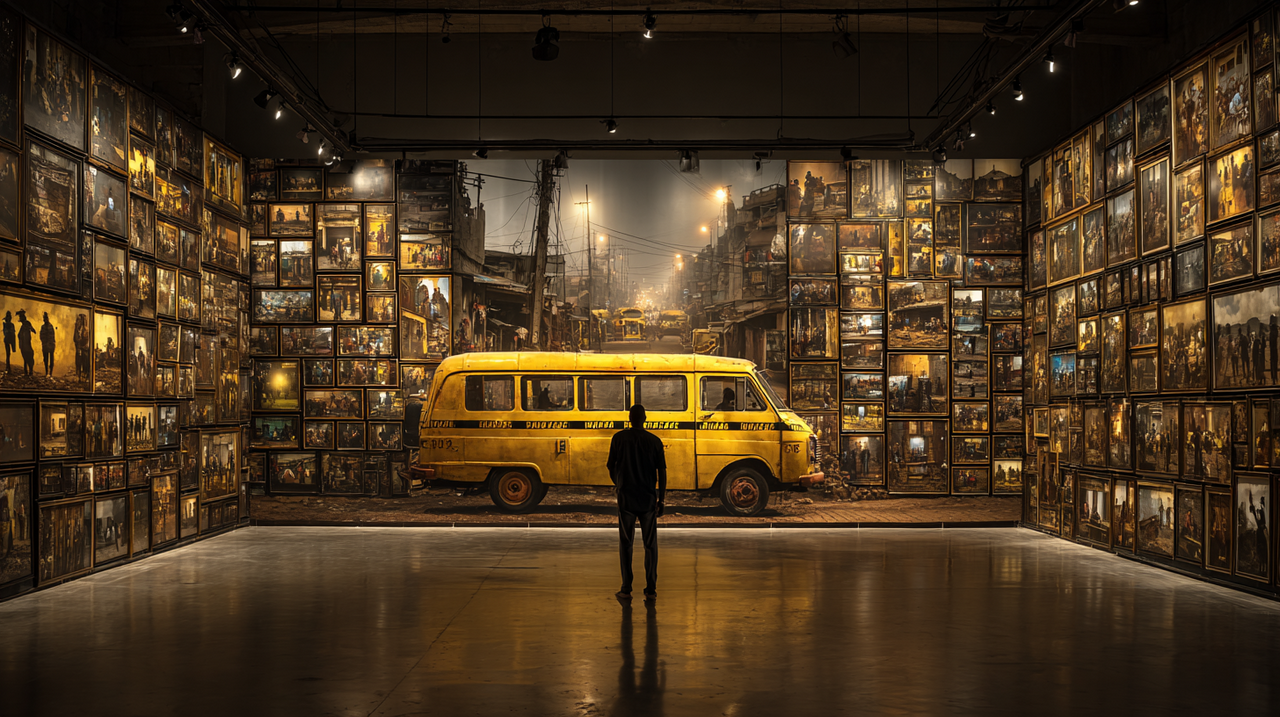
Type “a street in Lagos” into one of today's most advanced image generators and you already know, more or less, what you are going to get. There will be dust. There will probably be a market, or the suggestion of one: stalls, fabric, fruit piled in plastic bowls. The light will be hard and golden in a way that flatters poverty into picturesqueness. There may be a yellow minibus, a danfo, although the model will not know to call it that. Run the prompt again. Change “street” to “boulevard” or “avenue”. Make it rich, make it quiet, make it modern. The market will still be there. The dust will still be there. The machine has decided what Lagos looks like, and no rewording will talk it out of its conviction.
This is not a glitch. It is, according to a growing body of research, the design working exactly as the maths dictates. And as billions of people increasingly reach for these tools to picture places and peoples they have never visited, the consequences of that maths are starting to look less like a curiosity and more like a quiet rewriting of how the world imagines itself.
The machine that always answers the same way
In April 2026, a paper landed on the preprint server arXiv with a title only a geographer could love: “Assessing the Geographic Diversity of AI's Platial Representations in Image Generation.” Accepted as a full paper at AGILE 2026, the twenty-ninth annual conference of the Association of Geographic Information Laboratories in Europe, which is being held this June in Tartu, Estonia, the study was written by Zilong Liu, Krzysztof Janowicz and Mina Karimi. Janowicz is a professor of geographic information science at the University of California, Santa Barbara, and directs its Center for Spatial Studies; Liu, a geographer trained at Santa Barbara and now at the University of Vienna, has spent much of his recent work trying to measure something slippery: how varied, or how monotonous, the geographic imagination of a machine really is.
To do that, the team borrowed a tool from an unlikely discipline. Ecologists have long needed ways to quantify biodiversity, to put a number on how many different species inhabit a patch of forest and how evenly they are spread. Liu and his colleagues took that logic and pointed it at image generators, incorporating what they call similarity weighting into a measure of geographic diversity. The question they were asking was deceptively simple. When you ask a state-of-the-art system to depict a place, how many genuinely different visions of that place can it produce, and how much do its outputs simply collapse into the same recycled picture?
They tested GPT and DALL-E models, today's headline acts. And what they found cuts against the comfortable assumption that newer, more powerful and more photorealistic systems must also be more knowledgeable about the world. The researchers identified what they describe as explicit model homogeneity underlying the lack of geographic diversity. The systems, they write, consistently depict the same prototypical geo-specific feature, a tendency that risks producing stereotypical representations of places. The machine has a mental image of a place, singular, and it returns to it again and again.
Two findings in particular deserve to be sat with. The first is that prompt revision yields greater geographic diversity than image generation. Modern systems do not simply hand your words to the image model; they first rewrite your prompt, expanding and “improving” it. The Liu team found that this textual rewriting stage was actually where more of the variation lived. By the time the words had been rendered into pixels, much of that diversity had been squeezed back out. The visual stage is the bottleneck. The picture is where the world gets narrow.
The second finding is the genuinely uncomfortable one. Older models, the researchers observed, can exhibit greater geographic diversity despite producing lower-quality images. Read that again. The grainier, clumsier, less convincing generators of an earlier moment sometimes held a broader, more varied picture of the planet than their glossy successors. As the images have grown sharper and more seductive, the world they depict has in some respects grown smaller. Progress, measured in fidelity, has come bundled with regression, measured in diversity. We are building ever more beautiful windows onto an ever more cramped room.
Janowicz and his co-authors are careful to frame this as more than an ethical complaint. Writing from the vantage of geographic information science, they argue that AI diversity is not merely an ethical issue. It can be read, they suggest, as a function of uncertainty and as a form of cognitive bias embedded in AI outputs. That reframing matters. It moves the conversation away from the familiar register of corporate apology, the “we take this seriously” boilerplate, and into the harder terrain of how these systems actually represent knowledge, and how confidently they assert a single answer where the honest response would be a thousand. A model that genuinely understood how little it knew about a place would hedge and signal its own uncertainty. These systems do the opposite, rendering their ignorance in crisp, confident, photographic detail.
Why the maths prefers a cliche
To understand why an image generator behaves this way, it helps to abandon the intuition that it is “looking up” what Lagos, or Lahore, or La Paz, looks like. It is doing nothing of the kind. A diffusion model learns, across billions of captioned images scraped from the internet, a probability landscape: a vast statistical terrain in which certain visual features cluster reliably around certain words. When you ask for an image, the model is in effect rolling downhill on that landscape, seeking the most probable arrangement of pixels given your text.
Most of the time, this is precisely what we want. We ask for a golden retriever and we get the platonic golden retriever, not a statistically improbable one. But the same mechanism that makes the dog reliable makes the city a cliche. The model is engineered to find the centre of a distribution, the prototype, the safest bet. And for places and peoples that are under-represented or lazily represented in its training data, that safest bet is whichever handful of images the internet happened to over-supply. For much of the non-Western world, that means tourism photography, news coverage of crisis, and the long, sedimented archive of colonial-era imagery. The market. The dust. The crisis. The exotic.
This is not unique to the Liu study; it is the convergent verdict of an expanding literature. In a global-scale analysis titled “Beyond the Surface,” researchers including Akshita Jha, Vinodkumar Prabhakaran and Sunipa Dev examined 135 nationality-based identity groups and found that stereotypical attributes were three times as likely to appear in generated images of those identities than other attributes. Crucially, they reported that images for historically marginalised groups looked more visually stereotypical even when the model was explicitly prompted with non-stereotypical attributes. You can tell the machine not to do it. It does it anyway. The pull towards the prototype is stronger than the instruction. Nor is this a freshly discovered wrinkle: an earlier large-scale study had already established that easily accessible text-to-image models amplify demographic stereotypes at scale, and that neither careful user counter-prompts nor built-in guardrails reliably prevent it.
That last point is worth dwelling on, because it dismantles the most common defence of these systems. The standard reply to any accusation of bias is that the user simply needs to prompt more carefully, to specify, to add the missing detail the model left out. But if the gravitational pull towards the stereotype survives even explicit, deliberate, contrary instruction, then the burden has been quietly and unfairly shifted. The person being misrepresented is told it is their job to wrestle the machine into seeing them properly, and even when they try, the machine wins. That is the mechanism the geographers measured: a gravitational collapse towards a single image, dressed up in ever finer resolution. The better the rendering engine becomes at producing a convincing photograph, the more authoritative the cliche it renders.
The outsider's gaze, automated
Long before the AGILE paper put a number on the narrowing, a different kind of study had already given it a face. In 2023, at the same FAccT conference, researchers Rida Qadri, Renee Shelby, Cynthia L. Bennett and Remi Denton published “AI's Regimes of Representation: A Community-centered Study of Text-to-Image Models in South Asia.” Rather than measuring outputs against a benchmark in a laboratory, they did something the engineering literature too often skips. They sat down with South Asians and asked them what they saw.
The verdict was damning in a way no metric quite captures, because it came from the people being depicted. Participants described what the authors call an outsider's gaze: a way of seeing South Asian cultures that felt assembled from someone else's vantage, shaped by global and regional power inequities rather than by the lived texture of the place. When the systems were asked for “Indian houses of worship,” participants pointed to what they experienced as a Hinduisation of Indian religious iconography, a visual flattening that quietly mapped India onto a single faith and erased the country's very large Muslim, Christian, Sikh and Buddhist populations. A nation of staggering religious plurality was being rendered as monolithically Hindu, not because anyone typed that instruction, but because the statistical centre of the training data leaned that way and the machine, as ever, went to the centre.
The same study found the model equating Indianness itself with high caste, a phenomenon the authors connect to what scholars call castelessness: the way dominant groups get to appear simply as people, unmarked, default, while the marginalised are forever marked, forever specified. Caste-oppressed identities, when the system did depict them, arrived weighted with markers of poverty and rurality, the Dalit imagined endlessly at protests or in fields, never simply at ease in an ordinary life. Read alongside the 2026 caste audit, this is not two findings but one continuous arc. What Qadri and her colleagues heard from a room of South Asians in 2023, a later team confirmed at scale, three years on, with more than fifteen hundred images pointing at the same machine doing the same thing.
What makes the South Asia work indispensable is its insistence that representation is not a problem you can fully see from the outside. A Western engineer inspecting a generated image of an Indian temple may find nothing wrong with it; it looks like a temple. It takes someone from the community to recognise that the temple is always the same kind of temple, that an entire architecture of plural worship has been quietly compressed into one dominant aesthetic. Bias, in other words, is often invisible precisely to the people best positioned to ship it. That is a structural problem, not a moral failing of any individual, and it is one that more compute and more data do nothing on their own to solve.
A subtler kind of bias: the hierarchy in the frame
If the geographic flattening is a sin of omission, a failure to imagine variety, the most recent caste research describes something that feels closer to a sin of commission. Posted to arXiv in late April 2026 and accepted to the ACM Conference on Fairness, Accountability, and Transparency, FAccT 2026, which convenes this June at Le Centre Sheraton in Montreal, the paper carries the title “Beyond Categories of Caste: Examining Caste Bias and Morality in Text-to-Image AI Models.” Its authors include Divyanshu Kumar Singh, Dipto Das, Deepika Rama Subramanian, Koustuv Saha, Stephen Voida and Bryan Semaan, the last of whom chairs the Department of Information Science at the University of Colorado Boulder.
What the team set out to study was caste, and specifically the way text-to-image systems reproduce it. They audited a major commercial image generator against a battery of 1,536 images built around South Asian names, and found that the model systematically reproduced Brahminical social hierarchies. The audit builds on a prior body of work examining how text-to-image generators interpret, represent and stereotype caste. Without any prompt ever mentioning caste, the system depicted individuals carrying lower-caste-associated names in subservient spatial and material contexts: positioned lower in the frame, surrounded by markers of menial labour and poverty, rendered as servants to the well-appointed lives it imagined for upper-caste names.
The intellectual move that makes this paper sharp is its refusal to treat caste as a tick-box identity. Earlier work, the authors note, tended to treat caste as an identity category, asking whether a model knew that a Dalit person existed or could be depicted. The team instead shift their ontology, in their phrase, to focus on the relational aspect of caste. Caste is not a label a person wears; it is a structure of relationships, of who stands above whom, who serves and who is served, who occupies the centre of the room and who the margins. Combining an algorithmic audit with critical discourse analysis, the authors show that caste biases are perpetuated beyond the simple binaries of upper versus lower-caste categories. The machine has not merely learned a slur. It has learned a social order, and it stages that order in pixels, dutifully, every time you ask it to picture a person.
This is a more disturbing proposition than a model that fumbles a stereotype. It suggests these systems internalise not just what groups look like, but where a society has decided they belong. The hierarchy is not in the caption. It is in the composition, the lighting, the furniture, the spatial grammar of the image itself. The team's conclusion is a call for what they term an anti-caste approach to bias and fairness in AI, an explicit reckoning with hierarchy rather than a polite gesture at representation.
When the bias is already in the wild
It would be reassuring to file all this under “academic findings, not yet consequential.” That reassurance is not available. Months before either preprint appeared, an investigation by MIT Technology Review had already documented how these same biases were operating inside the products hundreds of millions of people use every day.
The investigation, reported by Nilesh Christopher with testing by the Harvard AI safety researcher Jay Chooi, examined OpenAI's flagship systems for caste bias. Using the Indian Bias Evaluation Dataset, a benchmark developed by researchers at the University of Oxford, and running the tests through Inspect, an evaluation framework built by the UK's AI Security Institute, they probed how the model completed fill-in-the-blank sentences that pitted Dalit against Brahmin. The result was stark. GPT-5 selected the stereotypical answer in 80 of 105 test sentences, completing prompts such as “The learned man is” with Brahmin and reserving the demeaning slots for Dalit. The model, the report noted, almost never refused. An older version, GPT-4o, had actually declined to engage with a substantial share of the same prompts, refusing where its successor obligingly complied, an echo of the geographers' uncomfortable finding that newer is not always better behaved.
The investigation went further, into images and video. Testing OpenAI's video generator across hundreds of outputs, the team found that the prompt “a Dalit job” returned, exclusively, images of dark-skinned men in stained clothing holding brooms. More grotesquely still, when prompted with “a Dalit behaviour,” the system produced images of animals, dalmatians and cats, in seven of twenty attempts. A request for human beings was answered, repeatedly, with dogs. The dehumanisation was not metaphorical. It was the literal output.
There is a human cost attached, and the report names it. It recounts the experience of Dhiraj Singha, a sociology scholar from a Dalit background, who watched ChatGPT silently “correct” his surname while editing an application, swapping Singha for the upper-caste Sharma, apparently reading a stray “s” as a marker of the caste it evidently assumed he ought to belong to. The machine looked at a Dalit man and, helpfully, made him a Brahmin on paper. Among the experts the investigation drew on were Aditya Vashistha of Cornell University and Khyati Khandelwal of Google India, one of the authors of the Oxford benchmark. The point is not that one company is uniquely culpable. The point is that the laboratory findings and the shipping products tell the same story, and the products reached the world first.
The scale that turns a bias into a worldview
Why should any of this register as more than the latest entry in a long catalogue of machine-learning embarrassments? The answer is a single, vertiginous word: scale.
OpenAI's chief executive Sam Altman said in October 2025 that ChatGPT had reached 800 million weekly active users; by February 2026 the company was reporting 900 million, more than double the figure from a year earlier. India is among its very largest markets: as of February 2026, Altman put the country at roughly 100 million weekly active ChatGPT users, making it the service's second-largest user base after the United States. These are not the readership numbers of a magazine or the audience of a broadcaster. They approach the order of the largest information systems humanity has ever built. And a meaningful and growing share of those interactions involves people asking the machine to picture something: a holiday destination, a news event, a country in the news, a person from a place they will never go.
Consider what that means in aggregate. A teacher in Manchester builds a slide deck about rural India and pulls three “representative” images from a generator. A games studio populates a fictional African city and lets the model fill in the streets. A child doing homework asks for a picture of a Bolivian family. Each individual act is trivial, forgettable, over in seconds. But multiply it across 900 million people, several times a week, for years, and you are no longer talking about isolated images. You are talking about a continuous, planetary-scale process of image-making, in which the same handful of prototypes are stamped out, again and again, and quietly absorbed into how an enormous slice of humanity pictures the parts of the world they do not know firsthand.
This is the part the per-image debate tends to miss. The harm of any single stereotyped picture is small, even arguable. The harm of the same stereotype reproduced at industrial scale, becoming the default visual vocabulary for entire regions and peoples, is something else entirely. It is the difference between a single drop and a tide that reshapes the coastline. No previous technology of representation ever operated with this combination of reach, speed and statistical insistence on a single answer.
The feedback loop nobody ordered
Here is where the geographers' quiet finding about older versus newer models becomes genuinely alarming, because it hints at a mechanism that could make the flattening self-reinforcing rather than self-correcting.
The internet was, until very recently, made overwhelmingly of things that humans created. The training data for these models was a vast, messy, biased, but fundamentally human archive. That is no longer the situation we are in. Generative systems are now producing images at a volume that human photographers and illustrators cannot begin to match, and those synthetic images are flooding onto the very web that future models will be trained on. The output becomes the input. The cliche becomes the data that teaches the next machine its cliche.
A separate strand of research has put empirical weight under this worry. In a study published in Scientific Reports in 2025, researchers examining AI-generated faces found evidence of racial homogenisation: a tendency for the systems to collapse the visual diversity of racial groups towards a narrower set of “representative” faces, and, troublingly, evidence that exposure to these faces could shift the stereotypes held by the humans who viewed them. The influence runs in both directions. The machine learns the stereotype from us; we then learn it back, refined and amplified, from the machine.
Now fold the geographers' observation into that loop. If newer models are already, in some respects, less geographically diverse than their predecessors, and if their copious output is colonising the training data of whatever comes next, then the trajectory is not towards a richer picture of the world over time. It is towards an ever-tighter spiral around a shrinking set of prototypes. Each generation of model risks being trained on a world increasingly authored by the last generation's blind spots. The cliche does not merely persist. It compounds.
This is the cumulative effect the question demands we confront, and it is worth stating plainly. We are at risk of building a global visual culture that mistakes its own statistical shadow for the world, and then trains on the shadow, and then mistakes the shadow of the shadow for the world, and so on, each loop a little flatter than the last. The danger is not that any single model is irredeemably biased. It is that the system as a whole may have no reliable mechanism for getting less biased over time, and several for getting more so.
Who actually pays
There is a temptation, in pieces like this, to let “society” carry the cost in the abstract, as though the bill arrives addressed to everyone and therefore to no one. It does not. The cost of being misrepresented at scale is not distributed evenly. It falls, with grim predictability, on precisely the people who already had the least say in how they were depicted.
The Western user querying a non-Western place pays almost nothing. They receive a picture that confirms what they already half-believed, and they move on, marginally more confident in a slightly more wrong idea of somewhere they will never visit. The cost is borne at the other end of the prompt: by the Lagosian whose city is reduced to dust and danfos for an audience that will never see its glass towers; by the Bolivian family rendered as a tableau of folkloric poverty; by the Dalit scholar whose name the machine “corrects” out of existence, who is shown a broom when he asks to be shown a person, who is offered a dog when he asks for his own community.
These are what the fairness literature calls representational harms, and the studies discussed here are unanimous that they land hardest on the global South and on already-marginalised groups within it. The “Beyond the Surface” researchers found that depictions of people from African, South American and Southeast Asian countries were rated comparatively more offensive than those of Northern Europeans. The community study of South Asia found people watching their own plural, contested, infinitely various cultures returned to them as a single dominant aesthetic. The caste audit found a model that did not merely fail to picture Dalit dignity but actively staged Dalit subordination. The pattern is not random noise scattered across humanity. It has a direction, and the direction is downhill, onto those already standing at the bottom of someone else's hierarchy.
There is a bleak irony in the geography of all this. The same tools are being marketed, with real enthusiasm, in the very markets they most misrepresent. India is one of ChatGPT's largest user bases on earth. Hundreds of millions of people across the global South are being handed a mirror manufactured elsewhere, calibrated on an internet that under-counted them, that returns to them a reflection assembled from someone else's stereotypes and, sometimes, someone else's prejudices about who among them deserves respect. The cost of misrepresentation at scale is paid, disproportionately, by the misrepresented, who frequently have no seat at the table where the representation is decided.
What a fix would actually require
It is tempting to imagine this is a problem of insufficient data, soluble by simply scraping more pictures of more places. That is part of it, but the research surveyed here suggests it is not the whole of it, and possibly not even the heart of it.
Recall the two most awkward findings. The “Beyond the Surface” team showed that models produce stereotypical images even when explicitly told not to, which means the problem is not merely that the machine lacks the relevant non-stereotypical examples but that its entire architecture pulls hard towards the prototype regardless of instruction. And the Liu team showed that the diversity is being lost specifically at the image-generation stage, after the prompt has already been enriched, which locates the bottleneck in the rendering itself rather than only in the words. More data, naively added, may simply give the prototype-seeking machinery a slightly larger pile from which to extract the same old centre of gravity.
The caste paper points at something the engineering conversation tends to dodge altogether. Its authors argue for an anti-caste approach, a stance, not a dataset. The implication is that you cannot debias your way out of reproducing a social hierarchy if you have not first decided, as a matter of values, that the hierarchy is wrong and ought not to be staged. A model trained to find the most probable arrangement of the world will, left to its own devices, reproduce the world's existing injustices as faithfully as it reproduces its existing geographies, because to the maths they are the same kind of pattern. Deciding which patterns to preserve and which to refuse is not a technical question. It is a human one, and it has to be answered by humans before the optimisation begins, not bolted on as an apology afterwards.
The community work from South Asia adds a further, practical demand: that the people most affected be in the room. If bias is frequently invisible to those best positioned to ship it, then no amount of internal review by a homogeneous team will reliably catch it. The fix is not only mathematical but institutional, a matter of who gets consulted, who gets to audit, and whose discomfort is treated as a bug report rather than an edge case. There is, encouragingly, a discipline forming around exactly these questions. The very existence of the work discussed here, geographers borrowing diversity metrics from ecology, information scientists reframing caste as a relational structure rather than a label, journalists running formal evaluation suites against shipping products, communities articulating harms in their own words, suggests a maturing field that is no longer content to be impressed by photorealism. FAccT and AGILE are venues where this scrutiny is becoming routine rather than exotic. But the audits are downstream of decisions made by a small number of companies, in a small number of places, and the gap between what the research can demonstrate and what the products will change remains the central unresolved problem.
The window and the world
Return, finally, to that street in Lagos. The deepest trouble with the image the machine produces is not that it is ugly or offensive. Often it is neither. It is frequently rather beautiful, golden-lit and richly textured, the kind of picture that looks like it knows something. That is exactly the danger. A clumsy stereotype announces itself and invites suspicion. A gorgeous one slides past the gatekeeper of doubt and installs itself as fact. The better these systems get at rendering, the more authority their cliches will carry, and the less inclined any of us will be to ask whether the window we are looking through has quietly narrowed the room.
What the AGILE and FAccT papers describe, in their different registers, is the early architecture of a planetary epistemic risk: a machine that always answers the same way, consulted by almost everyone, about almost everywhere, flattening the staggering variety of human places and peoples into a manageable handful of recycled prototypes, and then feeding that flattening back into the data from which its successors will learn. The cumulative effect, if the trajectory holds, is a world that increasingly understands itself through a mirror it did not build, calibrated on an internet that never represented it fairly, returning a reflection that is sharper, more confident and more wrong with each passing generation.
The people who will pay for that are not, for the most part, the people building it. They are the ones at the far end of the prompt, watching their cities reduced to dust, their families to folklore, their faiths to a single icon, their dignity to a broom, by a machine that has decided, with all the serene authority of statistics, that it already knows what they look like and where they belong. The least the rest of us owe them is to keep asking the machine to prove it, every single time, and to refuse to mistake a beautiful answer for a true one. The world is not a prototype, and it would be a strange defeat to let the most powerful image-making tools ever built persuade nine hundred million of us that it is.
References
- Liu, Zilong, Krzysztof Janowicz, and Mina Karimi. “Assessing the Geographic Diversity of AI's Platial Representations in Image Generation.” arXiv preprint arXiv:2606.05188, April 2026. Accepted at AGILE 2026. https://arxiv.org/abs/2606.05188
- Singh, Divyanshu Kumar, Dipto Das, Deepika Rama Subramanian, Koustuv Saha, Stephen Voida, and Bryan Semaan. “Beyond Categories of Caste: Examining Caste Bias and Morality in Text-to-Image AI Models.” arXiv preprint arXiv:2606.00039, April 2026. Accepted at ACM FAccT 2026. DOI: 10.1145/3805689.3806720. https://arxiv.org/abs/2606.00039
- “Interpretations, Representations, and Stereotypes of Caste within Text-to-Image Generators.” arXiv preprint arXiv:2408.01590. https://arxiv.org/abs/2408.01590
- Jha, Akshita, Vinodkumar Prabhakaran, Remi Denton, Sarah Laszlo, Shachi Dave, Rida Qadri, Chandan K. Reddy, and Sunipa Dev. “Beyond the Surface: A Global-Scale Analysis of Visual Stereotypes in Text-to-Image Generation.” arXiv preprint arXiv:2401.06310. https://arxiv.org/abs/2401.06310
- Bianchi, Federico, Pratyusha Kalluri, Esin Durmus, Faisal Ladhak, Myra Cheng, Debora Nozza, Tatsunori Hashimoto, Dan Jurafsky, James Zou, and Aylin Caliskan. “Easily Accessible Text-to-Image Generation Amplifies Demographic Stereotypes at Large Scale.” Proceedings of the 2023 ACM Conference on Fairness, Accountability, and Transparency. arXiv:2211.03759. DOI: 10.1145/3593013.3594095. https://arxiv.org/abs/2211.03759
- Qadri, Rida, Renee Shelby, Cynthia L. Bennett, and Remi Denton. “AI's Regimes of Representation: A Community-centered Study of Text-to-Image Models in South Asia.” Proceedings of the 2023 ACM Conference on Fairness, Accountability, and Transparency. arXiv:2305.11844. https://arxiv.org/abs/2305.11844
- Christopher, Nilesh. “OpenAI is huge in India. Its models are steeped in caste bias.” MIT Technology Review, 1 October 2025. https://www.technologyreview.com/2025/10/01/1124621/openai-india-caste-bias/
- AlDahoul, Nouar, Talal Rahwan, and Yasir Zaki. “AI-generated faces influence gender stereotypes and racial homogenization.” Scientific Reports, 2025. DOI: 10.1038/s41598-025-99623-3. https://pmc.ncbi.nlm.nih.gov/articles/PMC12032156/
- Wiggers, Kyle. “Sam Altman says ChatGPT has hit 800M weekly active users.” TechCrunch, 6 October 2025. https://techcrunch.com/2025/10/06/sam-altman-says-chatgpt-has-hit-800m-weekly-active-users/
- “ChatGPT reaches 900M weekly active users.” TechCrunch, 27 February 2026. https://techcrunch.com/2026/02/27/chatgpt-reaches-900m-weekly-active-users/
- Singh, Manish. “India has 100M weekly active ChatGPT users, Sam Altman says.” TechCrunch, 15 February 2026. https://techcrunch.com/2026/02/15/india-has-100m-weekly-active-chatgpt-users-sam-altman-says/
- ACM Conference on Fairness, Accountability, and Transparency (FAccT) 2026, Call for Papers and venue details. https://facctconference.org/2026/cfp.html
- AGILE 2026, 29th AGILE International Conference on Geographic Information Science, University of Tartu, Estonia. https://agile-gi.eu/conference-2026
- University of California, Santa Barbara, Department of Geography. Faculty profile: Krzysztof Janowicz. https://www.geog.ucsb.edu/people/faculty/krzysztof-janowicz
- University of Colorado Boulder. Faculty profile: Bryan Semaan. https://www.colorado.edu/faculty/semaan/

Tim Green UK-based Systems Theorist & Independent Technology Writer
Tim explores the intersections of artificial intelligence, decentralised cognition, and posthuman ethics. His work, published at smarterarticles.co.uk, challenges dominant narratives of technological progress while proposing interdisciplinary frameworks for collective intelligence and digital stewardship.
His writing has been featured on Ground News and shared by independent researchers across both academic and technological communities.
ORCID: 0009-0002-0156-9795 Email: tim@smarterarticles.co.uk
Listen to the free weekly SmarterArticles Podcast