Your Face Is Not Yours: The Legal Hole Under Deepfake Law
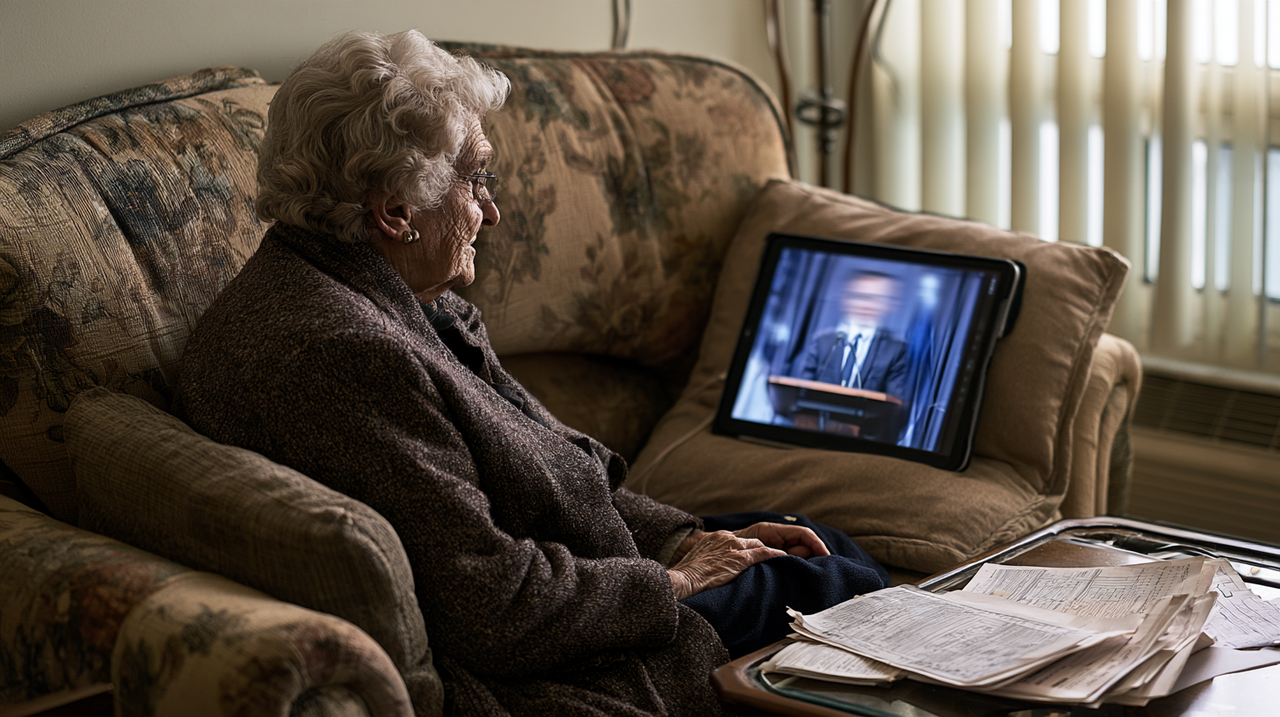
The advertisement that emptied Judy Skene's life appeared on Facebook, and it looked exactly like the Prime Minister of Canada.
Skene is 86 and lives in Sault Ste. Marie, Ontario. In the summer of 2025 she saw a video of Mark Carney explaining that a modest investment in a cryptocurrency platform would be underwritten by the country's central bank. “I saw an ad on Facebook of Mark Carney telling me if I invested $350 Canadian, it would be backed by the Bank of Canada,” she told CTV News, which reported her story in June 2026. She put in the $350. Someone rang to say it had already tripled. Over the following months she cashed a Registered Retirement Income Fund worth $650,000, placed a $300,000 mortgage on her condominium, and took a $35,000 cash advance on a credit card. Roughly $900,000 went into an account that showed her gains that did not exist. “Once I did the final payment, there was no more conversation and all my money was gone.”
Three weeks after that story ran, CTV published another. Deborah Friesen of Acton, Ontario, had been watching craft videos online when a similar Carney video found her. She invested $13,000, then, after months of daily phone calls from a man who became something close to a friend, another $70,000. “He had me convinced by then he was legitimate,” she said. When the calls stopped: “I just fell apart. I couldn't stop crying.”
Sit with the legal architecture of what happened here, because it is stranger than it looks. Two women lost a combined million dollars. The instrument of the theft was a synthetic reproduction of a third person's face and voice. Of the three of them, exactly one has a clean, established, centuries-tested cause of action arising from the misuse of a likeness — and it is not either of the women who lost the money. It is Mark Carney, whose persona has demonstrable commercial value and whose implied endorsement was appropriated. Canadian law has protected that interest since a 1971 Ontario case about a football player named Krouse and a Chrysler promotional calendar.
Skene and Friesen have fraud. Fraud requires defendants. The defendants are unlocatable, probably offshore, and almost certainly do not care.
And the third category of person — the schoolteacher, the nurse, the fifteen-year-old whose photograph is fed into a nudification tool by a classmate — has, until very recently, had nothing at all. No commercial value in their persona. No money taken. Just their body reproduced without their permission, in a country whose law has never quite decided that this is a thing that can be done to you.
A Letter to Ottawa Asking for the Impossible
On 12 August 2026, Stephen Crawford, Ontario's Minister of Public and Business Service Delivery and Procurement, wrote to his federal counterpart and asked for something no democracy has attempted.
“We are urging the federal government to enact an all-out ban on AI deepfakes and impersonations, which can lead to significant harms for vulnerable populations, including children and seniors,” Crawford wrote. “Anyone who uses these new tools to scam or harm Canadians deserves to face steep fines and jail time.” The letter, reported by CTV News and CP24, was prompted directly by the Skene and Friesen cases. Crawford acknowledged the obvious constitutional constraint — criminal law is federal, and Ontario cannot legislate here — and framed the request against the province's economic ambitions, citing projections that AI could add $122 billion to Ontario's GDP by 2035 and generate an average of 17,600 jobs a year. “As we work to unlock the full economic potential of AI,” he wrote, “we need to put strong safeguards in place to protect consumer data and privacy in this new digital landscape.”
It is worth being precise about how far outside the mainstream this sits. The European Union's approach, in Article 50 of the AI Act, is labelling. The United States' TAKE IT DOWN Act is notice and removal. Denmark's intervention is a civil property right. Canada's new criminal provisions target sexual content. The United Kingdom criminalises the creation of intimate images without consent. Every one of these regulates a category of conduct. Crawford asked for the prohibition of a technique.
The temptation is to dismiss it as a provincial minister posturing about a federal file. That would be a mistake. Crawford's letter is more interesting read as a symptom than as a proposal — as the noise a legal system makes when it discovers, under load, that it is missing a part. Every narrower response has to answer a question that Canadian law, and Anglo-American law generally, has no settled answer to: what exactly is the thing being protected? A ban dodges the question by prohibiting the act of synthesis itself. That is why it is unenforceable. It is also why it is honest in a way the alternatives are not.
The Threat Everyone Prepared For Never Came
For most of a decade, the research community readied itself for the wrong war.
That is the argument of a position paper posted to arXiv in May 2026 by Shaina Raza, titled “The Deepfakes We Missed.” Its opening lines are unusually blunt for the genre: “Nearly a decade of Machine Learning (ML) research on deepfake detection has been organized around a threat model inherited from 2017–2019, revolving around face-swap and talking-head manipulation of public figures, motivated by concerns about large-scale misinformation and video-evidence fraud. This position paper argues that the threat the field prepared for did not arrive, and the threats that did arrive are substantially different.”
Raza synthesises harm data from 2022 to 2026 across five distinct sources — FBI cybercrime complaints flagged for synthetic media, Internet Watch Foundation tracking of AI-generated child sexual abuse material, the curated AI Incident Database, academic victim-prevalence surveys, and named high-profile incidents. The mismatch that emerges is stark. Roughly 71 per cent of detection research addresses public-figure face-swap video. Under 1 per cent addresses non-consensual intimate imagery. The predicted catastrophe of synthetic political disinformation swamping the 2024 election cycle did not materialise at anything like the anticipated scale, despite enormous preparatory investment.
What arrived instead was three things. Peer-generated non-consensual intimate imagery, largest by victim count — the Internet Watch Foundation recorded AI-generated child sexual abuse videos rising from 13 in 2024 to more than 3,400 in 2025. Voice-clone and synthetic-identity fraud, running to billions in reported losses, encompassing grandparent scams, business impersonation, and precisely the sort of fabricated celebrity endorsement that found Judy Skene. And peer-distributed manipulation moving through encrypted messaging where no platform intervention reaches.
The FBI's Internet Crime Complaint Center broke out a dedicated artificial intelligence section in its 2025 annual report for the first time, logging 22,364 AI-related complaints and $893 million in losses, the largest category being investment fraud at roughly $632 million. The Bureau was explicit that this is a floor, not a ceiling.
Note what these categories share. They are not attacks on the information commons. They are attacks on individual people, most of whom are not famous, conducted by exploiting a resource — their face, their voice, their apparent presence — that the law does not recognise as belonging to them in any general sense.
Sixty-Four Per Cent
The second finding is worse, and it is the one that should reframe the entire debate.
In May 2026, Nicolas M. Müller and Wei Herng Choong published a large-scale study of how humans perceive synthetic speech. They recruited 1,768 participants who rendered 35,532 judgements on audio drawn from 138 text-to-speech and voice-conversion systems spanning ten architecture families. The design deliberately mirrored a 2021 baseline study, so the comparison over time is meaningful.
On synthetic audio, human accuracy fell only slightly: 71.2 per cent, down from 72.9 per cent five years earlier. Against the most capable systems the numbers collapse — 61.3 per cent for commercial APIs, 65.9 per cent for autoregressive language-model architectures, both hovering just above a coin toss. Machine detectors, meanwhile, held steady at around 94.5 per cent.
But the number that matters is a different one. Accuracy on real audio — genuine human speech, correctly identified as genuine — fell from 72.7 per cent to 64.1 per cent.
People have not got much worse at spotting fakes. They have got dramatically worse at recognising the truth. The researchers describe this as a shift towards scepticism, and their conclusion is the sentence that ought to be pinned above every legislative drafting desk in the country: “the primary threat posed by modern deepfakes may not be mere deception, but the erosion of trust in genuine audio.”
This is the point at which the harm stops being individual and becomes something else entirely. Judy Skene was deceived by a fake. But more than a third of the time, in controlled conditions, listeners now reject the real. That is not a fraud problem. It is the depletion of a shared resource — the default assumption that a voice belongs to its apparent owner — that every phone call, every voicemail, every recorded interview, every emergency dispatch and every piece of audio evidence has silently drawn on for a century.
Robert Chesney and Danielle Citron named the consequence in the California Law Review in 2019: the liar's dividend, the windfall that accrues to the genuinely guilty from the mere existence of convincing fakes. You do not need to produce a deepfake to benefit. You need only point at the category. Kaylyn Jackson Schiff, Daniel S. Schiff and Natália S. Bueno tested this empirically in the American Political Science Review in 2024 across five pre-registered experiments involving more than 15,000 American adults, and found that politicians who falsely dismissed damaging true reporting as misinformation gained measurable support — between roughly 0.17 and 0.24 standard deviations — outperforming apology or silence. The strategy worked across partisan lines. The dividend is real and it pays.
Put the two findings together and the shape of the problem changes. Prohibition, labelling, takedown, criminal penalty — every mechanism on the table addresses the fake. None of them restores the credibility of the real. A perfectly enforced ban on synthetic media would still leave every defendant in every courtroom free to say that recording could be anything, and would still leave 64 per cent as the rate at which a jury of ordinary listeners believes authentic audio.
What Canadian Law Thinks a Face Is Worth
To understand why an Ontario minister ended up asking for a total ban, you have to look at what he was working with.
Canada's protection of likeness comes from the tort of appropriation of personality, recognised in Krouse v. Chrysler Canada in 1971 and expanded in Athans v. Canadian Adventure Camps in 1977, which confirmed that the right covers both image and name. The doctrine is coherent and well-settled, and it is built on a single load-bearing assumption: that the plaintiff's identity has marketable value, exploitable through endorsement, which the defendant has helped himself to. Krouse lost, because the photograph showed only his back and number and he was not identifiable. Athans won, because a line drawing of him water-skiing in his signature pose was recognisably him and could have impaired his ability to sell endorsements.
This is a commercial doctrine wearing the clothes of a dignitary one. It protects the athlete, the musician, the person whose face is already a revenue-generating asset. It has very little to say to a teacher whose colleagues receive a synthetic video of her, because she was not planning to sell her face to anybody and the harm she suffers is not lost licensing income. Quebec is the partial exception: in Aubry v. Éditions Vice-Versa, decided by the Supreme Court in 1998, a private individual photographed on a public street succeeded under the Quebec Charter's protection of private life. That is a civil-law dignitary right, and it is closer to what the rest of the country needs than anything the common law offers.
Federal attempts to modernise this collapsed. Bill C-27, containing the Artificial Intelligence and Data Act — Canada's first comprehensive AI statute — died on the Order Paper when Parliament was prorogued on 6 January 2025. Bill C-63, the Online Harms Act, which addressed intimate-image deepfakes among much else, died the same morning, taking two years of committee work with it.
What eventually replaced them was narrower and arrived under pressure. Through late 2025 and into 2026, X's integrated chatbot Grok was used to generate sexualised images of real people, including minors, at industrial volume. Canada's Privacy Commissioner, Philippe Dufresne, found on 11 June 2026 that X Corp. and xAI had violated federal private-sector privacy law by launching the image-generation tool without adequate safeguards. Citing researchers, Dufresne noted that Grok was at one point generating well over 6,000 sexualised images per hour. He used the occasion to renew his call for modernised privacy legislation with administrative monetary penalties and order-making powers — which is to say, for the tools he did not have.
Bill C-16, the Protecting Victims Act, moved through Parliament in parallel, passing third reading in the House on 11 June 2026 and receiving Royal Assent on 18 June 2026, with most of its reforms coming into force on 18 July 2026. It amends the Criminal Code to bring synthetic sexual content within the intimate-image offences, adds an offence of threatening to distribute, and — following a justice committee amendment on 11 May 2026 made in direct response to the Grok episode — extends coverage to “nearly nude” AI-generated images and imposes a 48-hour platform takedown obligation.
C-16 is a genuinely good law. It is also, viewed against the harm landscape, a patch on one wall of a house with no foundation. It protects you if the synthetic content is sexual. Fraud law protects you if someone takes money. Appropriation of personality protects you if you had endorsement income to lose. If someone clones your voice to end your marriage, discredit you at work or call your mother, Canadian law offers a scramble through defamation, harassment and privacy torts of uncertain application, none designed for the facts.
Two further bills arrived in the same fortnight, and both bear on the question. On 10 June 2026, Marc Miller, the Minister of Canadian Identity and Culture, tabled Bill C-34, the Safe Social Media Act — the successor to the dead C-63 and Canada's third attempt at online harms legislation, carrying the same stated purpose of online safety and the protection of children, but a more prescriptive regulatory architecture and a broader range of covered digital services. Five days later came Bill C-36, the Protecting Privacy and Consumer Data Act, an overhaul of federal private-sector privacy law with penalties running to $25 million. C-36 is the more interesting of the two, because it does something no Canadian statute has done. It would give individuals a right to require that a company delete their personal information — and the deletion right, as drafted, extends explicitly to AI-generated deepfakes that use that individual's likeness. Dufresne had called for modernised privacy legislation with administrative monetary penalties and order-making powers four days earlier. This is the answer to that call.
It should be said plainly, because it matters: C-36 is the closest thing Canada currently has to a general remedy for having your likeness synthesised — one that does not require the image to be sexual, the use to be commercial, or money to have changed hands. But notice the route it takes. It arrives through privacy law, as a right against a data holder, rather than as a right in the likeness itself, and the distinction is not academic. A deletion right attaches to personal information held by an organisation. It does not attach to a person's persona, and it gives you nothing to assert against anyone who is not keeping a record about you. It reaches companies subject to federal private-sector privacy law, which is to say it does nothing about the offshore operation that took Judy Skene's money, nothing about the classmate with a nudification app, and nothing whatever about a model file running on a laptop in a bedroom. And it is a bill. C-27 was a bill. C-63 was a bill. Both died on the same January morning with two years of work inside them.
There is no general right. That is the hole Crawford was pointing at, even if the instrument he reached for was wrong.
The Weights Are Already Out
Now the enforcement objection, which is fatal to prohibition in its literal form.
A ban on deepfakes could mean one of two things: a ban on the conduct, or a ban on the tools. The first is largely what already exists, expanded — criminal and civil liability for what you do with a synthetic likeness. It is a real policy option, but it is not a ban in the sense Crawford's letter implies, and it does nothing about the enforcement gap that made his letter necessary: the perpetrators who took Judy Skene's money are already committing multiple existing offences and remain beyond reach.
The second is technically incoherent, and has been since roughly 2023. Zero-shot voice cloning no longer requires training a model. Open-weight systems that can be downloaded, run locally on consumer hardware and reproduce a target voice from a few seconds of reference audio have been publicly available for years. Face-swapping tools of comparable maturity are distributed the same way; when the developer of one widely used repository archived it in 2026 over concerns about downstream misuse, forks and successors persisted, because that is what happens to published weights. A model file, once released, behaves like any other number: it can be copied perfectly, transmitted anywhere, and does not phone home.
Michelle L. Ding, Harini Suresh and Suresh Venkatasubramanian mapped what this means for enforcement in a paper revised in May 2026, which describes the current regulatory posture as “a reactive cycle of whack-a-mole.” Drawing on more than a hundred primary sources, they identify eleven categories of technology facilitating AI-generated non-consensual intimate imagery — creation, distribution, discovery, infrastructural support, monetisation — and map United States federal law and 63 state laws against them. The finding is structural: interventions cluster on a few chokepoints, principally hosted consumer services, while the ecosystem routes around them through self-hosted models, mirror sites, payment intermediaries and encrypted redistribution.
Tennessee's ELVIS Act, signed on 21 March 2024 and in force from 1 July that year, is the most aggressive attempt anywhere to reach the tools themselves: it imposes liability on technologies whose “primary purpose or function” is producing unauthorised digital replicas. It is a sensible provision and it captures commercial nudification services. It cannot capture a general-purpose open-weight speech model whose primary purpose is speech synthesis, which is precisely the thing used in the overwhelming majority of voice-clone fraud.
You cannot ban arithmetic. You can only ban what people do with it, and then find them.
Denmark Decided You Are the Author of Yourself
Which brings us to the one jurisdiction that asked the right question.
On 26 June 2025 the Danish government unveiled a cross-party proposal to amend the national Copyright Act to grant every individual rights over their own body, facial features and voice. The mechanism is a neighbouring right — the same family of entitlements that protects performers and broadcasters rather than authors — implemented through two new provisions: one protecting performers against AI-generated imitation of their performances, and one extending protection to the general public against unauthorised realistic digital reproduction of their appearance or voice.
The design choices are worth dwelling on. Protection extends to all natural persons, not only public figures. Compensation is available without proof of reputational damage, which quietly severs the right from the commercial-value assumption that hobbles Canadian and American law. Enforcement borrows copyright's existing plumbing — notice-and-takedown, established infringement standards, platform liability — so it arrives with functioning machinery rather than requiring new institutions. And it carves out parody, satire, caricature and social criticism explicitly.
The amendment's status as of August 2026 is genuinely unclear from public sources. Commentary through late 2025 and early 2026 anticipated commencement on 31 March 2026, but a snap general election intervened, and the expectation has since slipped to the third quarter of 2026. I could not verify from primary Danish parliamentary records whether the provisions are in force. That uncertainty is instructive: the closest thing any democracy has to a likeness-ownership regime has spent over a year in legislative transit.
The criticism lands, though. Copyright is transferable and licensable; grafting personal identity onto it invites the possibility that a likeness could be signed away wholesale in a contract of adhesion — exactly the abuse California's AB 2602 was written to prevent, by requiring that digital-replica contract terms describe intended uses with reasonable specificity. There are also awkward interactions with the General Data Protection Regulation and the Digital Services Act, which already govern much of the same ground through different logic.
But Denmark got the ontology right, and that is the harder half. It began from the proposition that a likeness is a thing a person holds a right in — not because it is worth money, not because the depiction is sexual, not because someone was defrauded, but because it is theirs. Everything else is implementation detail.
Where Prohibition Meets the Charter
Suppose Ottawa took Crawford literally. What happens?
Section 2(b) of the Canadian Charter of Rights and Freedoms protects freedom of expression, and Canadian courts define expression expansively — any activity conveying meaning, regardless of content, subject only to a narrow exclusion for violent form. A synthetic image conveys meaning. So does a satirical voice clone of a party leader, a documentary reconstruction, a film using a de-ageing pipeline, a comedian's impression rendered in silicon rather than larynx. An all-out ban on AI-generated likeness would engage section 2(b) instantly and comprehensively.
It would then have to be saved under section 1, through the proportionality analysis the Supreme Court set out in R v. Oakes in 1986. The first step is straightforward: protecting people from impersonation-based fraud and sexual exploitation is unquestionably a pressing and substantial objective. The second, rational connection, is arguable. It is the third step where a total ban dies. Minimal impairment asks whether the limit impairs the right as little as reasonably necessary — and a prohibition that sweeps in parody, satire, art, journalism, education, accessibility tools and every legitimate synthetic-media application in order to reach fraud and abuse is the definition of a measure that could have been drawn more narrowly. Parliament has, in C-16, already demonstrated that it can draw it more narrowly. Having done so, it cannot easily argue that narrower was not available.
The American picture is harsher still. In Kohls v. Bonta, a federal court enjoined California's AB 2839, which restricted materially deceptive election-related deepfakes, and ultimately held it unconstitutional. Because the statute regulated a defined subset of speech by content, it faced strict scrutiny, and it did not survive. Judge John A. Mendez's formulation deserves quoting: “Most of AB 2839 acts as a hammer instead of a scalpel, serving as a blunt tool that hinders humorous expression.” That is not a marginal ruling about a badly drafted statute. It is the standard outcome when a democracy tries to prohibit a kind of image rather than a kind of injury.
The instructive contrast is what has survived. California's AB 602, enacted in 2019 as Civil Code section 1708.86, creates a private right of action for sexually explicit synthetic depictions, with statutory damages up to $150,000 where malice is shown — and includes explicit carve-outs for matters of legitimate public concern, political and newsworthy works, and protected commentary and criticism, while specifying that altered pornography is not newsworthy merely because the subject is a public figure. AB 1836 extends California's post-mortem publicity right to digital replicas for seventy years after death. The federal NO FAKES Act, reintroduced as S.4591 and advanced by the Senate Judiciary Committee on 18 June 2026 with bipartisan sponsorship from Blackburn, Coons, Tillis and Klobuchar, creates a federal property right in voice and visual likeness — and its 2026 revision is notable precisely for expanded First Amendment protections and a DMCA-style counter-notification procedure allowing users to contest removals.
The pattern is unmistakable. Prohibitions of technique fail constitutional review. Rights in persons, with expression carve-outs and adversarial process, survive it. Crawford's ban would not reach the Supreme Court of Canada. It would not reach second reading.
The Labels Come Off in Transit
The fallback everyone reaches for is provenance: mark the synthetic content, and let people see the mark.
The European Union has now made this binding. Article 50 of the AI Act imposes transparency obligations across four areas — direct interaction with humans, AI-generated content, emotion recognition and biometric categorisation, and deepfakes and AI-generated text on matters of public interest. The obligations became applicable on 2 August 2026, eleven days before Crawford wrote his letter, with limited transitional relief for machine-readable marking. The European Commission adopted implementing guidelines on 20 July 2026, alongside a Code of Practice on transparency of AI-generated content. Non-compliance can attract fines up to €15 million or 3 per cent of worldwide annual turnover, and the labelling duty applies regardless of intent to deceive.
This is the most serious labelling regime in the world and it will help. It will also not do what people imagine it does.
The technical substrate is the C2PA standard, which cryptographically binds provenance assertions to media through signed manifests. The standard's own security documentation enumerates the threats: manifest stripping, unauthorised re-signing, soft-binding collisions. In deployment the failure is more mundane and more complete. Major platforms strip metadata during upload as a routine consequence of transcoding. A signed manifest survives a download and dies on re-upload. Invisible watermarks embedded in the content itself can be perturbed away by a determined adversary, and research through 2026 on diffusion-based editing has documented failure modes in supposedly robust schemes. Platform provenance indicators and watermark detectors typically operate without reference to one another, producing contradictory signals on the same asset.
But the deeper problem is one of direction. Marking the synthetic tells you nothing about the authentic. In a world where 64 per cent is the rate at which humans correctly identify real speech as real, the useful infrastructure is not a label on the fake — which the adversary controls and can remove — but an attestation on the true, controlled by the speaker, attached at the point of capture. C2PA can technically do this. Almost nobody deploys it that way, because the regulatory pressure has all been pointed at labelling AI output.
We have built a system that asks liars to identify themselves.
The Right That Would Actually Do Something
So: what is the underlying right, and who does it belong to?
Here is the answer the evidence supports. There is a right, it belongs to every person equally, and its content is this — you decide whether a convincing representation of your face, body or voice is distributed as though it were you. Not because your likeness is a commercial asset. Not because the depiction is sexual. Not because you lost money. Because it is a representation of you, and you are the only person with standing to authorise it.
That right attaches to distribution, not to generation, and the distinction carries the entire enforcement argument. Generation cannot be policed, because the weights are already out and a model running on a laptop leaves no trace. Distribution can be, because distribution requires reach, and reach requires infrastructure that has addresses, jurisdictions and bank accounts. This is why C-16's 48-hour takedown provision matters more than its custodial penalties, why the TAKE IT DOWN Act's Section 3 — under which the Federal Trade Commission commenced enforcement on 19 May 2026, the statutory compliance deadline, warning fifteen major platforms including Alphabet, Meta, Microsoft, TikTok and X of their obligations — matters more than its criminal provisions, and why the Danish decision to route a dignitary right through copyright's takedown machinery was, whatever its conceptual awkwardness, tactically astute.
It must be a civil right with a cheap, fast, low-evidence remedy, and it must have expression carve-outs written into its bones rather than bolted on afterwards — parody, satire, caricature, criticism, news, art, biography, research. This is the CIGI position, argued by the AI governance researcher Yuan Y. Stevens in an analysis published by the Centre for International Governance Innovation in late 2025 that called for Canada to modernise its image and likeness rights so victims can obtain rapid takedown orders and damages, with carve-outs for legitimate expression. Stevens' framing of deepfake abuse as a form of digital violence disproportionately directed at women and girls is not rhetorical decoration. It is a claim about who the law has been built for. Right-of-publicity doctrine descends from cases about footballers and water-skiers. The people being harmed at scale are teenagers, teachers, nurses and pensioners. A right that only activates when your face has a market price is not a right most people have.
And then there is the part no individual right can fix.
If the Müller and Choong finding holds — if the population-level consequence of accessible synthesis is that people stop believing true recordings — then the injury is not only to the person impersonated. It is to everyone who will ever need to be believed. That is a commons problem, and commons problems are not solved by giving individuals causes of action. They are solved by building infrastructure: capture-time attestation in the devices people already carry, key material bound to persons rather than platforms, provenance that survives transcoding because platforms are obliged to preserve it rather than merely permitted to display it. None of this is in Article 50. None of it is in C-16. None of it would have been in Crawford's ban.
Which returns us, finally, to what that letter actually was. Not a serious enforcement proposal — it could not survive the Oakes test, and it could not survive contact with a downloaded model file. Read it instead as an accurate diagnosis expressed in the only vocabulary the writer had available. Confronted with an 86-year-old constituent who lost $900,000 because a machine wore the Prime Minister's face, a minister looked through the statute book for the provision that says your face is yours, found no such provision, and asked for the whole category to be outlawed instead.
The absence he was reaching into is real. Anglo-American law has never held that a person owns their own likeness. It has held that some people own the commercial value of theirs, that some depictions are obscene, that some uses are defamatory, that some deceptions are fraudulent. Each of those is a rule about something else that happens to catch likeness in passing. For a hundred years that was sufficient, because reproducing a person convincingly required a film crew, a budget and a reason. It required, in effect, that you be worth faking.
That condition no longer holds. Everyone is now worth faking, because faking costs nothing. And the law is discovering, in real time and in public, that it never wrote down the rule everyone assumed was there.
Ban or regulate was never the question. The question is whether Parliament will say the sentence that has gone unsaid — that a person's likeness belongs to that person, all persons, not merely the marketable ones — and then build the narrow, boring, well-carved-out machinery that makes it enforceable. Denmark tried to say it and got tangled in copyright. The NO FAKES Act keeps getting redrafted around the First Amendment. Canada has said a fragment of it, about sexual images, and is now feeling for the rest through privacy law rather than saying the sentence itself.
Judy Skene will not get her money back. But the reason a court could offer Mark Carney a remedy for the misuse of his face and offer her nothing at all for the same video is not a gap in enforcement. It is a gap in the concept. Until that is fixed, every ban, every label, every watermark and every takedown window is scaffolding around a building nobody has designed.
References
- “Ontario cabinet minister calls for 'all-out ban on AI deepfakes and impersonations'”, CP24 / CTV News, 12 August 2026. https://www.cp24.com/local/toronto/2026/08/12/ontario-cabinet-minister-calls-for-all-out-ban-on-ai-deepfakes-and-impersonations/
- “Ontario senior loses $900,000 to crypto platform scam that used AI deepfake of PM Carney”, CP24 / CTV News, 26 June 2026. https://www.cp24.com/local/toronto/2026/06/26/ontario-senior-loses-900000-to-crypto-platform-scam-that-used-ai-deepfake-of-pm-carney/
- ”'I couldn't stop crying': Ontario woman loses $83,000 after watching AI deepfake videos”, CP24 / CTV News, 15 July 2026. https://www.cp24.com/local/2026/07/15/i-couldnt-stop-crying-ontario-woman-loses-83000-after-watching-ai-deepfake-videos/
- Shaina Raza, “The Deepfakes We Missed: We Built Detectors for a Threat That Didn't Arrive”, arXiv:2605.12075, 12 May 2026. https://arxiv.org/abs/2605.12075
- Nicolas M. Müller and Wei Herng Choong, “Eroding Trust in Real Speech: A Large-Scale Study of Human Audio Deepfake Perception”, arXiv:2605.26136, 21 May 2026. https://arxiv.org/abs/2605.26136
- Yuan Y. Stevens, “Canada Must Do More to Protect Women and Girls from Harmful Deepfakes”, Centre for International Governance Innovation, 2025. https://www.cigionline.org/articles/canada-must-do-more-to-protect-women-and-girls-from-harmful-deepfakes/
- “FTC Begins Enforcing the TAKE IT DOWN Act”, Federal Trade Commission, May 2026. https://www.ftc.gov/news-events/news/press-releases/2026/05/ftc-begins-enforcing-take-it-down-act
- “Statement by the Privacy Commissioner of Canada on investigation into the Grok chatbot and sexualized deepfakes”, Office of the Privacy Commissioner of Canada, 11 June 2026. https://www.priv.gc.ca/en/opc-news/speeches-and-statements/2026/s-d_260611/
- “Prorogation's Digital Impact: Canada's Digital Bills Set to Die on the Order Paper”, Fasken, January 2025. https://www.fasken.com/en/knowledge/2025/01/prorogations-digital-impact
- “Kohls v. Bonta”, Electronic Privacy Information Center case documents. https://epic.org/documents/kohls-v-bonta/
- California AB-602, “Depiction of individual using digital or electronic technology: sexually explicit material: cause of action”, California Legislative Information, 2019. https://leginfo.legislature.ca.gov/faces/billTextClient.xhtml?bill_id=201920200AB602
- “California Enacts Host of AI-Related Bills Designed To Protect Individuals”, Skadden, Arps, Slate, Meagher & Flom LLP, September 2024. https://www.skadden.com/insights/publications/2024/09/california-enacts-host-of-ai-related-bills
- “Why Tennessee's ELVIS Act Is the King of Artificial Intelligence Protections”, Vanderbilt Law School. https://law.vanderbilt.edu/why-tennessees-elvis-act-is-the-king-of-artificial-intelligence-protections/
- S.4591, “NO FAKES Act of 2026”, 119th Congress, Congress.gov. https://www.congress.gov/bill/119th-congress/senate-bill/4591/text
- “Owning the Self: Denmark's Copyright Turn Against Deepfakes”, Schjødt, 2025. https://schjodt.com/news/owning-the-self-denmarks-copyright-turn-against-deepfakes
- “Copyrighting Voice and Image: How Denmark's New Deepfake Law Challenges Traditional Personality Rights in Europe”, Verfassungsblog. https://verfassungsblog.de/copyrighting-voice-and-image/
- “The AI Act's Transparency Obligations: Rules, Scope and Timeline”, Stibbe. https://www.stibbe.com/publications-and-insights/the-ai-acts-transparency-obligations-rules-scope-and-timeline
- “C2PA Implementation Guidance”, C2PA Specifications, version 2.4. https://spec.c2pa.org/specifications/specifications/2.4/guidance/Guidance.html
- “Editing Away the Evidence: Diffusion-Based Image Manipulation and the Failure Modes of Robust Watermarking”, arXiv:2603.12949, 2026. https://arxiv.org/pdf/2603.12949
- Michelle L. Ding, Harini Suresh and Suresh Venkatasubramanian, “How to Stop Playing Whack-a-Mole: Mapping the Ecosystem of Technologies Facilitating AI-Generated Non-Consensual Intimate Images”, arXiv:2602.04759, February 2026, revised May 2026. https://arxiv.org/pdf/2602.04759
- Kaylyn Jackson Schiff, Daniel S. Schiff and Natália S. Bueno, “The Liar's Dividend: Can Politicians Claim Misinformation to Evade Accountability?“, American Political Science Review, 2024. https://www.cambridge.org/core/journals/american-political-science-review/article/liars-dividend-can-politicians-claim-misinformation-to-evade-accountability/687FEE54DBD7ED0C96D72B26606AA073
- “2025 IC3 Annual Report”, Federal Bureau of Investigation Internet Crime Complaint Center, 2026. https://www.ic3.gov/AnnualReport/Reports/2025_IC3Report.pdf
- “2025 Annual Data & Insights Report: Executive Summary”, Internet Watch Foundation, 2026. https://www.iwf.org.uk/annual-data-insights-report-2025/executive-summary/
- Data (Use and Access) Act 2025, section 138, legislation.gov.uk, in force 6 February 2026. https://www.legislation.gov.uk/ukpga/2025/18/section/138
- “Legal Considerations in Canada related to Deepfake Videos and Images”, McMillan LLP. https://mcmillan.ca/insights/legal-considerations-in-canada-related-to-deepfake-videos-and-images/
- “New privacy bill would give Canadians right to request companies delete AI deepfakes”, CBC News, June 2026. https://www.cbc.ca/news/politics/ask-private-company-delete-information-legislation-9.7236343
- ”'Online Harms' is back: An overview of Bill C-34 The Safe Social Media Act”, Canadian Privacy Law Blog, June 2026. https://blog.privacylawyer.ca/2026/06/online-harms-is-back.html
- “Government Bill (House of Commons) C-16 (45-1) – Royal Assent – Protecting Victims Act”, Parliament of Canada. https://www.parl.ca/documentviewer/en/45-1/bill/C-16/royal-assent

Tim Green UK-based Systems Theorist & Independent Technology Writer
Tim explores the intersections of artificial intelligence, decentralised cognition, and posthuman ethics. His work, published at smarterarticles.co.uk, challenges dominant narratives of technological progress while proposing interdisciplinary frameworks for collective intelligence and digital stewardship.
His writing has been featured on Ground News and shared by independent researchers across both academic and technological communities.
ORCID: 0009-0002-0156-9795 Email: tim@smarterarticles.co.uk
Listen to the free weekly SmarterArticles Podcast