Pervert Glasses, Real Harm: The Disabled Users Paying for the Panic
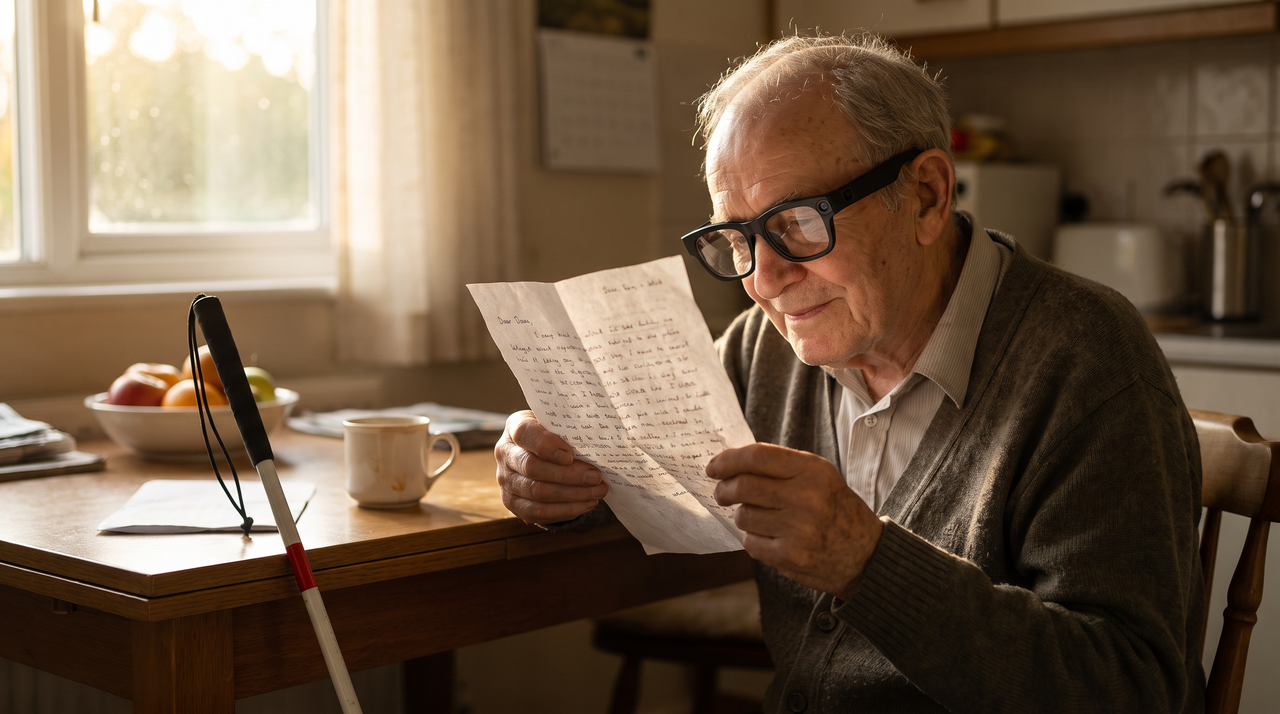
In Romiley, on the eastern edge of Greater Manchester, an optometrist called Aled Brassington runs a small independent practice and sells a product he was initially reluctant to stock. Colleagues persuaded him. He now reports that the majority of the people buying Ray-Ban Meta glasses from him have a visual impairment or a learning difficulty. One of his customers is practically illiterate. That man now has the world read aloud to him: labels, letters, the small print on a packet of tablets.
Writing to the Guardian on 14 August 2026, Brassington did not make the argument you would expect. He did not say the technology is wonderful and the critics are fools. He said something narrower and more disturbing. A week of British coverage branding the device “pervert glasses” had, he wrote, added a new anxiety for his patients. Not whether they could manage the journey into town — they had already solved that, which was the point of the purchase. Whether strangers would now assume the worst of them for wearing the thing that solved it.
That is a precise description of a specific harm. It is the moment an assistive device stops reading as a tool and starts reading as a costume. The white cane announces need. The Ray-Ban Meta, in Britain in August 2026, announces something else.
There is a lazy version of this article and it runs in two directions. In the first, a surveillance company has bolted a camera to a fashionable frame, men are using it to film women in gyms and on beaches, and the correct response is to get the thing out of public space; the disabled users are unfortunate collateral, and anyway, weren't they always going to be produced as human shields once the regulatory heat came on? In the second, disabled people have finally been handed an affordable route to independence after decades of four-thousand-pound devices that did less, and a moral panic driven by people who have never struggled to read a menu is about to take it away; how dare you.
Both readings are cheap in the same way. Each resolves the conflict by deciding in advance which set of people does not count. The harder position is that the surveillance objection and the accessibility objection are both substantially right, that they collide in specific places at specific moments, and that almost nobody involved in the August 2026 ban cycle — venue operators, campaigners, legislators or Meta — has done the work of designing the collision out.
A Week in Which a Device Became an Accusation
The chronology matters, because the speed of it is part of the story. Through early August 2026, British venues moved almost in unison. The pub chain Wetherspoons, with more than eight hundred outlets, instructed staff that customers could not record other patrons or employees without consent; its chairman Tim Martin framed the devices as breaching a general code against filming people who have not agreed to it. The restaurateur Jeremy King barred them from Simpsons in the Strand, Arlington and The Park, saying he would never knowingly allow any invasion of guest privacy other than with the eyes we were born with. ATG Theatres said audiences would be asked to remove them; Soho House extended its existing filming prohibition to cover them. On 14 August, His Majesty's Courts and Tribunals Service prohibited them across the courts of England and Wales, with confiscation on entry. By 20 August the UK Cinema Association was weighing a sector-wide position, its chief executive Phil Clapp acknowledging to Sky News that the same frames can deliver customised subtitling to people who need it.
Alongside the venues, a campaign. Stop Smart Glasses, created by the technology founder Liz Hunter and joined by the teacher Guy Holder — who had opened a parliamentary petition on 9 June calling for an immediate ban on the sale and promotion of the devices — began supplying retailers, politicians and opticians with letter templates and a database of stockists. Hunter's formulation, given to the Irish Times on 21 August, is the sharpest sentence the controversy produced: the wearer chooses to put a camera on their face, and everyone else is forced to live with that choice, which is a transfer of power dressed up as progress. The framing has kept travelling since. By October the Dutch optician chain Hans Anders had halted Ray-Ban Meta sales across the Netherlands and Belgium, and mock TfL stickers dubbing the glasses “pervert technology” — the work of the campaign group Everyone Hates Elon — had appeared on the London Underground.
Note what is absent from that sequence. Not one of those decisions, on the public record, was taken in consultation with a disability organisation. I could find no evidence in the reporting that the Royal National Institute of Blind People, Sense, Scope, Disability Rights UK or Muscular Dystrophy UK were asked for a position before the policies were written, nor approached for comment during the coverage cycle that produced the framing. Meta was asked. Privacy campaigners were asked. The people for whom the device is a prosthesis were, until the letters page of 14 August, a rhetorical device deployed by both sides. The silence held after August too. It was October before the first prominent intervention from the sector itself, when the RNIB and Guide Dogs publicly warned, in BBC coverage on 7 October, that venue bans risk excluding disabled people who rely on the glasses as accessibility aids, and urged venues to treat them as a reasonable adjustment under the Equality Act. The disability organisations did not help write the policies; they arrived two months after them, in the position of asking that what had already been announced be softened.
Colin Hughes, one of those letter writers, has severe limb girdle muscular dystrophy and cannot pick up or operate a smartphone. A former BBC producer, he uses the glasses to make calls, send WhatsApp messages, take photographs and start video calls entirely by voice. Writing on his own site in late July, he made an observation the venue policies have almost universally failed to absorb: safety measures should distinguish between recording and the many functions that do not involve recording at all. If he lost access, he wrote, he would be less safe, less connected and less independent. And then the line that should frame the whole debate: we should not have to choose between privacy and independence, we should insist on both.
Take the Case Against the Glasses at Its Strongest
The other side deserves better than the perfunctory nod it usually receives in accessibility commentary, because the harms are not hypothetical, not rare, and not a matter of etiquette. A BBC investigation published in January 2026 found dozens of male influencers on TikTok and Instagram using Ray-Ban Meta glasses to film women without their knowledge. One woman, identified only as Dilara and aged twenty-one, was recorded on her lunch break; the footage accumulated 1.3 million views and included her phone number, after which the messages and calls started. Another, identified as Kim, was filmed on a beach discussing details about her employer and her family she would not have disclosed had she known a camera was running.
Then the pipeline behind the lens. Investigations by the Swedish outlets Svenska Dagbladet and Göteborgs-Posten established that outsourced workers at the contractor Sama in Kenya were reviewing footage captured through the glasses, including material recorded in bedrooms and bathrooms. That reporting produced a class action, Bartone and others against Meta Platforms, filed on 4 March 2026 in the Northern District of California, alleging that marketing copy promising a product designed for privacy and controlled by the user could not be squared with a human review process buyers had no way of anticipating. The Information Commissioner's Office wrote to Meta the next day. The suit has since grown into something larger. Thirteen related cases were consolidated as In re Meta AI Glasses Litigation before Judge Edward M. Chen, with roughly seventy plaintiffs, and in September the proposed classes were expanded to include bystanders recorded by the glasses — people who never bought the device, never wore it and never agreed to any terms of use. On 24 September, Chen reset the case deadlines and allowed discovery to proceed, rejecting Meta's request to wait until its motions to compel arbitration and to dismiss were resolved. The case is in active discovery as of November.
The company's own data settlement compounds the point rather than answering it. Since a policy revision in April 2025, voice recordings triggered by the wake word are stored in the cloud by default and retained for up to a year, and American users can no longer opt out; the option survives in the European Union only because the law there is stricter. There is no meaningful on-device intelligence, since the AI functions are cloud-dependent by design. Which produces an irony the accessibility argument must swallow rather than dodge. The disabled user is the heaviest user of exactly the features that generate the most cloud processing. The person who most needs the glasses pays the highest privacy price for them, continuously.
The recording indicator, meanwhile, is a joke Meta is only now scrambling to un-tell. Small operations sprang up charging around sixty dollars to remove the LED permanently, and when the company blocked recording where the light was taped over, modders drilled the diode out. In July 2026 Meta shipped tamper detection that shuts the camera off if the indicator has been destroyed, a fix that cannot reach altered hardware; the Electronic Frontier Foundation had warned in March that the safeguard was trivially defeatable. The same month, the Financial Times reported Meta was testing “super sensing” prototypes capturing continuous audio and photographs every few seconds. Mark McCreary, a lawyer at Fox Rothschild, put the timing to Fortune with an economy the sector deserves: a cynic could say, don't look at the fire, look over here.
Above all this sits Name Tag, the facial recognition feature reported in February 2026 and provisionally slated for release later in the year. The year has since run out without the feature shipping: as of November, Meta maintains that nothing has been released to consumers and no final decision has been made, and the unreleased recognition code WIRED found inside Meta's AI app — rebranded in the code as “Connections” — was removed in an app update the day after the report appeared. Internal material indicated the company saw advantage in launching while civil society had its attention elsewhere. The opposition has been correspondingly broad: the Electronic Privacy Information Center has urged the Federal Trade Commission and state regulators to block the feature outright, Senators Markey, Wyden and Merkley demanded answers in March, more than seventy advocacy groups called in April for the feature to be scrapped entirely, and in August the German digital-rights group HateAid filed a criminal complaint over the glasses.
The academic picture confirms that ordinary people are not being irrational. A study led by Xueyang Wang, posted to arXiv on 5 March 2026, surveyed 525 people and ran twenty paired interviews with wearers and bystanders. It found a persistent gap: bystanders consistently demand stronger transparency and control than wearers will concede, and in sensitive settings between 65 and 90 per cent said they would take defensive action. That is not a communications problem. That is a population telling researchers it does not consent.
Why Three Hundred Pounds of Sunglasses Beats Four Thousand Pounds of Medical Device
Here is the part of the argument that the surveillance debate has almost entirely failed to metabolise, and it is not sentimental. It is economic and it is well documented.
The purpose-built low-vision market prices its products like medical equipment because that is how they are reimbursed and sold. An OrCam MyEye 3 Pro runs to roughly $4,490; an eSight Go is around $4,950. Meta's AI glasses start at $299, with Ray-Ban Meta frames retailing in Britain for roughly three hundred to three hundred and sixty pounds. That is not a marginal difference. It is the difference between a device a person buys on a Saturday and a device a person applies for.
Price is only the first advantage. The RNIB's own guidance lists what the glasses do: reading groceries, letters, instructions and recipes; reading street signs, timetables and departure boards; asking what is in front of the camera; making calls hands-free; connecting to a sighted volunteer through Be My Eyes. That is much of the functionality of a dedicated reader, in a device that also looks like sunglasses.
The appearance is not vanity. It is the mechanism. Disability studies has a term for the alternative, coined by Liz Jackson in 2019 and elaborated with Alex Haagaard and Rua Williams in 2022: the disability dongle, a well-intended, elegant and largely useless solution to a problem nobody identified, designed for a hypothetical disabled user by people who never asked a real one. The dongle wins design awards. The mainstream device wins because it is cheap, sold in ordinary shops, replaceable, and does not announce a diagnosis to every stranger in the room.
This has been measured. When researchers at Newcastle University led by John Vines ran extended trials of Google Glass with people with Parkinson's disease, publishing in Interacting with Computers, participants reported that the refined consumer appearance reduced stigma relative to conventional medical equipment, precisely because it did not look assistive. The finding recurs across decades of hearing aid research: a 2019 scoping review of working-age adults found visibility and appearance repeatedly cited as reasons for embarrassment and non-adoption.
So the assistive value is real, and inseparable from the mainstream form factor. But honesty requires the counterweight, and it comes from the disability sector itself rather than from Meta's critics in technology policy. Reviewing the glasses for the American Foundation for the Blind's AccessWorld in autumn 2025, Steven Kelley called them an accessibility tool only by coincidence. They were built to put photographs on social media. The AI is sometimes unreliable about where things are, and not fast enough to be trusted at a road crossing. And there is a bleak detail that ought to end any claim the glasses were designed with blind users in mind: the recording indicator, the single safeguard offered to bystanders, is a dim light many blind and low-vision people cannot perceive at all. As Ariana Aboulafia of the Center for Democracy and Technology observed in Tech Policy Press on 12 August 2026, that leaves disabled people disproportionately vulnerable to being recorded without knowing it. They are on both sides of this harm.
The Doorman Is Not Authorised to Make This Decision
The legal position in Britain is less comfortable for venue operators than the speed of the August announcements suggests.
Under the Equality Act 2010, a service provider's duty to make reasonable adjustments is anticipatory. It is owed to disabled people in general, not to the individual who happens to complain, and it must be discharged in advance rather than improvised when someone is refused entry. Section 20 expressly extends to changing a practice and to providing auxiliary aids. A blanket prohibition on a device that functions, for a particular customer, as an auxiliary aid is exactly the sort of practice the anticipatory duty exists to catch. Applied to an assistive user it also has an obvious indirect discrimination shape: a neutral rule that puts disabled people at a particular disadvantage, lawful only where the operator can show it is a proportionate means of achieving a legitimate aim.
That test is the whole game, and it does not deliver one answer across contexts. A theatre's aim of preventing filming during a performance is legitimate; a total prohibition on wearing the frames is unlikely to be the least intrusive route to it, particularly where captioning is the reason the customer bought them. A court's aim of preventing the photographing of witnesses is legitimate and unusually weighty, and the case for a hard rule is strongest there — although even HMCTS returns the device on exit rather than pretending the wearer's needs vanish at the door. A swimming pool changing room is different again, and this is where accessibility advocacy has to stop and take the point properly. A leisure centre owes safeguarding duties to children who are undressing. No configuration of a camera-bearing device makes those duties disappear, and no reasonable adjustment analysis requires a pool to accept the risk. The answer in that room is that the glasses come off, and the obligation this creates is that the venue provides assistance some other way rather than leaving a blind customer to work out the lockers alone.
American law arrives at the same structure by a different road. Writing on 1 June 2026, the employment lawyer Sara Jodka set out why categorical prohibitions are the wrong instrument under Titles I and III of the Americans with Disabilities Act. Smart glasses, she noted, deliver optical character recognition and live description for vision loss, real-time captioning for hearing loss, and task prompts for cognitive disabilities. A flat refusal without individualised assessment, she wrote, is the single largest source of ADA exposure in this area. Her alternative is conditioned permission: allow the device while configuring it, camera disabled, audio confined to the encounter, geography limited.
Layered above both, the international instruments say the quiet part explicitly. Article 9 of the UN Convention on the Rights of Persons with Disabilities obliges states to ensure access on an equal basis with others to information and communications, including technologies. Article 22 provides that no disabled person shall be subjected to arbitrary or unlawful interference with their privacy or correspondence. The Convention does not rank them. It asserts both, which is exactly what Colin Hughes asserted from his flat in London. And the European Accessibility Act, in force since 28 June 2025 with full compliance due by 2030, has begun pushing accessibility from a charitable add-on towards a product requirement across the single market.
An Exemption That Charges Admission in Dignity
So write the exemption. This is where the argument gets genuinely hard, and where the pressure to produce a tidy ending should be resisted.
An accessibility carve-out sounds obvious until you ask how it is administered at eleven o'clock on a Friday night by a nineteen-year-old on a door. The available mechanisms are all bad. Self-declaration is trivially gameable and every venue operator knows it, so it will not survive first contact with a viral video of someone filming in a toilet while claiming an exemption. Documentary proof means a disabled person carrying evidence of their condition to the pub and producing it to a stranger in front of a queue — a return to the medical model at precisely the point of social life where it does most damage, and a disclosure obligation no non-disabled customer will ever face. A registration scheme run by charities or by the manufacturer means building a national list of disabled people and their devices, a privacy harm of exactly the kind this controversy is supposedly about, imposed on the group least able to refuse it.
The most honest position anyone in the ban camp has taken is the Stop Smart Glasses campaign's own. Its accessibility page states that regulation should protect legitimate disability-related and assistive uses, then concedes that the precise mechanism needs to be developed with disabled people, accessibility organisations and relevant experts, not decided without them. That deserves acknowledgement. It is also, read plainly, an admission that a campaign demanding an immediate sales ban has not solved the problem its own ban would create — and that the petition it supports contains no carve-out at all. That petition crossed the ten thousand signatures that oblige a government response on 5 October, and closes on 9 December. The government's position is already on record: no specific legislation on smart glasses is planned, because existing criminal offences already cover the harmful conduct. Which is, in miniature, the conduct-first settlement this article argues for — arrived at by default, without any of the design work that would make it survivable for the people the ban campaign forgot.
I do not think there is a clean answer here, and articles that produce one are lying. What I think is defensible is a shift in the unit of regulation. Stop asking who is wearing the device and start asking what the device is doing. Hughes's distinction — between recording and the many functions that do not involve recording — is the only formulation that survives contact with a door policy, because it can be enforced against behaviour rather than against a person's medical history. A venue that prohibits capture, posts it clearly, trains its staff and removes people who film is enforcing a rule that applies identically to a smartphone, a body camera and a pair of Ray-Bans. A venue that prohibits the frames is enforcing a rule about faces.
When a Person's Need Becomes a Company's Press Release
None of which lets Meta anywhere near the moral high ground, and the timeline explains why.
The AI Glasses Impact Grants programme opened in January 2026 and drew nearly five hundred applications; recipients were announced on 27 July, distributing close to two million dollars across thirty organisations in eighteen states. On 18 August, in the middle of the British backlash, the disability dimension of that same programme was foregrounded: twelve of the thirty recipients working on disability, among them the American Council of the Blind, the Braille Institute of America and United Spinal Association. On 12 June, Meta had announced free glasses and training for every blind veteran in America, more than 130,000 people, with its chief technology officer Andrew Bosworth calling it a profound honour. On 12 August, Meta Ireland donated 15,000 pairs to Vision Ireland, covering every blind and low-vision adult on the charity's roster, at a moment when the company's relationship with Irish data protection authorities was, to put it gently, live.
Interrogate that pattern honestly and two things are true at once. The first is that the accessibility case is being deployed as a shield. Aboulafia's argument is that this is systematic rather than accidental: companies present disability benefit as justification for privacy-invasive capability, and the clearest evidence here is the internal reasoning about launching facial recognition while civil society is distracted. You need not impute bad faith to every grant officer to observe that a firm facing venue bans, a class action, an ICO letter and a parliamentary petition has an obvious interest in there being visible, sympathetic, quotable disabled users in every story written about it.
The second is that the case being useful to Meta does not make it false. The man in Romiley is still having his post read to him. Colin Hughes still cannot pick up a phone. Fifteen thousand people in Ireland did not become less blind because the donation was also good public relations. This is the invidious position disabled users occupy, and it is worth stating without softening: their genuine, materially transformative need has been conscripted as marketing by a company that then built a data pipeline they cannot opt out of, and their reward for saying so is to be told they are Meta's mouthpiece. The conscription is Meta's doing. The scepticism it earns lands on the wrong people.
The strongest version of the accessibility argument is therefore also a demand made of Meta, not only of venues. If the glasses are assistive technology, build them like assistive technology. On-device processing for reading and description, so that the person who uses them forty times a day is not sending forty images to a server. A recording indicator perceptible to people with low vision. An assistive mode that verifiably disables capture while preserving reading, translation, captioning and calls, so a venue can permit the device without permitting the camera. None of that is technically exotic, and Meta has since demonstrated the capture-free end of it from its own catalogue: in September the company announced Ray-Ban Meta Audio, a camera-free model keeping calls, music and live translation while dispensing with the lens. That a capture-free pair ships at all weakens every claim that the camera is inseparable from the product — though it also strips out the reading and description functions that make the camera-bearing pair assistive, which is precisely why the assistive mode has to live on the device, disabled at the function level, rather than being exiled to a different product. Accessibility, as the Canadian digital literacy educators at the White Hatter put it during the same controversy, must not become a shield protecting technology companies from the consequences of design decisions disabled people did not make.
Nairobi Was Never Offered the Expensive Option
The cost argument sounds like a British consumer preference until you leave wealthy countries, at which point it becomes the whole question.
On 22 August 2026, coverage emerged of Sightra, an assistive navigation system built by the Kenyan founders Ruth Nzuki and Brian Gillo. It runs as a web application on an ordinary phone rather than dedicated hardware, detecting cars, trees, furniture and other obstacles in real time and speaking descriptions into an earpiece, with GPS handling the route. The critical design choice is that it was trained on Nairobi and on Kenyan infrastructure rather than on the smooth pavements where most computer vision datasets are collected. Nzuki describes the benefit as the user knowing exactly what is ahead of them in their path. Julius Mbura, a lawyer with a visual impairment who tested it, said it would be critical for blind people. It costs a hundred dollars a year, with the first six months free, and the founders are targeting three to five thousand users in a country where the 2022 national survey found around two per cent of people aged five and over reporting difficulty seeing.
Set that against a $4,950 headset. In most of the world the purpose-built device does not exist at any price, and the mainstream phone or pair of glasses is not the cheap alternative to assistive technology; it is assistive technology. A settlement designed in London or Brussels that treats camera-bearing wearables as inherently illegitimate exports a norm to places where the substitute is nothing at all. That is not an argument against regulation. It is an argument that its object should be capture, retention and transfer — things a rule can govern across contexts — rather than the existence of a category of consumer device.
We Have Run This Panic Before and Someone Always Pays the Interim
The shape of this controversy is old, and the pattern of who absorbs the cost is consistent.
In September 2003, the Washington Post reported that health clubs around Washington had begun banning camera phones. No misuse had yet been reported at those clubs; managers were acting on potential. Legislators followed with the Video Voyeurism Prevention Act. Two decades later the camera phone is universal, the bans have evaporated, and the specific behaviour — covert recording in changing rooms — is prohibited by criminal law rather than by banning the device. That is roughly the correct destination, and it was reached by regulating conduct.
The Google Glass episode ran the other way. The Explorer programme, which had sold the beta device at $1,500, closed on 19 January 2015 after a backlash that produced the word “Glasshole”, bans in cinemas, bars and casinos, and at least one assault. What is rarely recorded is what that closure did to the users who had built genuine assistive workflows on the platform — the Parkinson's trials at Newcastle, the navigation prototypes for blind users, the autism support work. Those people had no mainstream product to fall back on, because the mainstream product had been killed by its social reception rather than by its technical failure. The Australian research led by Fareed Kaviani, surveying 1,037 people and published in PLOS ONE in 2024, found the mechanism still running: owners saw the devices as consistent with their self-image, non-owners saw privacy risk and antisocial potential. Stigma is not a mood. It is a mechanism that removes products from the market, and when it does, it removes the accessibility use with them.
The research emerging in 2026 suggests a settlement is technically available if anyone wants it. A CHI 2026 study titled See Me If You Can tested a privacy-by-default protocol combining on-device obfuscation with consent-based restoration, and found bystanders regarded opt-in as essential and wanted stronger anonymisation still. Work by Jieqiong Ding and colleagues, posted to arXiv on 8 April 2026, ran a smart glasses probe called CollabLens through mixed-vision workshops and found meaningful support for inclusive collaboration by expanding blind and low-vision participants' assistive networks — while noting, tellingly, that sighted participants were unsure how to adapt their own supportive behaviour. And a companion paper from Xiaoan Liu and colleagues, describing an always-on agent called VisionClaw built on Ray-Ban Meta hardware, found in deployment that users delegated more and more of their day to the system. That is the warning inside the promise. The direction of travel is towards continuous perception, and every argument made now about a device that records when told to will shortly have to be remade about one that perceives by default.
Regulate the Capture, Not the Face That Wears It
What does it mean for the man in Romiley when the debate about his glasses brands him suspicious? It means the technology has stopped being infrastructure and become a statement, and infrastructure that must be defended every time it is used is not infrastructure. It means the anxiety Brassington describes is a real access cost, imposed by a discourse rather than by a rule, and therefore reachable by no appeal and no remedy. It means a person who solved a hard problem now has a second stacked on the first, manufactured by people who were not thinking about him at all.
The right to accessibility does not survive a debate that treats disabled people as a distraction, because the anticipatory duty in the Equality Act is precisely a duty to think about people who are not in the room, and a policy written in a week under press pressure is by definition one that did not. The Guardian's own leader, by the account of the readers who wrote in, conceded the usefulness of the glasses to blind people and then asked that this not distract from the harms. Brassington's reply was that his patients were being cast as the distraction. He is right about the grammar, and the grammar reveals the priority.
But the reciprocal error is just as available, and disability advocacy should refuse it. The women filmed on the beach and in the gym are not a distraction from accessibility. Nor are the Kenyan contractors reviewing footage from bedrooms, nor the facial recognition feature waiting in the software, nor the 65 to 90 per cent of surveyed bystanders who said they would take defensive action in sensitive settings. Any settlement requiring those claims to be discounted is not a settlement; it is a different group being told they do not count.
The way through is narrower than either camp wants and mostly unglamorous. Regulate capture rather than devices, so the rule reaches a modified pair of Ray-Bans, a smartphone in a pocket and a body camera identically. Require an auditable assistive mode that disables recording while preserving reading, description, captioning, translation and calls, so permission can be conditioned rather than refused. Force processing on-device wherever the function permits, which answers the surveillance objection and the disabled user's own exposure in the same move. Make the indicator perceptible to the people least able to perceive it. Publish venue policies in advance, as the anticipatory duty already requires, and design the exceptions with disabled people before the ban rather than after the letters page. And accept that in a changing room the answer is no, and that the obligation this creates is to provide human assistance rather than pretend the problem is solved.
None of that is a compromise in which each side gets half. It is an insistence that the two rights in play — Article 9 and Article 22 — were never opposed at the level of function, only at the level of product design, and that they feel opposed because a company shipped a camera on a face and left everyone else to negotiate the consequences.
The man in Romiley did not ship anything. He bought a pair of glasses from a local optician and, for the first time, the world started reading itself to him. Whatever settlement Britain reaches about surveillance, the test of whether it was designed well is whether he can walk into a pub wearing them without rehearsing an explanation.
References
- The Guardian (2026). “Smart glasses controversy sidelines the benefits for disabled people,” letters, 14 August, syndicated. https://www.aol.co.uk/articles/smart-glasses-controversy-sidelines-benefits-152259000.html
- IBTimes UK (2026). “UK Court Service Bans Meta Smart Glasses After Restaurants, Theatres and Pubs Lead 'Spyware' Privacy Push.” https://www.ibtimes.co.uk/uk-courts-ban-meta-smart-glasses-privacy-concerns-1814197
- Euronews (2026). “UK cinemas consider ban on Meta 'pervert glasses' over piracy and privacy concerns,” 20 August. https://www.euronews.com/culture/2026/08/20/uk-cinemas-consider-ban-on-meta-pervert-glasses-over-piracy-and-privacy-concerns
- The Irish Times (2026). “New campaign aims to ban smart glasses,” 21 August. https://www.irishtimes.com/business/2026/08/21/new-campaign-aims-to-ban-smart-glasses/
- UK Parliament Petitions (2026). “Introduce an immediate ban on the sale and promotion of smart glasses,” petition 769206. https://petition.parliament.uk/petitions/769206
- Stop Smart Glasses (2026). “Exemption for disabled people.” https://stopsmartglasses.com/exemption-for-disabled-people/
- Hughes, C. (2026). “The smart glasses backlash is missing disabled people,” 30 July. https://www.aestumanda.com/opinion/2026/07/smart-glasses-backlash-disabled-people/
- National Law Review (2026). “Smart Glasses and Privacy: Wearable Surveillance and Disclosure Issues.” https://natlawreview.com/article/smart-glasses-and-privacy-wearable-surveillance-and-disclosure-issues
- TechCrunch (2026). “Meta sued over AI smart glasses' privacy concerns, after workers reviewed nudity, sex, and other footage,” 5 March. https://techcrunch.com/2026/03/05/meta-sued-over-ai-smartglasses-privacy-concerns-after-workers-reviewed-nudity-sex-and-other-footage/
- PetaPixel (2025). “Meta Updates Smart Glasses Policy to Expand AI Data Collection,” 1 May. https://petapixel.com/2025/05/01/meta-updates-smart-glasses-policy-to-expand-ai-data-collection/
- Fortune (2026). “Meta tightens Ray-Ban smart glasses privacy while it tests 'super-sensing' AI prototype,” 11 July. https://fortune.com/2026/07/11/meta-ray-ban-smart-glasses-camera-led-light-privacy-safeguard-super-sensing-ai-prototype-covert-recording-concerns/
- Electronic Privacy Information Center (2026). “EPIC Urges FTC, States to Block Meta's Facial Recognition Smart Glasses Plan.” https://epic.org/epic-urges-ftc-states-to-block-metas-facial-recognition-smart-glasses-plan/
- Aboulafia, A. (2026). “For Meta's Smart Glasses, Access Is An Afterthought,” Tech Policy Press, 12 August. https://www.techpolicy.press/for-metas-smart-glasses-access-is-an-afterthought/
- Kelley, S. (2025). “A Review of the Ray-Ban Meta AI Glasses for People With Low Vision,” AccessWorld, American Foundation for the Blind. https://afb.org/aw/fall2025/meta-glasses-review
- RNIB (2026). “6 ways Ray-Ban Meta smart glasses can help blind and partially sighted people.” https://shop.rnib.org.uk/blogs/news/6-ways-ray-ban-meta-smart-glasses-can-help-blind-and-partially-sighted-people
- Florida Reading and Vision Technology (2026). “OrCam vs. Envision vs. Ray-Ban Meta: Choosing the Right Smart Glasses for Low Vision.” https://floridareading.com/blogs/news/orcam-vs-envision-vs-ray-ban-meta-choosing-the-right-smart-glasses-for-low-vision
- Jackson, L., Haagaard, A. and Williams, R. (2022). “Disability Dongle,” Platypus, Committee on the Anthropology of Science, Technology and Computing. https://blog.castac.org/2022/04/disability-dongle/
- Vines, J., McNaney, R., Holden, A., Poliakov, I., Wright, P. and Olivier, P. (2017). “Our Year With the Glass: Expectations, Letdowns and Ethical Dilemmas of Technology Trials With Vulnerable People,” Interacting with Computers, 29(1), pp. 27-44. https://academic.oup.com/iwc/article/29/1/27/2607844
- Kaviani, F., Lyall, B. and Koppel, S. (2024). “Exploring social perceptions of everyday smartglass use in Australia,” PLOS ONE. https://pmc.ncbi.nlm.nih.gov/articles/PMC11530075/
- Wang, X., Peng, K., Yi, X. and Li, H. (2026). “Mind the Gap: Mapping Wearer-Bystander Privacy Tensions and Context-Adaptive Pathways for Camera Glasses,” arXiv:2603.04930. https://arxiv.org/abs/2603.04930
- Ding, J., Zhang, Y., Zhu, X. T., Yang, K., Wei, Y., Wang, S., Liu, Y. and Jiao, Y. (2026). “Reshaping Inclusive Interpersonal Dynamics through Smart Glasses in Mixed-Vision Social Activities,” arXiv:2604.07232. https://arxiv.org/abs/2604.07232
- Liu, X., Lee, D., Gonzalez, E. J., Gonzalez-Franco, M. and Suzuki, R. (2026). “VisionClaw: Always-On AI Agents through Smart Glasses,” arXiv:2604.03486. https://arxiv.org/abs/2604.03486
- Proceedings of the 2026 CHI Conference on Human Factors in Computing Systems (2026). “See Me If You Can: A Multi-Layer Protocol for Bystander Privacy with Consent-Based Restoration.” https://doi.org/10.1145/3772318.3790394
- Jodka, S. (2026). “When the Microphone Lives on Your Face: Smart Glasses in the Workplace and the Clinic,” Dickinson Wright Health Law Blog, 1 June. https://healthlawblog.dwlaw.com/2026/06/when-the-microphone-lives-on-your-face-smart-glasses-in-the-workplace-and-the-clinic/
- Equality Act 2010, UK Public General Acts. https://www.legislation.gov.uk/ukpga/2010/15/contents
- United Nations Division for Inclusive Social Development. “Article 9 – Accessibility,” Convention on the Rights of Persons with Disabilities. https://social.desa.un.org/issues/disability/crpd/article-9-accessibility
- United Nations Division for Inclusive Social Development. “Article 22 – Respect for privacy,” Convention on the Rights of Persons with Disabilities. https://social.desa.un.org/issues/disability/crpd/article-22-respect-for-privacy
- European Disability Forum. “European Accessibility Act: products and services required to be accessible.” https://www.edf-feph.org/accessibility-act-enters-into-force-products-and-services-must-be-accessible/
- Disability Scoop (2026). “Meta Taps Disability Groups To Explore Uses For AI Glasses,” 18 August. https://www.disabilityscoop.com/2026/08/18/meta-taps-disability-groups-to-explore-uses-for-ai-glasses/32130/
- Meta (2026). “Announcing the AI Glasses Impact Grant Recipients: Helping People Work, Learn, and Live More Independently,” 27 July. https://about.fb.com/news/2026/07/ai-glasses-helping-people-work-learn-live-independently/
- Meta (2026). “The Future Is for Everyone: Free AI Glasses for Every Blind Veteran in America,” 12 June. https://about.fb.com/news/2026/06/free-ai-glasses-for-every-blind-veteran/
- PPC Land (2026). “Ireland's blind adults gain 15,000 free Meta AI glasses in phased rollout,” 12 August. https://ppc.land/irelands-blind-adults-gain-15-000-free-meta-ai-glasses-in-phased-rollout/
- Africanews (2026). “Phone app helps Kenya's visually impaired get around,” 20 August. https://www.africanews.com/2026/08/20/phone-app-helps-kenyas-visually-impaired-get-around/
- The Voice of Africa (2026). “Kenya AI Accessibility Innovation Uses Local Roads to Help Visually Impaired Users Navigate,” 22 August. https://thevoiceofafrica.com/2026/08/22/kenya-ai-accessibility-innovation-uses-local-roads-to-help-visually-impaired-users-navigate/
- The Washington Post (2003). “Some Gyms Ban Camera Phones,” 23 September. https://www.washingtonpost.com/archive/lifestyle/wellness/2003/09/23/some-gyms-ban-camera-phones/9661df84-5be0-4256-9e3b-b31597dfb08b/
- Time (2015). “Google Glass Ends Explorer Beta Program.” https://time.com/3669927/google-glass-explorer-program-ends/
- Disability and Rehabilitation (2019). “Studies on stigma regarding hearing impairment and hearing aid use among adults of working age: a scoping review.” https://pubmed.ncbi.nlm.nih.gov/31177867/
- The White Hatter (2026). “Accessibility Shouldn't Be a Shield for Poor Technology Design & Privacy Concerns.” https://www.thewhitehatter.ca/post/accessibility-shouldn-t-be-a-shield-for-poor-technology-design-privacy-concerns
- BBC News (2026). “Blind and visually impaired people fear smart glasses backlash,” 7 October. https://www.bbc.co.uk/news/articles/cmx2qlz7ney2o
- Law360 (2026). “Meta AI Glasses Privacy Suit Expands To Add Bystander Class.” https://www.law360.com/articles/2520314/meta-ai-glasses-privacy-suit-expands-to-add-bystander-class
- CourtListener (2026). “In re Meta AI Glasses Litigation, No. 3:26-cv-01897-EMC,” docket, N.D. Cal. https://www.courtlistener.com/docket/72365892/in-re-meta-ai-glasses-litigation/
- PetaPixel (2026). “Meta Removes Facial Recognition Code from Ray-Ban Smart Glasses App,” 9 June. https://petapixel.com/2026/06/09/meta-removes-facial-recognition-code-from-ray-ban-smart-glasses-app/
- Markey, E., Wyden, R. and Merkley, J. (2026). “Markey, Wyden, Merkley Demand Transparency from Meta on Facial Recognition Technology in Smart Glasses,” 17 March. https://www.markey.senate.gov/news/press-releases/markey-wyden-merkley-demand-transparency-from-meta-on-facial-recognition-technology-in-smart-glasses
- American Civil Liberties Union (2026). “ACLU and 75 Organizations Sound Alarm on Meta's Plan to Add Facial Recognition Technology to Ray-Ban and Oakley Eyeglasses,” 13 April. https://www.aclu.org/press-releases/aclu-and-75-organizations-sound-alarm-on-metas-plans-to-add-facial-recognition-technology-to-ray-ban-and-oakley-eyeglasses
- Reuters (2026). “German advocacy group lodges criminal complaint over Meta AI glasses,” 12 August. https://www.reuters.com/legal/government/german-advocacy-group-lodges-criminal-complaint-over-meta-ai-glasses-2026-08-12/
- TechCrunch (2026). “Meta introduces camera-free AI glasses,” 23 September. https://techcrunch.com/2026/09/23/meta-introduces-camera-free-ai-glasses/
- Channel News Asia (2026). “Dutch eyewear chain Hans Anders halts sale of Meta glasses, citing privacy concerns,” 2 October. https://www.channelnewsasia.com/business/dutch-eyewear-chain-hans-anders-halts-sale-meta-glasses-citing-privacy-concerns-6427331

Tim Green UK-based Systems Theorist & Independent Technology Writer
Tim explores the intersections of artificial intelligence, decentralised cognition, and posthuman ethics. His work, published at smarterarticles.co.uk, challenges dominant narratives of technological progress while proposing interdisciplinary frameworks for collective intelligence and digital stewardship.
His writing has been featured on Ground News and shared by independent researchers across both academic and technological communities.
ORCID: 0009-0002-0156-9795 Email: tim@smarterarticles.co.uk
Listen to the free weekly SmarterArticles Podcast