The Exported Thirst: How AI Drinks Water India Cannot Spare
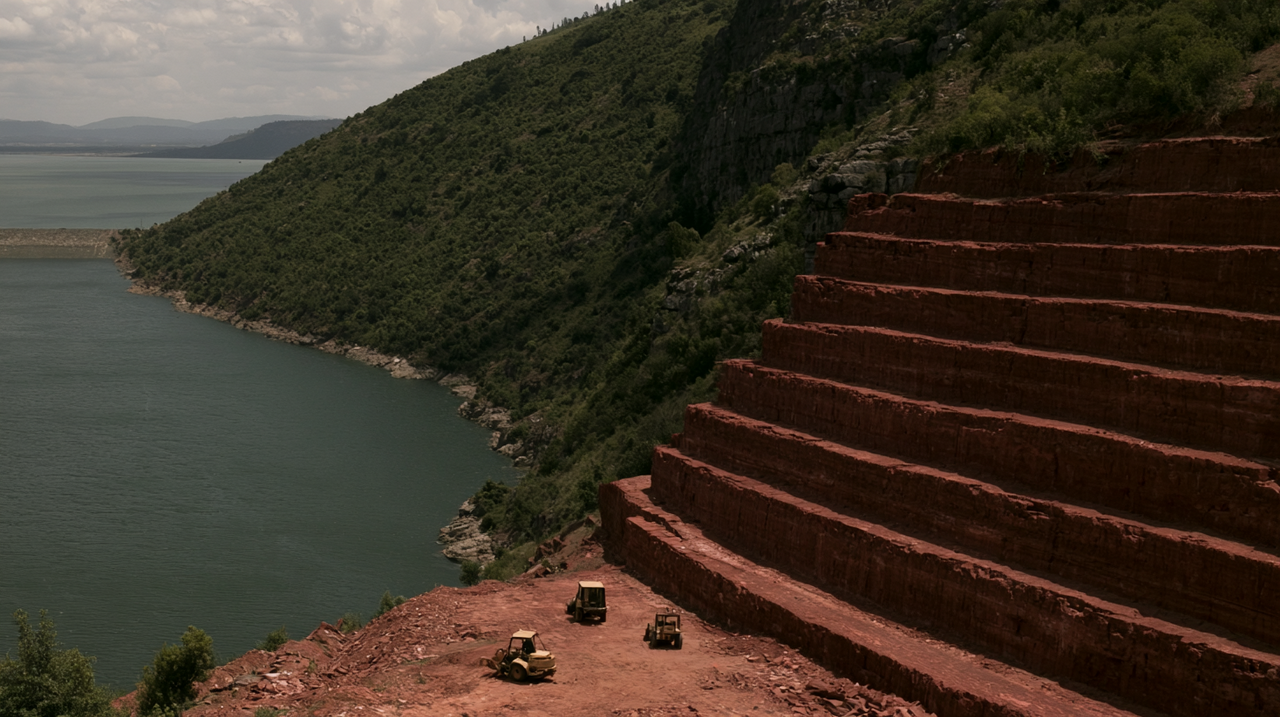
The hillside above Adavivaram has been stripped to red earth and cut into terraces, a staircase of raw laterite climbing away from the coast. Reuters journalists who walked the site in early August found work proceeding at full pace, earthmovers reshaping a slope that until recently was green. Below the cut, roughly 120 metres away according to the Human Rights Forum, sits the Mudasarlova reservoir, one of the water bodies that keeps Visakhapatnam's taps running. Within a kilometre in the other direction lies the Kambalakonda Wildlife Sanctuary, home to leopards and pangolins, and, in the assessment Reuters reported, only 860 metres from the construction site itself.
In the city below, activists and children have marched with banners reading “We cannot drink DATA”, some painting handcuffs on to the Google logo. On the Sunday before the Reuters visit, campaigners met to plan door-to-door awareness drives and beach protests. It is not the reception a 15 billion dollar investment usually gets.
This is Google's largest AI infrastructure project outside the United States: a gigawatt-scale campus, built with the Adani Group and Bharti Airtel, announced in October 2025 and intended to make Visakhapatnam a landing point for subsea cables and a node in the global machinery of artificial intelligence. Andhra Pradesh's chief minister, Nara Chandrababu Naidu, laid the foundation stone in April 2026, targeting completion by September 2028. The state calls it historic and transformational.
It is also being built in a city that does not have enough water. By the state's own accounting, cited by Reuters, Visakhapatnam receives about 410 million litres a day against a requirement of 480 million. Rationing is routine for a population of roughly 2.5 million. Mongabay India reported that Visakhapatnam district holds the lowest volume of available groundwater of any district in Andhra Pradesh, 2.12 thousand million cubic feet as of 1 April 2026. Into this basin, the state has promised the project guaranteed water for twenty years.
The question that raises is not simply whether Visakhapatnam can spare the water. It is a question about the shape of the AI economy: what it means that the physical substrate of a technology consumed overwhelmingly in wealthy countries is being poured, literally, into the ground of places that cannot afford it, and what anyone in those places is entitled to demand in return.
Why Andhra Said Yes
Start with the strongest possible version of the case for building it.
India is not a bystander in the AI economy. Mongabay India reported that the country hosts something like 20 per cent of the world's data while holding around 3 per cent of global data centre capacity. That asymmetry is not neutral. Indian data sits on foreign soil, under foreign jurisdiction, and the value generated by processing it accrues elsewhere. Every argument European governments have made for digital sovereignty applies to India with more force, because India has more to lose.
Andhra Pradesh wants to change that, pursuing roughly 6.5 gigawatts of compute capacity. India's total stood at about 1.5 gigawatts at the end of 2025, up from around 375 megawatts in 2020, with Deloitte forecasting 8 to 10 gigawatts by 2030. Visakhapatnam, with its coastline, port, subsea cable potential and engineering colleges, is the obvious place for a large slice of it.
The economics offered are considerable. State officials have put job creation at up to 188,000 across the project's ecosystem. Google has committed to new transmission lines, clean energy generation and storage, and says it is building its own renewable generation without state or central incentives. The Tribune reported the allotment of 480 acres across Visakhapatnam and Anakapalli districts. Land has been discounted, stamp duty waived, electricity and water tariffs reduced and tax reimbursed during construction, a package the News Minute totalled at around 22,000 crore rupees.
Then there is the moral argument, which deserves to be taken seriously rather than waved away. Western commentators objecting to a data centre in India are objecting to infrastructure of a kind their own countries have built freely for twenty years. Northern Virginia hosts more capacity than most nations; Ireland's grid has been reshaped around it. To insist the footprint is acceptable in Loudoun County but not in Anakapalli requires justification, and “we got there first” is not one. Refusing the Global South the compute the Global North takes for granted, in the name of protecting it, entrenches precisely the dependency that sovereign AI programmes exist to break.
So the case is real. The problem is that almost none of it survives contact with the specifics.
The Arithmetic of Thirst
Water numbers in the data centre debate are unusually slippery, and the slipperiness is not accidental.
The first distinction is between withdrawal and consumption. A facility that withdraws a million litres, passes it through a heat exchanger and returns it a few degrees warmer has consumed almost nothing, though it has still altered the river. A facility that evaporates the same million litres through a cooling tower has consumed all of it. The water is not destroyed, but it has left the basin, and for the people downstream that is the only definition of loss that counts. Headline figures routinely conflate the two.
The second distinction is between on-site and off-site water: what the cooling system uses, versus what was consumed generating the electricity the facility draws. For most of the world's grids, the second dwarfs the first. The third problem is opacity. Nobody outside the companies knows the real figures, because until very recently nobody published them.
Consider what the Visakhapatnam project has declared. According to the News Minute's reporting on the clearance documents, the special purpose vehicles behind the campuses declared a combined water requirement of 501 kilolitres a day, of which 446 would be fresh and 55 recycled. That is roughly half a million litres a day. Set against a city deficit of 70 million litres a day, it sounds trivial.
Now set it against the other numbers in the same documents. The declared power requirement is 1,626 megawatts, plus 971.5 megawatts of diesel backup. A facility drawing more than one and a half gigawatts while consuming half a million litres a day would be, by a wide margin, the most water-efficient large computing installation on Earth. It is not impossible; fully air-cooled designs approach that profile. But it sits uneasily beside estimates from the other direction. Raja Rama Mohan Roy, founder of the non-profit Green Visakha and author of a widely circulated analysis in Countercurrents, puts the cluster's likely freshwater requirement at 55 to 70 million litres a day.
The gap between half a million litres and seventy million is not a rounding error. It is two orders of magnitude, and it exists because there is no mandatory, audited disclosure of data centre water use in India, or almost anywhere else. Mongabay India found that of the fifteen Indian states with dedicated data centre policies, most set no performance standards at all for power or water usage effectiveness, and that a national policy drafted by the electronics and IT ministry has sat unfinalised since 2020. A community cannot argue about a number nobody is required to produce.
The Water You Cannot See
Even if the on-site figure turns out to be genuinely small, the off-site figure will not be.
India's electricity still comes predominantly from coal, and thermal generation is intensely water-hungry because steam turbines require cooling. Under India's Environment (Protection) Amendment Rules, plants commissioned after 1 January 2017 may consume up to three cubic metres of water per megawatt-hour, a limit itself diluted from a stricter 2.5, and one the Centre for Science and Environment has repeatedly documented the sector failing to meet.
Do the arithmetic. A facility drawing one gigawatt continuously for a year consumes roughly 8.76 terawatt-hours. At three cubic metres per megawatt-hour, the embedded water in that electricity is on the order of 26 million cubic metres a year, around 72 million litres a day. That is a back-of-envelope figure, and the real number depends on the generation mix, on how much load is genuinely matched to wind and solar, and on whether the thermal plants use once-through or closed-cycle cooling. But the order of magnitude is the point. The water embedded in the electricity is plausibly a hundred times the water declared for the cooling system.
Google's commitment to build its own renewable generation matters, and in the right direction: solar and wind consume almost no water in operation. But grid-scale matching is an accounting exercise, not a physical one. A data centre running at three in the morning draws electrons from whatever is spinning, and in Andhra Pradesh that is largely coal. The declared diesel backup is a further reminder that keeping a gigawatt of silicon alive on an imperfect grid does not resemble the press release.
This is the analytical heart of the question, and it appears in neither the sustainability report nor the protest banner. The relevant footprint is the pipe entering the building, plus the river cooling the power station, plus the reservoir behind the pumped storage plant that firms the renewables. Count only the first and a gigawatt of compute consumes less water than a mid-sized hotel.
Air Cooling and Its Bill
Google's stated answer is air cooling, and this is a material concession rather than a public relations gesture.
On 3 June 2026 the company published water stewardship commitments that go further than any comparable operator. Google said it would only consider water cooling where local resources are healthy and resilient, and that where a source is at high risk it would choose air cooling or recycled water. It committed to replenishing more water than it consumes across its sites by 2030, a broadening of the 120 per cent replenishment target it had previously set, and put figures behind it: 165 water stewardship projects across 97 watersheds, expected to replenish more than 19 billion gallons a year, more than double what the company consumed in 2024, supported by more than 500 million dollars for water and reuse infrastructure. It also committed to reporting data centre water use by location, the first major cloud provider to do so. Its 2026 environmental report, published on 30 June, stated the company replenished approximately 7.7 billion gallons in 2025, roughly 78 per cent of its freshwater consumption. Google has cited a new Indian data centre as a site where watershed assessment pushed it towards air cooling, and told Reuters the Visakhapatnam project would use advanced air cooling to protect vital local water resources.
Take that at face value and it is a win for the campaigners, and it is also the direct result of pressure. Google did not adopt a watershed risk screen in a vacuum. It adopted one after Querétaro, after Santiago, after years of local resistance in exactly the places where communities had the standing to make trouble.
But air cooling is not free, and the bill lands on the other side of the ledger. Removing heat with air rather than evaporating water requires more fans and airflow, typically around ten per cent more electricity for equivalent cooling. On a coal-heavy grid, that means roughly ten per cent more embedded water consumed at the power station, plus the associated emissions. The net effect can be to move water consumption from one basin to another rather than eliminate it. It is a real improvement for Mudasarlova. Whether it is one for Andhra Pradesh depends on arithmetic nobody has published.
Replenishment carries a similar asterisk. Restoring a wetland in one watershed does not put water back into a different one, and a pledge to return more water than the company consumes is portfolio-wide arithmetic. Nineteen billion gallons replenished across ninety-seven watersheds is a global ratio, and a global ratio says nothing whatever about any particular basin, including the one above Mudasarlova. The commitment means something only if it is basin-specific, same-year and independently verified, and it has not yet been tested in Visakhapatnam.
Nine Days in April
If the water numbers are contested, the process that approved them is not. It is documented, and it is remarkable.
According to the News Minute's account of the clearance record, two special purpose vehicles owned by Adani Infra applied online for environmental clearance on 9 April 2026. The State Level Expert Appraisal Committee met on 10 April. Clearances were granted on 18 April. The foundation stone was laid on 28 April. Nine days elapsed between application and approval for one of the largest industrial developments in the state's history.
The mechanism was a classification decision. The projects were appraised as Category B2 building and construction projects under Schedule 8(a) of the Environment Impact Assessment Notification of 2006, a category requiring neither union government appraisal nor a public hearing. Schedule 8(a) defines it as covering built-up areas below 1.5 lakh square metres. Each of the two Visakhapatnam parks declared a built-up area of roughly 149,000 square metres. E.A.S. Sarma, a retired Indian Administrative Service officer who served as secretary to the Government of India in the power ministry and who lives in Visakhapatnam, has written repeatedly to the environment ministry arguing that the clearances were rushed, leaving little time for meaningful appraisal, and that states sometimes use Category B precisely to avoid central scrutiny. He has asked for them to be revoked.
The deeper problem is structural, and the government has confirmed it in Parliament. Kirti Vardhan Singh, minister of state for environment, forest and climate change, told the Rajya Sabha on 2 April 2026 that AI data centres do not, as such, require environmental clearance under the 2006 notification, and the government restated the position in Parliament in August 2026 with the thresholds spelled out. A data centre needs clearance only if it forms part of a building and construction project with a built-up area above 20,000 square metres, or a township or area development project covering fifty hectares or more, or one with a built-up area of 150,000 square metres or more. India's assessment regime has no category for a facility whose defining impacts are electricity demand, water demand and heat rejection. It regulates the shed, not the machine inside it. A structure is assessed on its square metreage; the gigawatt it draws and the aquifer it taps are, formally, somebody else's department.
The consequences are predictable. The Human Rights Forum has objected that the forest department granted a no objection certificate for a 160-acre site adjacent to Kambalakonda and its notified eco-sensitive zone, and that nearly 90 per cent of the Tarluvada site overlaps the Pedda Chukka Konda reserve forest. Sarma argues that construction is blocking natural water inflows into Mudasarlova. The Forum has filed three cases at the National Green Tribunal. Bolisetti Satyanarayana, national convener of the water conservation network Jal Biradari, has a public interest litigation before the Andhra Pradesh High Court asking it to determine whether statutory environmental and wildlife clearances were required at all for data centre projects near Kambalakonda, and to protect the natural streams and drinking water sources below them. That case was listed for 2 September. The High Court advanced it to 24 August after an application alleging that land levelling, tree felling and other construction activity were continuing on the slopes of the Simhachalam hill range, and directed the respondents to file their answers before the earlier date. A court moving its own timetable forward because the building is outrunning the case is a precise measure of the difficulty: once the participatory channels are closed, litigation is the only instrument left, and litigation moves more slowly than an earthmover. The state denies the project was fast-tracked, and says no water intended for rural or residential use will be diverted, and that the nearby reservoir will not be drawn upon.
Notice what is missing. At no point was there a statutory public hearing. The people of Adavivaram, Tarluvada and Rambilli were not asked. They are litigating because litigation was the only channel left open to them.
The Sovereignty Trilemma
Visakhapatnam is a specific place with specific hills and a specific reservoir. It is also an instance of a pattern that has now been mapped.
In July 2026 a team led by Muntaser Syed, with Marius C. Silaghi, Sheikh Abujar, Sharun Akter Khushbu and Amal El Ahmad, published a study on arXiv titled “The Environmental Cost of Digital Sovereignty: Water, Energy, and Emissions Impacts of Sovereign AI Infrastructure in the Global South”. Nations across the Global South have committed over 200 billion dollars to sovereign AI development, it notes, and the environmental consequences have gone almost entirely unexamined.
The headline finding is stark. Of 52 developing countries with active sovereign AI programmes, roughly 70.6 per cent face high overall water risk according to the World Resources Institute's Aqueduct atlas. The overlap between where sovereign compute is being built and where water is already scarce is close to total. The paper models four cases: the United Arab Emirates, Bangladesh, India and Kenya. A hypothetical 1,024-GPU cluster using evaporative cooling in the UAE would require over 30 million litres a year. Bangladesh's plans, the authors found, contain no siting strategy at all, in a country where more than a fifth of the land floods in an average year and as much as 70 per cent of it in an extreme one.
The authors name the bind precisely, calling it a sovereignty-sustainability trilemma: the difficulty of simultaneously achieving AI sovereignty, environmental responsibility and affordable resources for citizens. Pick any two. A country can have sovereign compute and cheap water if it is prepared to wreck its basins. It can have environmental responsibility and affordable resources if it is prepared to rent its compute from Virginia.
India's position sharpens the point. The World Resources Institute ranks India thirteenth among countries facing extremely high baseline water stress, a group in which agriculture, industry and municipalities withdraw more than 80 per cent of available supply in an average year. This is the country in which the world's largest overseas AI campus is being built.
The global demand curve makes local decisions cumulative. Pengfei Li, Jianyi Yang, Mohammad A. Islam and Shaolei Ren, in the paper that first forced water into the AI conversation, projected that global AI demand would account for 4.2 to 6.6 billion cubic metres of water withdrawal in 2027. The error bars are wide, and its authors say so. But no plausible version of it is small, and every cubic metre lands somewhere specific. Pedram Bakhtiarifard, Pınar Tözün, Christian Igel and Raghavendra Selvan, in a position paper accepted for ICML 2026, argue that treating sustainability as an emissions question alone obscures the tension between expanding access and expanding resource use.
Who Gets To Be Consulted
In July 2026, at the annual session of the United Nations Expert Mechanism on the Rights of Indigenous Peoples, data centres appeared substantially on the agenda for the first time.
Maren Storslett, a member of the Sámi Parliament in Norway, told the meeting that AI is resource-intensive and requires vast amounts of energy, and that in Sápmi large data centres already put immense pressure on their territories. She added a formulation since widely quoted: that the world must not only ask what AI can do, but what it should do, and that respect for the rights of Indigenous peoples must apply. Cheyenna Morgan, an enrolled member of the Keetoowah Band of Cherokee and coalition coordinator for Stop Data Colonialism, put it plainest: these impacts will be felt by regular people who did not ask to have these facilities in their neighbourhoods.
The demand was specific. Delegates called for data centre projects to comply with free, prior and informed consent, for in-depth impact studies before permitting rather than after, and for participation across a project's whole lifecycle. Roberto Anacé, a leader of the Anacé people of northeastern Brazil, described how a ten billion dollar facility proposed near his community had divided it; his people filed a formal complaint in 2025 alleging their consultation rights had been violated. Delegates cited precedents where consent regimes had bitten: a Google data centre in Santiago suspended by a Chilean environmental tribunal in 2024 over an inadequate impact assessment, construction moratoriums adopted by the Seminole Nation of Oklahoma and the Eastern Band of Cherokee Indians, and a 650-megawatt project in Alberta in which the Woodland Cree First Nation holds a 51 per cent stake.
Transpose that framework to Andhra Pradesh and it stops working. India does not accept that the international category of Indigenous peoples applies within its borders. It has not ratified ILO Convention 169, and it voted for the UN Declaration on the Rights of Indigenous Peoples while maintaining that all Indians are indigenous and the declaration is therefore not applicable domestically. What India has instead is a constitutional category, Scheduled Tribes, and a domestic architecture: the Fifth Schedule, designating Scheduled Areas; the Panchayats (Extension to Scheduled Areas) Act of 1996, requiring consultation with the gram sabha before land there is acquired; and the Forest Rights Act of 2006, requiring gram sabha consent for diverting forest land. On paper this is not weaker than free, prior and informed consent. In practice it is chronically under-implemented: Andhra Pradesh published PESA rules in 2011, fifteen years after the Act, and awareness among the communities it protects remains minimal.
Here is what gets lost in the framing. The three campuses are not in Scheduled Areas. Adavivaram, Tarluvada and Rambilli sit in the coastal belt, not the Fifth Schedule agency tracts of the hills, and the people fighting the project in the High Court are urban environmentalists, retired civil servants and residents worried about their taps. Presenting Visakhapatnam as a straightforward story of Indigenous dispossession would be inaccurate. The Adivasi dimension is real, but it is one step upstream, in the electricity.
The Power Comes From the Hills
A gigawatt-scale campus needs firm power, and firm power in a renewables-heavy system needs storage. Andhra Pradesh's answer has been pumped storage hydro, and its pumped storage projects are overwhelmingly located in the Fifth Schedule agency areas of the north of the state.
Reporting by The Wire documented five such projects allocated to private developers, with a combined capacity of 6,600 megawatts across around 2,260 acres in Parvathipuram Manyam and Alluri Sitharama Raju districts, ranging from Karrivalasa at 1,000 megawatts to Pedakota at 1,800. G. Rohit, state secretary of the Human Rights Forum in Andhra Pradesh, said the organisation was shocked at the brazen manner in which the projects had been granted in open contempt of the law, and that no information had been conveyed, no discussion had taken place and there had been no transparency. Ramarao Dora, convenor of the Andhra Pradesh Adivasi Joint Action Committee, said Adivasis in the scheduled areas oppose the projects because they rightly perceive them as harmful. The alleged breaches are specific: Section 5 of PESA, Section 6 of the Forest Rights Act, and the absence of the statutorily required consultation with the Tribal Advisory Council.
These projects predate the Google announcement and are not formally attached to it. That is exactly why they matter. The energy system that will make gigawatt-scale compute viable on India's east coast is being assembled in Adivasi territory, under a consent regime the communities concerned say is being ignored, and no clearance for a campus in Anakapalli will ever ask about it. The impact assessment stops at the fence line. The supply chain does not.
This is the governance gap in its purest form. Consent, where it applies at all, applies to the project on the land. The AI build-out is not a project on a piece of land. It is a system: a campus, a substation, a transmission corridor, a reservoir in the hills, a coal plant burning through a river's cooling capacity. Consent granted or withheld at any single node cannot govern the whole.
Counting the Jobs
The economic case deserves the same scrutiny, and it does not emerge unscathed.
The most careful recent evidence comes from Dany Bahar and Greg Wright, whose analysis of data centre employment effects was published by Brookings in May 2026 and updated on 10 August. Their finding is two-sided. Labour markets receiving their first large data centre see employment in data processing rise by 56 per cent over the first decade, with telecommunications gains of 43 per cent, an effect larger for hyperscale facilities than for colocation providers. But wages remain flat, home prices rise by two to five per cent, and the facilities themselves generate roughly 100 to 200 local jobs each. The authors' summary is that data centres do create jobs, but fewer than industry advocates claim.
Hold that against 188,000. The figure is an ecosystem projection covering construction, indirect and induced employment across a multi-year build-out, not a headcount of people who will work at the campus. Construction employment is genuine, substantial and temporary. Permanent operational staffing is measured in hundreds, because the facilities are automated by design.
That does not make the investment worthless. Subsea cable landings, transmission upgrades and low-latency compute are genuine public goods, and hyperscalers attract other hyperscalers. But it changes how the trade should be evaluated. If the state is discounting land, waiving stamp duty, cutting electricity tariffs for fifteen years and reimbursing tax up to 2,245 crore rupees, the public is buying something and should be told accurately what. Guaranteeing water for twenty years in a city with a 70 million litre daily deficit is itself a subsidy, and it is the one that has not been priced.
What Protection Would Actually Look Like
The gap between what communities in Visakhapatnam can demand and what communities in Santiago or Oklahoma have secured is not one of moral entitlement. It is a gap in legal machinery, and machinery can be built. Six changes would close most of it.
First, make data centres a distinct category under India's Environment Impact Assessment Notification, triggered by connected load and water demand rather than floor area, with mandatory public hearings above a threshold. A facility drawing 1,626 megawatts should not be appraised as a building. The government's own answer to Parliament establishes that it currently is.
Second, require cumulative, basin-level assessment. Visakhapatnam is not receiving one data centre but a cluster, with other operators also planning capacity in the region. Assessing each special purpose vehicle in isolation guarantees the aggregate impact is never examined by anyone.
Third, mandate full water accounting, disclosed publicly per site, independently audited, covering withdrawal and consumption separately and including the embedded water of purchased electricity. Google's per-location reporting is the right template and should be a licence condition rather than a voluntary pledge, applied to every operator. A two-order-of-magnitude gap between declared and estimated consumption should not be possible in a regulated industry.
Fourth, extend consent obligations along the supply chain. If a data centre's firm power depends on pumped storage in a Fifth Schedule area, the gram sabha consent requirements of PESA and the Forest Rights Act should attach to the offtaker as well as the generator. This is not exotic; it is the logic already governing due diligence for conflict minerals and forced labour.
Fifth, price and contract the water properly. Twenty-year guaranteed supply in a deficit basin should carry a full-cost tariff, a hard volumetric cap, automatic curtailment ahead of domestic and agricultural users during declared scarcity, and same-basin replenishment verified annually by an independent body. Credits earned in another watershed should not count.
Sixth, negotiate a binding community benefit agreement rather than relying on corporate social responsibility. The Alberta precedent, where a First Nation holds a majority stake in a 650-megawatt facility, shows the alternative to exclusion is not obstruction but ownership. Equity, local hiring guarantees, funded municipal water infrastructure and an enforceable grievance mechanism turn a community from an obstacle into a counterparty.
None of this requires India to accept a category of Indigenous peoples it has rejected for four decades. Every item is achievable inside its existing constitutional framework. They require only that the framework be applied.
Answering the Question From the Hillside
So what does it mean when the technology powering artificial intelligence in wealthier nations is fuelled by water drawn from a set of countries composed, almost entirely, of countries that cannot spare it? Of the 52 developing nations with active sovereign AI programmes, 70.6 per cent already face high water risk. That is not a claim about the developing world in general. It is a claim about the particular list of countries that have decided to build their own compute, and that list is made up, very nearly without exception, of places where the water has already run short.
It means, first, that the transaction is not what it appears. The exchange offered to Visakhapatnam is not water for prosperity. It is water, land, forest, forgone revenue, discounted power and twenty years of guaranteed supply, in return for a few hundred permanent jobs, a modest ecosystem effect, and a claim on digital sovereignty that will be exercised mainly by a company headquartered in Mountain View. That may still be a trade worth making. It is not the trade that was described.
It means, second, that the injustice is procedural before it is environmental. Nine days is not enough time to appraise anything, and a classification that avoids a public hearing is not a technicality; it is the whole ballgame. The people of Adavivaram did not lose an argument about water. They were never given the argument. Everything that has followed, the marches, the banners, the tribunal cases, the litigation the High Court pulled forward to keep pace with the diggers, is the sound of a community using the only instruments left after the participatory ones were bypassed.
It means, third, that the exported thirst is invisible even to the people exporting it. The user in London generating a summary cannot know that the marginal electron came from a coal plant in Andhra Pradesh, that the plant consumed three cubic metres of water per megawatt-hour, or that the reservoir firming the renewables sits on land an Adivasi gram sabha was never asked about. The trilemma identified by Syed and colleagues is invisible from the prompt box by design.
And what protections should exist? Not a veto exercised from abroad. The paternalism objection is right that the Global South should not be denied infrastructure the Global North built without asking anyone. But it cuts the other way, and harder. Communities in Chile, in Oklahoma and in Ireland have won moratoriums, suspensions, disclosure requirements and equity stakes, because they had standing, hearings, tribunals that would listen, and in some cases treaty rights. The paternalistic act is not insisting that Visakhapatnam gets protections. It is building at Visakhapatnam precisely because it will not.
The protections that should exist are the ones that already exist elsewhere: a statutory right to be heard before the earth is cut, audited disclosure of what will be consumed, consent obligations that follow the electricity to its source, and a share of the equity rather than a plaque on a wall. There is nothing in that list Google could not accept tomorrow and still make money, and nothing Andhra Pradesh lacks the power to require.
Work on the hillside above Mudasarlova continues. The terraces are cut, the red earth is exposed, and the monsoon runoff that used to feed the reservoir now finds a different path down. The High Court's hearing is listed for this week, the matter live before it as this goes to press. Whatever it decides, and whenever, the more consequential question was settled by default in nine days in April, by a form that classified a gigawatt of artificial intelligence as a building. The water will follow the law. The only thing still undecided is whose law it is.
Sources and References
- Reuters, “Google's $15 billion India data centre project battles water, wildlife concerns”, 6 August 2026, syndicated by The Kathmandu Post. https://kathmandupost.com/world/2026/08/06/google-s-15-billion-india-data-centre-project-battles-water-wildlife-concerns
- edie, “Google's $15bn India data centre project faces water and environmental challenges”, August 2026. https://www.edie.net/googles-15bn-india-data-centre-project-faces-water-and-environmental-challenges/
- Google, “Our first AI hub in India, powered by a $15 billion investment”, Google India Blog, 14 October 2025. https://blog.google/intl/en-in/company-news/our-first-ai-hub-in-india-powered-by-a-15-billion-investment/
- The Tribune (India), “Andhra govt allots 480 acres for Adani-Google AI data Centre in Visakhapatnam”. https://www.tribuneindia.com/news/business/andhra-govt-allots-480-acres-for-adani-google-ai-data-centre-in-visakhapatnam/
- Data Center Dynamics, “Google confirms $15bn data center project in Andhra Pradesh, India”. https://www.datacenterdynamics.com/en/news/google-confirms-15bn-data-center-project-in-andhra-pradesh-india/
- The News Minute, “Inside the subsidies for Google's Vizag data centre amid Andhra-Karnataka spar”. https://www.thenewsminute.com/andhra-pradesh/inside-the-subsidies-for-googles-vizag-data-centre-amid-andhra-karnataka-spar
- The News Minute, “Vizag Google Adani AI data centre: State govt rushed environmental clearance, activists allege”. https://www.thenewsminute.com/andhra-pradesh/vizag-google-adani-ai-data-centre-state-govt-rushed-environmental-clearance-activists-allege
- The News Minute, “HRF challenges legality of Adani-Google Vizag data centre, demands immediate stop”. https://www.thenewsminute.com/andhra-pradesh/hrf-challenges-legality-of-adani-google-vizag-data-centre-demands-immediate-stop
- Mongabay India, “India bets on data centres even as water, energy-use concerns mount”, May 2026. https://india.mongabay.com/2026/05/india-bets-on-data-centres-even-as-water-energy-use-concerns-mount/
- Mongabay, “Indigenous advocates push for rights protections around AI data centers”, July 2026. https://news.mongabay.com/2026/07/indigenous-advocates-push-for-rights-protections-around-ai-data-centers/
- Business & Human Rights Resource Centre, “Global: Indigenous leaders call for data centres projects to comply with their right to free, prior and informed consent during UN meeting”, July 2026. https://www.business-humanrights.org/en/latest-news/global-indigenous-leaders-call-for-data-centres-projects-to-comply-with-their-right-to-free-prior-and-informed-consent-during-un-meeting/
- Raja Rama Mohan Roy, “The Hidden Environmental Cost of AI: Can Visakhapatnam Afford Giant Data Centres?“, Countercurrents, July 2026. https://countercurrents.org/2026/07/the-hidden-environmental-cost-of-ai-can-visakhapatnam-afford-giant-data-centres/
- Countercurrents, “AI Data Centres and Environmental Justice: E.A.S. Sarma Urges Scrutiny of Projects Amid Ecological and Human Rights Concerns”, June 2026. https://countercurrents.org/2026/06/ai-data-centres-and-environmental-justice-e-a-s-sarma-urges-scrutiny-of-projects-amid-ecological-and-human-rights-concerns/
- Countercurrents, “HRF Demands Halt to Vizag Hyperscale Data Center Over Alleged Environmental Violations”, May 2026. https://countercurrents.org/2026/05/hrf-demands-halt-to-vizag-hyperscale-data-center-over-alleged-environmental-violations/
- Deccan Chronicle, “High Court Advances Hearing Over Data Centres Near Kambalakonda Sanctuary”. https://www.deccanchronicle.com/southern-states/andhra-pradesh/high-court-advances-hearing-over-data-centres-near-kambalakonda-sanctuary-1976576
- Muntaser Syed, Marius C. Silaghi, Sheikh Abujar, Sharun Akter Khushbu and Amal El Ahmad, “The Environmental Cost of Digital Sovereignty: Water, Energy, and Emissions Impacts of Sovereign AI Infrastructure in the Global South”, arXiv:2607.13443, 15 July 2026. https://arxiv.org/abs/2607.13443
- Pengfei Li, Jianyi Yang, Mohammad A. Islam and Shaolei Ren, “Making AI Less 'Thirsty': Uncovering and Addressing the Secret Water Footprint of AI Models”, arXiv:2304.03271. https://arxiv.org/abs/2304.03271
- Pedram Bakhtiarifard, Pınar Tözün, Christian Igel and Raghavendra Selvan, “Position: Neglecting the Sustainability of AI is Fuelling a Global AI Arms Race”, arXiv:2502.20016, accepted at ICML 2026. https://arxiv.org/abs/2502.20016
- World Resources Institute, “25 Countries, Housing One-quarter of the Population, Face Extremely High Water Stress”, Aqueduct Water Risk Atlas. https://www.wri.org/insights/highest-water-stressed-countries
- Google, “Google's water stewardship commitments for local communities”, 3 June 2026. https://blog.google/company-news/outreach-and-initiatives/sustainability/new-water-stewardship-commitments/
- Google, “Read Google's 2026 Environmental Report”, 30 June 2026. https://blog.google/company-news/outreach-and-initiatives/sustainability/2026-environmental-report/
- Down To Earth, “As told to Parliament (April 2, 2026): Centre acknowledges AI's energy and water footprint while key facilities remain beyond EIA mandate”. https://www.downtoearth.org.in/environment/as-told-to-parliament-april-2-2026-centre-acknowledges-ais-energy-and-water-footprint-while-key-facilities-remain-beyond-eia-mandate
- The Print, “AI data centres do not need environment clearance, Centre tells Parliament”, August 2026. https://theprint.in/environment/ai-data-centres-environment-clearance-centre-parliament/3007640/
- The Wire, “Andhra Pradesh: Pumped Storage Projects Spark Concerns over Tribal Displacement and Environmental Harm”, 6 December 2024. https://m.thewire.in/article/environment/andhra-pradesh-pumped-storage-projects-spark-concerns-over-tribal-displacement-and-environmental-harm
- Dany Bahar and Greg Wright, “New evidence on data center employment effects”, Brookings Institution, published 4 May 2026, updated 10 August 2026. https://www.brookings.edu/articles/new-evidence-on-data-center-employment-effects/

Tim Green UK-based Systems Theorist & Independent Technology Writer
Tim explores the intersections of artificial intelligence, decentralised cognition, and posthuman ethics. His work, published at smarterarticles.co.uk, challenges dominant narratives of technological progress while proposing interdisciplinary frameworks for collective intelligence and digital stewardship.
His writing has been featured on Ground News and shared by independent researchers across both academic and technological communities.
ORCID: 0009-0002-0156-9795 Email: tim@smarterarticles.co.uk
Listen to the free weekly SmarterArticles Podcast