AI Models and Body Image: Fix the Default, Not the Label
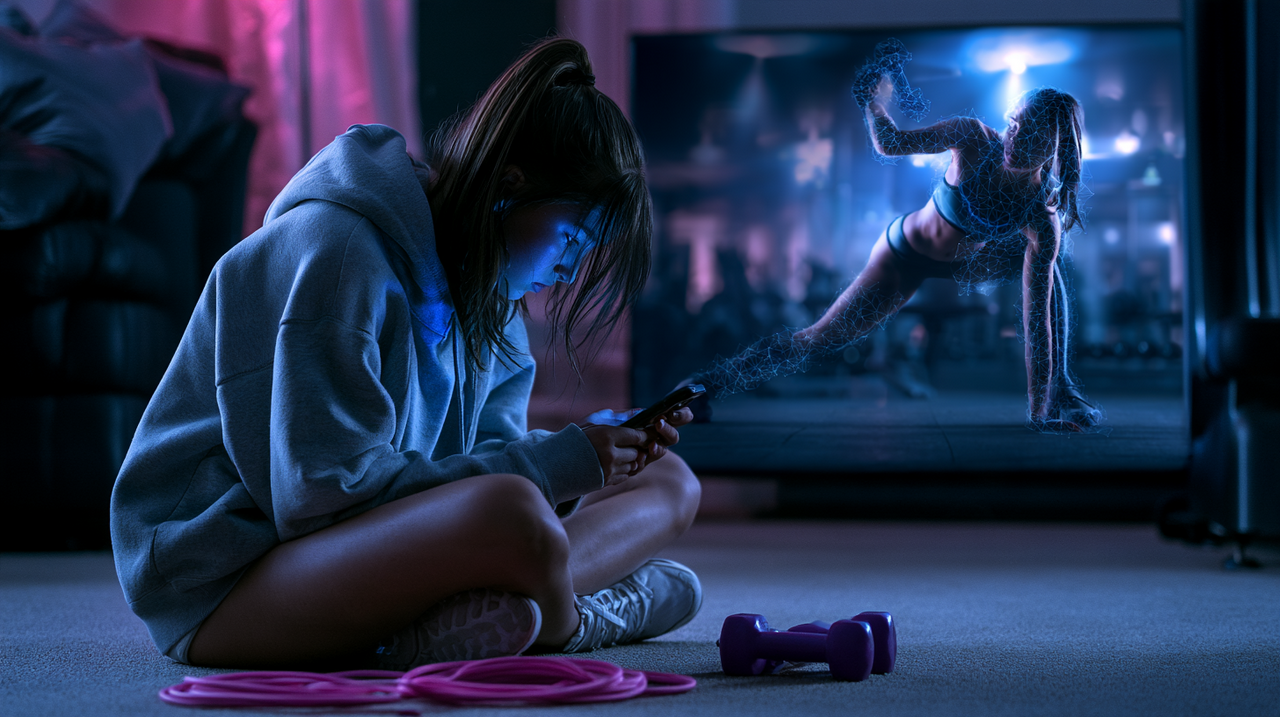
Somewhere in a comment thread under an image of a very thin young woman, a 12-year-old girl is asking for the workout routine. Nobody will answer her truthfully, because no routine exists. The woman in the picture never trained. She never ate, never slept, never stood in front of a mirror. She was generated.
That scene is not an invention for the purposes of this article. It is a pattern that Mia Perumal, a 19-year-old student at Cardiff University who has recovered from an eating disorder, described to the BBC in a report published on 4 October 2026. Over the past year, she said, she has watched very thin AI-generated people multiply across her social media feeds, and she has seen comments from girls as young as 12 asking how to get the body on screen. “It's all very well saying 'oh, it's AI, it's not real',” she told the BBC. “But eating disorders don't really listen to rationality.”
The same report carried a warning from Phillippa Diedrichs, professor of psychology at the Centre for Appearance Research at the University of the West of England in Bristol, whose research spans body image, eating disorder prevention and advertising. Generative systems, she explained, tend to fall back on narrowly defined traditional beauty standards unless someone deliberately prompts them to do otherwise. The result is that people of colour, and people with distinctive features, quietly disappear from the pool of images that young people measure themselves against. “If we're comparing ourselves to a very narrow beauty standard,” she said, “... that inevitably means that many of us are not going to meet those beauty ideals.”
Put those two observations side by side and a set of uncomfortable questions emerges. What happens to the way young people see their own bodies when the bodies they are invited to compare themselves with are not merely idealised, but invented? Does knowing that an image is synthetic offer any protection at all? And if the default image produced by these systems is a choice rather than a law of nature, what would happen if the industry decided to change it on purpose?
The research, some decades old and some published only this year, gives surprisingly clear answers. They are not reassuring.
Fashion Has Already Hired Models Who Do Not Exist
The BBC's warning landed in an industry that has been edging towards synthetic people for some time. In the August 2025 issue of American Vogue, an advertisement for Guess featured a flawless blonde model in a striped maxi dress and a floral playsuit. She had been created by Seraphinne Vallora, a London-based AI marketing agency founded by Valentina Gonzalez and Andreea Petrescu. A small line of text at the edge of the page disclosed that the model was AI-generated. It was the first time a synthetic person had appeared in the magazine, and the backlash was immediate.
Vanessa Longley, chief executive of the UK eating disorder charity Beat, told the BBC at the time that the development was worrying, warning that exposure to unrealistic bodies can damage self-esteem and that poor body image increases the risk of developing an eating disorder.
Guess was not alone. In March 2025, H&M announced it would create AI “digital twins” of 30 real models, working with the models and their agencies, and a campaign using those twins followed in the summer. The BBC's October report listed Balmain and Levi's among the brands that have experimented with AI models. The commercial logic is obvious: a synthetic model never ages, never gets ill and never needs a flight.
What the commercial logic leaves out is the person looking at the result. As Hannah Marriott, a lecturer in marketing and strategy at Cardiff Business School, argued in a piece for The Conversation in August 2026, consumers have long been able to recognise that a photograph has been heavily edited while still believing that a human being exists behind it. Synthetic models sever that link. “Authenticity may depend less on what a model looks like,” she wrote, “and more on whether consumers perceive them as genuinely human.”
Adult consumers, it seems, can be put off by synthetic models when they know what they are looking at. The question is whether that conscious scepticism reaches the part of the mind where body image actually lives.
Why the Mind Compares Itself With Strangers
In 1954 the American social psychologist Leon Festinger published “A Theory of Social Comparison Processes” in the journal Human Relations. His central proposal has proved remarkably durable: when there is no objective yardstick available, people evaluate themselves by comparing with others. Festinger also argued that people prefer to compare themselves with others who are reasonably similar. A novice chess player does not measure herself against a grandmaster.
Seventy years of body image research have complicated that last point. Appearance is a domain with no objective yardstick at all, and people compare themselves constantly with others who are not remotely similar: models, actors, athletes, influencers. Upward comparison with people judged more attractive is consistently associated with worse mood and greater body dissatisfaction. This is the engine behind what researchers call the thin ideal and, more recently, the fit ideal: the culturally specific picture of a desirable body that people absorb, or internalise, from the images around them.
Social media made that engine run faster by collapsing the distance between celebrity and peer. An influencer appears in the same feed as school friends and replies to comments. Festinger's similarity principle has been exploited rather than overturned. Synthetic influencers take this one step further: they are designed to look like people who might plausibly be in your feed, with gym selfies, beach shots and outfit posts. The 12-year-old asking for a workout routine is not making a mistake about genre. She has correctly read the visual cues that tell her this is a peer-like body, attainable through effort, and she has responded exactly as social comparison theory predicts. The problem is that the cues are false. The body was never attained through effort, because it was never attained at all.
There is a further twist. Even the most heavily retouched photograph of a real model began with a real body, constrained by anatomy. A retoucher could narrow a waist or lengthen a leg, but there was a skeleton underneath and a person who could, at least in principle, be met. A generated body has no such constraint. The comparison target is not merely an exaggerated human. It is a statistical composite presented as an individual.
What the Machines Learnt About Beauty
If generative systems produced a genuinely random spread of body types, the risk might be diluted. They do not. A steady accumulation of audits since 2023 shows that, left to their own devices, image generators reproduce and frequently amplify the narrowest version of conventional attractiveness.
In June 2023, Bloomberg published an analysis by Leonardo Nicoletti and Dina Bass of more than 5,000 images produced by Stable Diffusion. Under the headline “Humans Are Biased. Generative AI Is Even Worse”, it reported that the model took racial and gender disparities to extremes worse than those found in the real world.
A year later, in June 2024, The Washington Post asked three of the leading tools, Midjourney, DALL-E and Stable Diffusion, to generate pictures of a “beautiful woman”. Every single image depicted a thin woman. Just 2 per cent showed visible signs of ageing, and only 9 per cent showed women with dark skin tones. Diedrichs's warning about who gets left out is not a hypothesis. It has been measured.
The pattern holds when researchers look specifically at bodies. In a study published in Psychology of Popular Media and announced by the University of Toronto in November 2025, Delaney Thibodeau, a postdoctoral researcher in the Faculty of Kinesiology and Physical Education, and colleagues including Professor Catherine Sabiston systematically coded 300 images generated by Midjourney, DALL-E and Stable Diffusion. AI-generated women were overwhelmingly thin and AI-generated men hyper-muscular. Images of athletes were far more likely to show very low body fat and highly defined muscularity. Ninety per cent of images of an unspecified “athlete” showed a male body. Racial and age diversity was minimal, and not a single image showed a visible disability.
A preprint released in April 2026 by Justin Thomas and colleagues, titled “Underweight and Overrepresented”, went further. The researchers generated images of women in various occupations using prompts that said nothing about body size, then asked 129 American women to rate the figures' body size. The proportion of images perceived as underweight was more than three times the expected rate of underweight among American women. Women in higher-prestige occupations were more likely to be rated underweight. The study has not yet completed peer review, but its direction matches the wider literature.
A Fordham University study presented at a 2025 computational linguistics conference found the mirror image: DALL-E 3 tended to depict words such as “greedy” or “immoral” as heavier people. And in 2023 the Center for Countering Digital Hate found that image generators produced pictures glorifying unrealistic bodies in response to 32 per cent of prompts drawn from eating disorder forums.
None of this is mysterious. Generative systems are trained on vast collections of internet images saturated with advertising, fashion and stock photography, the very images body image researchers have spent decades criticising. They learn the historical bias of that visual culture and output its statistical centre with perfect lighting. Diedrichs's point about defaults is precisely this. The narrow ideal is not something the system has to be told to produce. It is what comes out when nobody tells it anything.
A Decade of Labels That Did Not Work
The intuitive response, and the one Mia Perumal says people keep offering her, is disclosure: tell young people the bodies are fake. Body image researchers have been testing that intuition for well over a decade with retouched photography, and the results are consistently discouraging.
In 2013, Marika Tiggemann and colleagues at Flinders University in Adelaide published a pair of experiments in the journal Body Image. Female undergraduates viewed fashion advertisements with no label, a generic warning that the image had been digitally altered, or a more specific warning. The labels produced no benefit. Worse, for women who habitually compared their appearance with others, the specific warning labels were associated with increased body dissatisfaction.
In 2018, Jasmine Fardouly and Elise Holland tested the social media version of the idea. They showed 164 young American women idealised Instagram images with or without disclaimer comments. Viewing the idealised images harmed body image regardless of the disclaimer. The only measurable effect of the disclaimers was that women formed a less positive impression of the person who posted them.
By 2020 there was enough evidence for a systematic review. Sarah McComb and Jennifer Mills of York University in Toronto examined 15 experimental studies on media disclaimers, publishing their findings in Body Image. Eleven found disclaimers ineffective at reducing body dissatisfaction after exposure to thin-ideal images. Three found medium-sized benefits. One found that disclaimers made things worse. Particularly troubling, specific and warning-style disclaimers appeared harmful for women who were already highly dissatisfied with their bodies, and in one case women with restrictive eating habits who saw a warning label went on to eat fewer calories than those who saw the same image without one.
A warning that draws attention to a body can increase the attention paid to it. For someone already vulnerable, a label saying “this waist has been altered” may simply confirm that the waist is the thing worth looking at.
Telling People It Is AI Changes Trust, Not Feelings
Perhaps AI is different. A label saying a body has been slimmed still implies a real body underneath; a label saying the whole person is synthetic seems more decisive. This year researchers began testing that directly, and the early answer is no.
In February 2026, the International Journal of Eating Disorders published a study by Brooke Bennett and colleagues at Clemson University in South Carolina. They recruited 296 women who were regular social media users and randomly assigned them to one of two groups. Both viewed ten AI-generated Instagram images of female content creators; only one was told they were AI-generated.
Both groups reported significantly lower body satisfaction after viewing the images. Knowing that the images were AI-generated made no significant difference to that decline. What disclosure did change was trust: the informed group showed a steeper drop in their trust in technology. The authors concluded that viewing AI-generated images of influencers negatively affects body image regardless of whether the role of AI is known, and that labels “may help keep the user informed” but “are not enough”.
A second experiment, published this year in Computers in Human Behavior: Artificial Humans by Jessica Alleva, Tuğba Türkcan, Linda Lin, Chrisa Sloutas and Jasmine Fardouly, reached a similar conclusion. The researchers showed 291 women aged 18 to 31 one of three sets of AI-generated images: bodies conforming to the fit ideal, bodies emphasising functionality and diversity, or neutral objects. Half of each group was told the images were made with generative AI. Women who saw fit-ideal imagery reported lower body appreciation than those in the control condition. Disclosure produced a small increase in one measure, appreciation of what the body can do, but made no difference to body appreciation or appearance satisfaction. And the effects of the imagery, positive and negative, were strongest among women who already tended to compare their appearance or had internalised appearance ideals.
Dove's own large-scale survey work, conducted with Edelman for its 2024 “Real State of Beauty” report across more than 33,000 respondents in 20 countries, found that one in three women felt pressure to alter their appearance because of what they saw online, even when they knew it was fake or AI-generated.
Put together, these findings make Mia Perumal's observation look less like intuition and more like a summary of the evidence.
The Gap Between Knowing and Feeling
Why should conscious knowledge offer so little protection? The research does not settle the mechanism, but the literature suggests several plausible explanations.
The first is that appearance comparison is fast and largely automatic. The comparison happens first, and any correction comes later, if at all. A label is read after the image has already been seen and evaluated.
The second is internalisation. Once a person has absorbed a particular ideal as the standard of what bodies should look like, every image that matches the ideal reinforces it, whether or not that specific image is real. A synthetic body does not need to be believed in to confirm what the viewer already thinks a good body looks like.
The third concerns vulnerability, and it is the most important for the girls Mia Perumal describes. Several of the studies cited here, from Tiggemann's in 2013 to Alleva's in 2026, found the harm concentrated among people who already compared themselves heavily or had already internalised appearance ideals. Those are precisely the people most at risk of developing eating disorders, and adolescence is a period when appearance comparison and body concern often intensify.
The scale of that risk in the UK is not small. NHS England's 2023 follow-up to its Mental Health of Children and Young People survey found that 12.5 per cent of 17 to 19 year olds in England had an eating disorder, up from 0.8 per cent in 2017. Among young women in that age group the figure was 20.8 per cent. Methods differed between survey waves, so the comparison should be treated with caution, but the direction is hard to ignore.
Eating disorders are not simply mistaken beliefs that the right information will correct. They involve compulsions, fears and distorted perceptions that resist argument. Telling someone in the grip of one that the image is not real is a little like telling someone with a phobia that the spider is harmless. The statement is true. It is also beside the point.
Laws Written for the Airbrush
Governments have tried to regulate idealised imagery before, and most interventions have been built on the disclosure model the research now calls into question.
Israel was an early mover. Its so-called “Photoshop law”, passed by the Knesset in March 2012 and in force from 1 January 2013, required fashion and commercial models to have a body mass index of at least 18.5, and required advertisers to disclose when images had been digitally altered to make models look thinner.
France followed. Under a 2016 health law and a decree that took effect on 1 October 2017, commercial photographs in which a model's body shape or silhouette had been altered by image-editing software must carry the words “photographie retouchée”. Breaches carry fines of up to 37,500 euros, or up to 30 per cent of the cost of the advertisement.
Norway went further still. Since 1 July 2022, its Marketing Control Act has required a standardised label on paid advertising, including sponsored influencer posts, in which body shape, size or skin has been altered by retouching or other manipulation, including filters. Its stated aim is to make consumers, particularly children and young people, aware that the people in advertisements deviate from reality.
In the UK, the Conservative MP Luke Evans introduced a Digitally Altered Body Images Bill in September 2020, and again as a Ten Minute Rule Bill in January 2022, proposing a logo for advertisements in which a body's proportions had been digitally altered. Neither version progressed. Instead, the Advertising Standards Authority has acted case by case. In February 2021, following the #filterdrop campaign started by the make-up artist Sasha Pallari, the ASA ruled that two tanning brands' influencer advertisements were misleading because filters exaggerated what their products could do.
All of these interventions share an assumption: that there is a real body somewhere, and that the problem is the gap between that body and its altered image. Synthetic models dissolve that assumption. There is no original body to deviate from. A Norwegian-style label stating that a body has been retouched makes little sense when the whole body has been generated, and the research suggests that changing the wording to “AI-generated” would not make the label work any better.
The newer generation of rules aimed specifically at AI largely inherits the same logic. The EU's AI Act, whose transparency obligations under Article 50 began applying on 2 August 2026, requires providers to mark synthetic images in a machine-readable format and requires deployers to disclose deepfakes, which the Act defines broadly to include content that resembles real or plausible persons. The Digital Omnibus on AI, Regulation (EU) 2026/1744, which entered into force on 27 July 2026, deferred most high-risk obligations but left these transparency rules in place. Its one concession gives providers of generative systems already on the market before 2 August 2026 until 2 December 2026 to comply with the machine-readable marking duty in Article 50(2). Machine-readable marking is aimed at detection tools rather than human eyes, and disclosure is precisely what the research finds wanting.
The UK regulator has been commendably honest about this limitation in a related context. In guidance published on 29 May 2025, the ASA stated that “disclosure alone is very unlikely to mitigate the harm caused by a fundamentally misleading message”. It warned that using an AI-generated image to show the effect of a cosmetic product that does not reflect real-world results is likely to be materially misleading, whatever the label says. Yet the same guidance noted that making clear an influencer is AI-generated “could well help to negate an otherwise misleading impression”. That may hold for whether a consumer has been misled about a product. It is a different question from whether a child's body image has been harmed.
The Online Safety Act 2023 does not fill the gap either. Since 25 July 2025, platforms have been under a legal duty to protect children from “primary priority content”, which includes material that encourages, promotes or gives instructions for an eating disorder. But a polished image of an impossibly thin synthetic fitness influencer does not, on its face, encourage an eating disorder. It simply sits in the feed, looking aspirational, accumulating comments from 12-year-olds.
Defaults Are Decisions
If disclosure is weak, the logic of the evidence points somewhere else: not to warning people about the images, but to changing the images themselves. This is where the third question raised by the BBC report becomes concrete. What would it mean for appearance standards if the industry default were changed by design rather than left to reflect whatever the systems have learnt?
Nothing about the current default is neutral. A generator that produces only thin women when asked for a beautiful one has not discovered a fact about beauty. It has reproduced decades of commercial decisions by advertisers, editors and casting directors, and leaving that output unchanged preserves those decisions at enormous scale.
Changing defaults is not a radical idea in imaging. In September 2017, Getty Images, the world's largest stock photography supplier, told contributors that from 1 October it would no longer accept “any creative content depicting models whose body shapes have been retouched to make them look thinner or larger”. That was a design decision at the level of supply, not a label at the level of the viewer.
A major brand has also tried to intervene at the level of the prompt. In April 2024, marking 20 years of its Campaign for Real Beauty, Dove pledged never to use AI to create or distort images of women in its advertising, and published what it called the Real Beauty Prompt Guidelines: guidance on the language needed to get generative tools such as Midjourney and DALL-E to produce more representative images. Dove's chief marketing officer, Alessandro Manfredi, said the company sought “a future in which women get to decide and declare what real beauty looks like, not algorithms”. Diedrichs, who has collaborated with the Dove Self-Esteem Project, observed at the launch that it was becoming “increasingly difficult to distinguish between what is real beauty and what is manufactured by AI”.
But prompt guidelines place the burden on the user, exactly the situation Diedrichs described to the BBC: diversity appears only when someone deliberately asks for it.
The Evidence That Different Images Help
Would changing the default actually help? Here the research is more encouraging than it is about labels.
In 2011, Diedrichs and Christina Lee published a study in Psychology and Health with the memorable title “Waif goodbye!”. They showed 171 women and 120 men advertisements featuring thin models, average-size models or no models. Average-size models were rated as just as effective in the advertisements as thin models. And for women who had internalised cultural beauty ideals to an average or high degree, seeing average-size models was associated with a significantly more positive body image state than seeing thin models or none.
In 2019, Rachel Cohen, Jasmine Fardouly, Toby Newton-John and Amy Slater tested body-positive Instagram content on 195 young women. Brief exposure to body-positive posts improved positive mood, body satisfaction and body appreciation compared with thin-ideal or neutral posts. There was a caveat: both thin-ideal and body-positive posts increased self-objectification, the tendency to view one's own body from an observer's perspective, relative to content that did not feature bodies at all.
And the 2026 study by Alleva and colleagues tested exactly the variable in question using generated images. AI imagery emphasising body functionality and diversity was associated with better outcomes for body appreciation and appearance satisfaction than fit-ideal imagery, and the benefits, like the harms, were strongest for the most vulnerable women. Generative tools can produce images that help as well as images that hurt. Which they produce by default is a design decision.
What a Designed Default Could and Could Not Do
Imagine that image generator companies decided that when a user asks for a person without specifying a body, the output should reflect the real range of human sizes, ages, skin tones, features and abilities. Developers already tune their systems heavily to block violence, nudity and copyrighted characters. Adjusting the distribution of body types is the same kind of intervention.
The effect on appearance standards could be significant precisely because of the scale involved. Appearance ideals are learnt from the images a culture circulates. If a growing share of those images is generated, whoever controls the default holds unusual influence over what the next generation learns a normal body looks like.
There are real limits, and honest critics have named them. A generator that produces diverse bodies on request can also be used to simulate diversity without hiring anyone. Hannah Marriott makes this point in her analysis of AI fashion models: synthetic people can mimic a range of appearances, but they cannot share the lived experience of navigating the world in a larger body, or facing discrimination because of one's appearance. A brand could generate a plus-size model, collecting the reputational credit while eliminating the actual person.
Nor would changing generator defaults solve the problem Mia Perumal describes. The thin bodies in her feed are posted by accounts that choose what to publish. A diverse default does nothing to stop a user who deliberately prompts for an extreme body. That is where recommendation algorithms and the enforcement of existing safety duties have to do the work labels cannot.
Who Gets to Decide What a Normal Body Looks Like
There is currently no regulation in the UK, the EU or the United States requiring that the default human body produced by a generative system bear any relationship to real human bodies. The decisions are being taken inside a small number of companies, under commercial pressure to produce images that users find appealing.
One argument holds that any mandated default would itself encode someone's values. But a default always encodes someone's values. The current one encodes the values of the advertising archive. Choosing not to change it is not neutrality. It is a vote for the status quo, cast on behalf of every user who never thinks to ask.
A more modest proposal would treat body representation in generative systems the way some regulators already treat other forms of measurable bias: require developers to audit the distribution of body types their systems produce by default, publish the results, and explain any significant departure from population reality. That would not force any particular aesthetic on anyone. It would simply make the default visible, and therefore contestable. The Washington Post ran such an audit using dozens of prompts.
Advertisers could go further on their own. Rather than a small disclaimer in the corner of a Vogue page, a brand could decline to generate bodies no human being could have, much as Getty did for retouching in 2017 and Israel attempted with its minimum BMI rule for real models. If a body would be unhealthy or impossible in a real person, it should not be used to sell clothes to teenagers.
The Workout Routine for a Body That Was Never Born
Go back to the 12-year-old in the comments. She is not confused about what she wants. She wants to look like the person in the picture, and she has been offered a clear visual promise that this is achievable through diet and exercise. Even if someone told her the body was generated, the evidence suggests it would make little difference to how she felt about her own.
Decades of body image research now extend into the age of generative AI with their conclusions intact. Idealised images harm body image, particularly for the young and vulnerable. Labels do little to prevent that, and telling viewers a body is synthetic reduces their trust in technology but not the damage to how they see themselves. Meanwhile the systems producing these images default, by measurement, to bodies thinner, younger, lighter-skinned and less varied than the real population.
The same research offers a way forward that does not depend on a child reading the small print. Images of varied bodies, real or generated, appear to help rather than harm, and in experiments they were rated just as effective in advertising. The default is a setting, chosen by people, and it can be chosen differently.
Mia Perumal is right that eating disorders do not listen to rationality. That is exactly why the responsibility cannot rest with the people looking at the images. It has to rest with the people deciding what the images look like before anyone sees them.
References and Sources
- BBC News. “AI models could harm young people's body image, warn experts.” 4 October 2026. Includes interviews with Mia Perumal and Professor Phillippa Diedrichs. Syndicated text consulted via NewsBeep: https://www.newsbeep.com/us/870333/
- Coverage of fashion brands' use of AI models. Guess advertisement in Vogue, August 2025: ABC News / Good Morning America, “Controversy stirs over AI generated 'models' in new Guess ads appearing in Vogue”, July 2025: https://abc7news.com/post/controversy-stirs-ai-generated-models-new-guess-ads-appearing-vogue/17390923/ ; Malay Mail (citing BBC and Beat's Vanessa Longley), 28 July 2025: https://malaymail.com/news/life/2025/07/28/lazy-and-cheap-fashion-mag-vogue-under-fire-for-debuting-ai-generated-model-in-print-campaign-video/185491 . H&M digital twins: FashionUnited, “H&M to create 'twins' of models with AI”, March 2025: https://fashionunited.uk/news/fashion/h-m-to-create-twins-of-models-with-ai-the-possibilities-are-almost-endless/2025032880819 ; “H&M turns to AI 'digital twins' in new campaign”, July 2025: https://fashionunited.uk/news/fashion/h-m-turns-to-ai-digital-twins-in-new-campaign-as-fashion-grapples-with-blurred-realities/2025070482637
- Marriott, Hannah. “AI-generated fashion models: innovation, illusion or a step too far?” The Conversation, republished by Cyprus Mail, 29 August 2026. https://cyprus-mail.com/2026/08/29/ai-generated-fashion-models-innovation-illusion-or-a-step-too-far
- Festinger, Leon. “A Theory of Social Comparison Processes.” Human Relations 7, no. 2 (1954): 117 to 140. https://doi.org/10.1177/001872675400700202
- Nicoletti, Leonardo, and Dina Bass. “Humans Are Biased. Generative AI Is Even Worse.” Bloomberg, June 2023. https://www.bloomberg.com/graphics/2023-generative-ai-bias
- The Washington Post. “What AI thinks a beautiful woman looks like: Mostly white and thin.” 6 June 2024. https://www.washingtonpost.com/technology/interactive/2024/ai-bias-beautiful-women-ugly-images/
- University of Toronto. “U of T study asks AI to generate male and female body images, with predictable results.” 25 November 2025. https://www.utoronto.ca/news/u-t-study-asks-ai-generate-male-and-female-body-images-predictable-results ; Faculty of Kinesiology and Physical Education, “New KPE study investigates the ideal body, according to AI”: https://kpe.utoronto.ca/node/5120
- Thomas, Justin, Fahad Al-Beyahi, Najud Al-Dugheithir and Mohammad Amin Kuhail. “Underweight and Overrepresented: Body Size Bias in AI-Generated Depictions of Women.” Research Square preprint, 6 April 2026. https://doi.org/10.21203/rs.3.rs-9266968/v1
- Fordham University. “Fatphobia Is Fueled by AI-Created Images, Study Finds.” 2025: https://now.fordham.edu/science-and-technology/fatphobia-is-fueled-by-ai-created-images-study-finds/ ; “Decoding Fatphobia: Examining Anti-Fat and Pro-Thin Bias in AI-Generated Images”, Findings of the Association for Computational Linguistics: NAACL 2025: https://aclanthology.org/2025.findings-naacl.266/
- Center for Countering Digital Hate. “AI and Eating Disorders: How generative AI is enabling users to generate harmful eating disorder content.” August 2023. https://counterhate.com/wp-content/uploads/2023/08/230705-AI-and-Eating-Disorders-REPORT.pdf
- Tiggemann, Marika, Amy Slater, Belinda Bury, Kimberley Hawkins and Bonny Firth. “Disclaimer labels on fashion magazine advertisements: Effects on social comparison and body dissatisfaction.” Body Image 10, no. 1 (2013): 45 to 53. https://doi.org/10.1016/j.bodyim.2012.08.001
- Fardouly, Jasmine, and Elise Holland. “Social media is not real life: The effect of attaching disclaimer-type labels to idealized social media images on women's body image and mood.” New Media and Society 20, no. 11 (2018): 4311 to 4328. https://doi.org/10.1177/1461444818771083
- McComb, Sarah E., and Jennifer S. Mills. “A systematic review on the effects of media disclaimers on young women's body image and mood.” Body Image 32 (2020): 34 to 52. https://doi.org/10.1016/j.bodyim.2019.10.010 ; York University, “Disclaimers on retouched photos don't solve problem of negative body image”, 28 November 2019: https://news.yorku.ca/2019/11/28/disclaimers-on-retouched-photos-dont-solve-problem-of-negative-body-image/
- Bennett, Brooke L., Alexis Lamere, Anastasia Kopan, Ellena Wood, Radha Hari and Evan Wright. “Filtering Trust: Disclosing the Role of Artificial Intelligence Decreases Trust in Technology, but Does Not Prevent Harm to Body Image After Viewing AI-Generated Content.” International Journal of Eating Disorders 59, no. 6 (2026): 1304 to 1312. Published online 18 February 2026. https://doi.org/10.1002/eat.70059 ; PubMed record: https://pubmed.ncbi.nlm.nih.gov/41705397/
- Alleva, Jessica M., Tuğba Türkcan, Linda Lin, Chrisa L. Sloutas and Jasmine Fardouly. “The effects of exposure to imagery created with generative artificial intelligence (gen-AI) on young women's body image: Do image type and disclosure matter?” Computers in Human Behavior: Artificial Humans 9 (August 2026): 100339. https://doi.org/10.1016/j.chbah.2026.100339 ; Istanbul Gelisim University announcement, 17 July 2026: https://sbf.gelisim.edu.tr/en/akademik-department-nutrition-and-dietetics-english-news-new-publication-effects-of-generative-artificial-intelligence-generated-images-on-body-image-evaluated
- Dove pledge and Real State of Beauty report, April 2024. Retail Dive, “Dove pledges no generative AI models in Real Beauty campaign”, 10 April 2024: https://www.retaildive.com/news/dove-pledges-no-generative-ai-models-real-beauty-campaign/712716/ ; FashionUnited, “Dove commits to never using AI to represent real beauty”, 11 April 2024: https://fashionunited.uk/news/business/dove-commits-to-never-using-ai-to-represent-real-beauty/2024041175082 ; Cosmetics Design Europe, “Dove pledges to 'keep beauty real' in the age of AI”, 10 April 2024: https://www.cosmeticsdesign.com/Article/2024/04/10/Dove-pledges-to-keep-beauty-real-in-the-age-of-AI
- NHS England. “Mental Health of Children and Young People in England, 2023: wave 4 follow up to the 2017 survey.” November 2023. https://digital.nhs.uk/data-and-information/publications/statistical/mental-health-of-children-and-young-people-in-england/2023-wave-4-follow-up ; University of Exeter summary: https://news.exeter.ac.uk/faculty-of-health-and-life-sciences/one-in-five-children-and-young-people-had-a-probable-mental-disorder-in-2023/
- National laws on retouched images. Israel's 2012 “Photoshop law”: The Times of Israel, “Thin no longer in”: https://www.timesofisrael.com/underweight-models-go-out-with-2012/ ; Christian Science Monitor, “Israel tells underweight models to gain weight or get off the runway”, 4 January 2013: https://www.csmonitor.com/World/Middle-East/2013/0104/Israel-tells-underweight-models-to-gain-weight-or-get-off-the-runway . France, Décret n° 2017-738 du 4 mai 2017 relatif aux photographies à usage commercial de mannequins dont l'apparence corporelle a été modifiée: Osborne Clarke, “1 October 2017: advertisers must include label identifying retouched photographs”: https://marketinglaw.osborneclarke.com/advertising-regulation/1-october-2017-advertisers-must-include-label-identifying-retouched-photographs/ . Norway: Norwegian Consumer Authority (Forbrukertilsynet), “The Norwegian Consumer Authority's Guideline on Labelling Retouched Advertising”: https://www.forbrukertilsynet.no/english/the-norwegian-consumer-authoritys-guideline-on-labelling-retouched-advertising
- UK Parliament. “Digitally Altered Body Images Bill”, Session 2019 to 21: https://bills.parliament.uk/bills/2778 ; Session 2021 to 22: https://bills.parliament.uk/bills/3093
- Advertising Standards Authority. “Disclosure of AI in advertising: striking the balance between creativity and responsibility.” 29 May 2025. https://www.asa.org.uk/news/disclosure-of-ai-in-advertising-striking-the-balance-between-creativity-and-responsibility.html ; February 2021 filter rulings: Cosmetics Business, “Beauty brands and influencers banned from using 'misleading' filters, rules ASA”: https://cosmeticsbusiness.com/beauty-brands-and-influencers-banned-from-using-misleading-filters-rules-asa--174232
- Regulation (EU) 2024/1689 (Artificial Intelligence Act), Article 50 and Article 3(60). EUR-Lex: https://eur-lex.europa.eu/eli/reg/2024/1689/oj ; Jones Day, “European Commission Publishes Draft Code of Practice on AI Labelling and Transparency”, January 2026: https://www.jonesday.com/en/insights/2026/01/european-commission-publishes-draft-code-of-practice-on-ai-labelling-and-transparency ; Goodwin, “Not Delayed, Not Deferred: EU AI Act Transparency Obligations Are Now in Force”, August 2026: https://www.goodwinlaw.com/en/insights/publications/2026/08/alerts-technology-dpc-eu-ai-act-transparency-obligations-now-in-force
- UK Government. “Online Safety Act: explainer.” https://www.gov.uk/government/publications/online-safety-act-explainer/online-safety-act-explainer ; Herbert Smith Freehills Kramer, “What is harmful content and what are the key duties under the OSA to protect children online?”, January 2025: https://www.hsfkramer.com/insights/2025-01/what-is-harmful-content-and-what-are-the-key-duties-under-the-osa-to-protect-children-online
- Getty Images retouching policy, effective 1 October 2017. PetaPixel, “Getty Images Bans Photos Containing Photoshopped Weight”, 26 September 2017: https://petapixel.com/2017/09/26/getty-images-bans-photos-containing-photoshopped-weight/ ; Engadget, 27 September 2017: https://www.engadget.com/2017/09/27/getty-bans-photoshop-images-models-thinner/
- Diedrichs, Phillippa C., and Christina Lee. “Waif goodbye! Average-size female models promote positive body image and appeal to consumers.” Psychology and Health 26, no. 10 (2011): 1273 to 1291. https://doi.org/10.1080/08870446.2010.515308 ; UWE repository: https://uwe-repository.worktribe.com/output/958730/waif-goodbye-average-size-female-models-promote-positive-body-image-and-appeal-to-consumers
- Cohen, Rachel, Jasmine Fardouly, Toby Newton-John and Amy Slater. “#BoPo on Instagram: An experimental investigation of the effects of viewing body positive content on young women's mood and body image.” New Media and Society 21, no. 7 (2019): 1546 to 1564. https://doi.org/10.1177/1461444819826530

Tim Green UK-based Systems Theorist & Independent Technology Writer
Tim explores the intersections of artificial intelligence, decentralised cognition, and posthuman ethics. His work, published at smarterarticles.co.uk, challenges dominant narratives of technological progress while proposing interdisciplinary frameworks for collective intelligence and digital stewardship.
His writing has been featured on Ground News and shared by independent researchers across both academic and technological communities.
ORCID: 0009-0002-0156-9795 Email: tim@smarterarticles.co.uk
Listen to the free weekly SmarterArticles Podcast